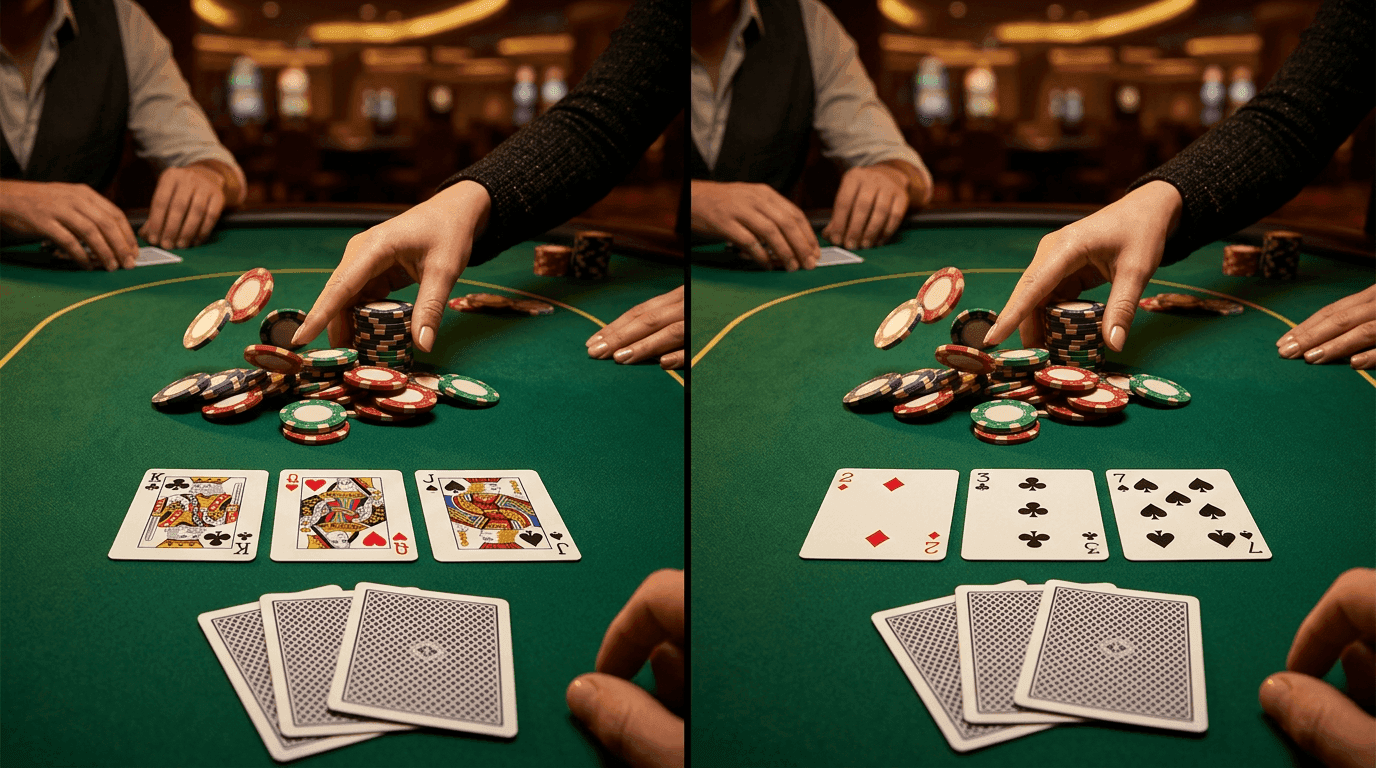
You hold K♥K♠J♥9♠ against A♣A♦7♣2♠. Before the flop, the double-suited kings are behind but very live, with about 41.4% equity.
Then the flop lands K♦T♣4♥. The same kings now have top set and about 87.3% equity.
Change only the flop to A♥8♦3♣ and those kings collapse to about 6.6% equity.
That is an 80.7-point swing from board texture alone — and it happens because bare aces are the most range-readable hand in PLO. Playing kings against them well is less about your hand and more about reading a flop the way your opponent cannot hide from.
Why Bare Aces Are Readable, and Kings Are Not
Your opponent has A♣A♦7♣2♠ because a lot of players treat any aces as an automatic 3-bet or 4-bet regardless of the side cards. That habit hands you two gifts. First, their range is capped: with no connectivity or suits, bare aces flop a set or a bare overpair and almost nothing in between — no wraps, no nut flush draws unless the board hands them one. Second, because the range is so narrow, the flop tells you almost exactly where they are.
Your K♥K♠J♥9♠ is the opposite kind of hand. The two suits and the J-9 gap give you sets, flush draws, and straight draws across far more boards, so your range stays hidden and elastic. The practical consequence is a rule most players miss: you get to barrel many flops for your whole range, not just when you improve, precisely because your opponent's bare aces are so easy to put on a capped one-pair holding. The three flops below are the three things that capped range can become.
Worked Spot: When the Flop Promotes Your Kings
Kings versus bare aces is a comparison with a clean answer once you sort it by flop. Kings are better whenever the board leaves aces capped at one pair, which is most boards. Aces are better on the narrow set of ace-high flops that uncap them. And the edge is worse than it looks for whoever holds a made hand with no redraw when a flush or straight completes on the turn. Here is each case as a worked spot.
You 3-bet K♥K♠J♥9♠, get called by A♣A♦7♣2♠, and play a roughly SPR-4 pot in position. First the friendly version: the flop is K♦T♣4♥. You have top set, the aces have two outs and no draw, and you are near 87%. Promotion is clean — but the money still goes in over two streets, not in one panic. Bet two-thirds pot on the flop and bet again on the turn, because a range this far behind will call twice and checking back only gifts a free card to their two outs.
Now change one card: the flop is K♣T♣4♥. Same top set, but the ace of clubs backs a live nut-flush draw and your equity falls to about 67%.
Twenty points of value vanished without your hand changing — only the loser's redraw did. So you bet full pot on the flop to charge the draw now, and you keep barrelling blank turns. But if a third club arrives and your opponent raises, you fold your set: their capped range does not raise a made overpair there, so the raise is the flush, and your top set is drawing to a boat you will not always make. Reading the cap is what lets you fold a set correctly.
Worked Spot: When Neither Hand — or the Wrong Hand — Sets Up
Same 3-bet pot, but the flop is T♠8♠5♦. Nobody flopped a set. Your kings are a bare overpair, except you also hold K♠9♠ for a king-high spade draw, so you sit around 60% against the aces' range.
This is the bucket that justifies holding double-suited kings instead of bare ones. Bet around half pot: you are ahead, you have a real redraw, and your opponent's capped range has to fold every hand that missed. A bare-ace holding on this exact flop is the hand that misplays it in reverse — an overpair with no backdoors, no way to keep barrelling, forced to check and give up. You have the second way to win, so you keep the lead and the pressure.
The mirror is the flop that promotes your opponent: A♥8♦3♣. Now the aces have top set and your kings are one pair worth about 6.6%. The same read that let you barrel the king boards tells you to stop here — an ace-high flop is exactly where the capped range is uncapped and strong. Check back if checked to, and fold to a real bet. There is no exploit in calling when the board hands your opponent the one part of their range you cannot beat.
The Filter, in One Pass
You never need to memorize boards, only run the read: bare aces are capped, so ask what this flop did to that cap. A king or a blank leaves them one pair and hands you the barrel — stack off over two streets if you flopped a set and they are drawing dead, bet pot and stay foldable if they picked up the nut-flush draw, and bet your redraws while keeping the pot small when neither of you connected. An ace uncaps them, and that is the one flop where your beautiful preflop kings are just one pair. The hand you were dealt barely changes across all four boards. The read does all the work, and it is a read your opponent, holding the transparent hand, never gets to make in return. If you want the preflop reasons those suits and gaps matter, double-suited hands in PLO covers the starting-hand side; SPR in PLO covers how stack depth sets the sizing.