
You Flopped Top Two Pair. Should You Go Broke?
It depends entirely on one number you probably aren't calculating.
You open A♠K♥J♦T♣ from the cutoff, the button calls. The pot is 7bb, you both have 93bb behind. The flop comes A♦K♣5♠. You bet 5bb, get raised to 18bb. Now you're facing a decision for your remaining 75bb into a pot of about 43bb.
Your SPR — stack-to-pot ratio — was 13.3 going into the flop (93bb behind / 7bb pot). That's a high SPR, which means top two pair on a dry board is strong but shouldn't automatically go all-in. If the SPR were 2.5, you'd shove without thinking. Same hand, same flop, completely different decision.
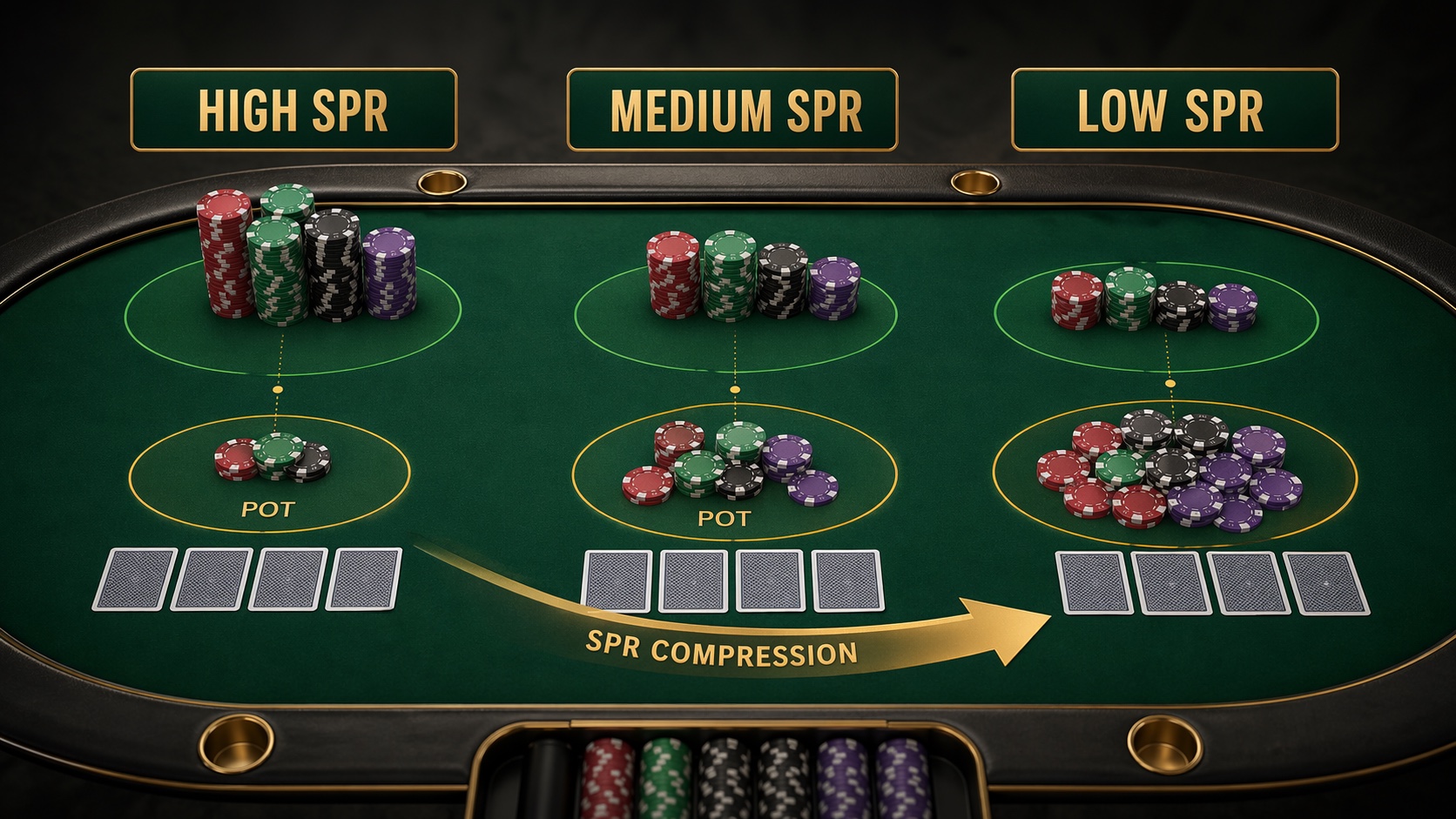 Inline visual: as preflop action builds the pot, the same stack becomes a lower-SPR decision where one flop bet can commit you.
What SPR Is and How to Calculate It
SPR = effective remaining stack / pot size on the flop.
That's it. Before you act on the flop, divide what's left in the shorter stack by the pot. The result tells you how committed you should be.
| SPR | Category | Meaning |
|---|---|---|
| Below 3 | Low | Near-committed. Top pair or overpair is often good enough. |
| 3 to 8 | Medium | Need strong two pair, sets, or premium draws to stack off. |
| Above 8 | High | Only commit with the nuts, nut draws, or sets with redraws. |
Low SPR (Under 3): Commit with One Pair
Low SPR happens after 3-bet or 4-bet pots, or at short effective stacks. With an SPR of 2, getting all-in means putting 2x the pot in. That's only one pot-sized bet. In live games, the short stacked live PLO adjustment is to pair that SPR math with the opponent type instead of stacking off automatically.
You 3-bet A♣A♦9♥8♣ from the big blind, the button calls. Pot is 25bb, you have 75bb behind. SPR = 3. The flop comes Q♠7♦2♣. With aces and an SPR of 3, you bet pot and call a shove. You're only putting 50bb more into a pot that will be 75bb. Overpairs at low SPR are essentially nut hands.
This is also why AAxx always wants to build the pot preflop. More preflop money = lower SPR = easier decisions for aces on the flop.
Medium SPR (3-8): The Decision Zone
This is where most 100bb single-raised pots land. The SPR is high enough that top pair alone is often a check-fold to heavy action, but strong two pair, sets, and combo draws are worth stacking off.
You open Q♠J♠T♥9♣ from the cutoff, the big blind calls. Pot is 7bb, stacks are 93bb behind. SPR = 13... but after you c-bet 5bb and get called, the pot is 17bb and stacks are 88bb. Now SPR is about 5 going into the turn.
At SPR 5, you need at least strong two pair or a wrap with a flush draw to feel comfortable putting it all in. A bare pair of queens here is a check-call at best, not a stack-off.
High SPR (Above 8): Nut or Nothing
High SPR pots are limped or min-raised pots where both players are deep. With an SPR of 12+, you need to hit the flop hard or get out.
You limp 5♠5♥4♣3♦ on the button in a passive game. Four players see the flop, pot is 5bb, stacks are 200bb. SPR = 40. The flop comes K♠5♦7♣. You flopped bottom set, which is great — but at SPR 40, another player with K♠K♥ or 8♠6♠ has serious equity against you. You need to consider whether your set has redraws (back-door flush draw, straight potential) before committing 200bb.
At extreme SPR, even a set without redraws can be played cautiously. The hand that thrives at high SPR is something like a nut flush draw plus a 13-card wrap — so many outs that you're actually a favorite to win even against a set.
Using SPR to Plan Preflop
The real power of SPR isn't post-hoc analysis — it's preflop planning. Before you call a raise, 3-bet, or squeeze, estimate the postflop SPR and ask whether your hand plays well at that depth.
Now UTG opens and the cutoff 3-bets. If you cold-call, the pot will be around 25bb and your stack is 100bb. SPR = 3. At SPR 3, your speculative rundown is terrible. You can't realize equity with draws when there's only one pot-sized bet behind. Fold.
The SPR Cheat Sheet
| Your Hand | Good SPR | Bad SPR |
|---|---|---|
| Bare overpair (KK with no redraws) | Under 4 | Above 6 |
| Top two pair | 3-8 | Above 12 |
| Set with redraws | Any SPR | — |
| Bare set (no redraws) | Under 8 | Above 15 |
| Nut flush draw + straight draw | Above 5 | Under 3 |
| Speculative rundown preflop | Above 10 | Under 5 |
See SPR in Action
The One Habit That Transforms Your PLO Game
Start announcing the SPR to yourself before you act on the flop. Every hand. "Pot is 12bb, I have 88bb behind. SPR about 7." Within a few sessions, you'll start making commitment decisions based on the math rather than gut feel, and your big losing pots will shrink dramatically.
FAQ
Does SPR matter in multiway pots? Absolutely. In multiway pots, SPR matters even more because you're likely to face action from stronger ranges. An SPR of 5 multiway requires a significantly stronger hand to commit than an SPR of 5 heads-up.
Can I manipulate SPR preflop? Yes, and you should. With aces, 3-bet to lower the SPR so your hand is easy to play postflop. With speculative hands, flat-call to keep SPR high so your draws have maximum implied odds. Preflop sizing is SPR engineering.
What SPR do most $1/$2 live PLO pots have? In a typical limped pot with 4-5 players, the pot might be 10bb and stacks are 100-150bb. SPR = 10-15. This means live players need much stronger hands to commit than they think — which is why so many recreational players stack off too light with top pair and overpairs.