
Two Players Both Flop Straights. One Wins a Buy-In. The Other Loses One.
Here is a hand that illustrates maybe the most important concept in PLO that nobody talks about enough.
Player A holds A♠K♠Q♦J♦ on a board of J♥T♠9♣. They have a straight -- K-high, the current nuts. They also have a flush draw in spades (backdoor) and cards that make Broadway if an ace or a queen rolls off.
Player B holds 8♦7♦6♣2♥ on the same board. They also have a straight -- J-high, the low end. They have no flush draw and no way to improve beyond their current straight.
Both players have the same hand category right now: a made straight. But Player A's hand is significantly more valuable. Why? Because when the turn and river change the board, Player A can improve. Player B is frozen -- their hand is what it is, and every card that comes is a threat.
This gap -- the gap between a made hand with redraws and a naked made hand -- is the defining concept of advanced PLO play.
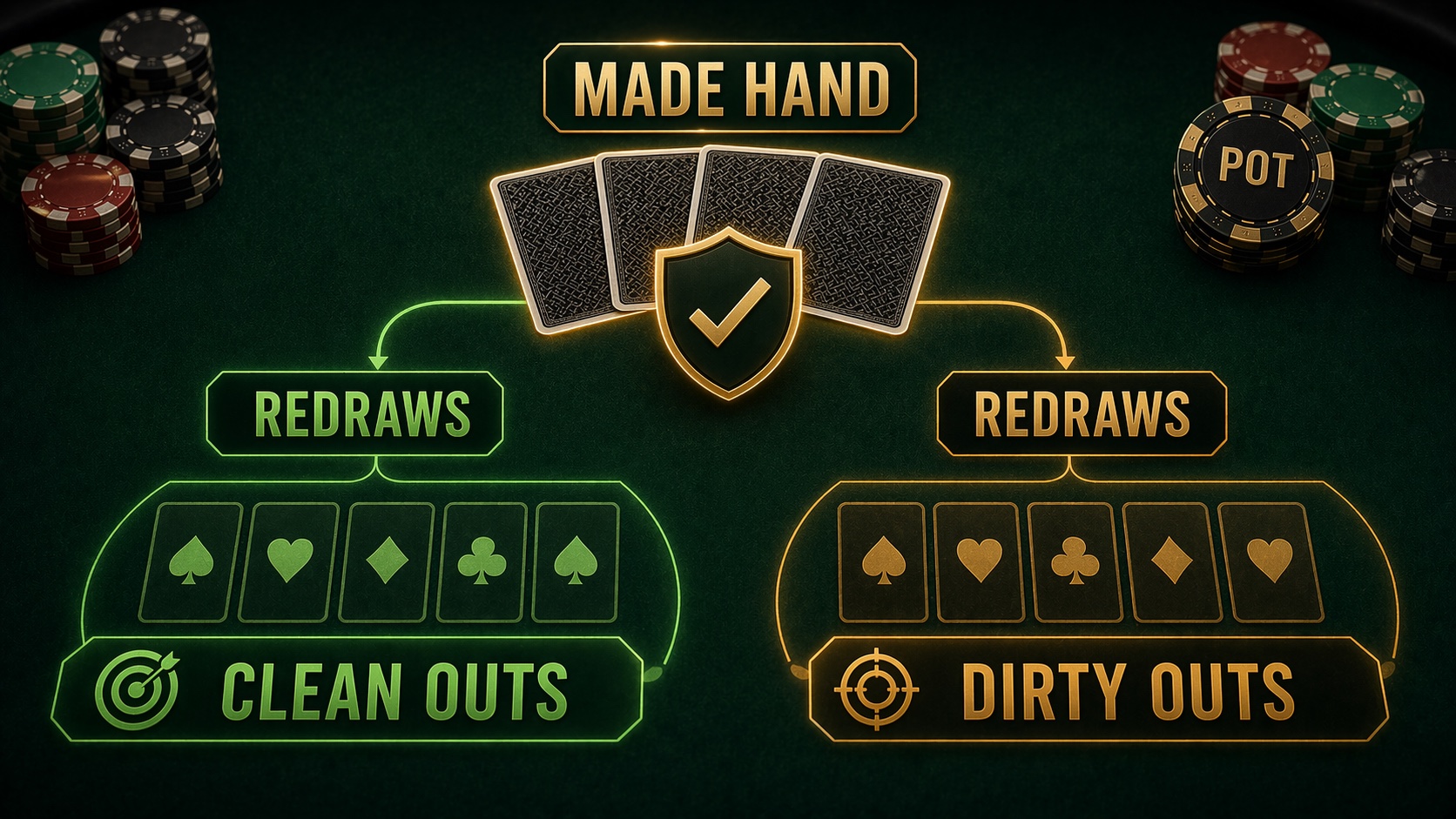 Inline visual: redraws act like insurance. Clean outs improve you without improving villain; dirty outs can make the pot bigger while leaving you second best.
What Redraws Are and Why They Matter
A redraw is the ability of a made hand to improve further on later streets. It is the hidden equity sitting beneath your current hand strength.
Common redraws include:
- Flush draw on top of a made straight. You have the straight and nine more outs to a flush. Even if your opponent also has a straight, you have more ways to win on later streets.
- Overset draw on top of a set. You flopped top set and also have a flush draw. If a flush card hits, you still win. If the board pairs, you have a full house.
- Higher straight draw on top of a current straight. You have the nut straight and cards that make an even better straight if the board extends.
- Board-pairing outs on top of a made flush. You have a flush and a pair, meaning you can make a full house if the board pairs.
Each of these redraws adds insurance against being outdrawn and sometimes converts your hand from the current nuts into a future-proof powerhouse.
Naked Hands vs. Redraw Hands: The Equity Gap
The easiest way to understand redraws is to compare identical hand categories with and without them.
Top set with redraw vs. top set without redraw:
You hold K♠K♥Q♠J♥ on K♦T♠8♣. Top set with a gutshot straight draw and a backdoor flush draw. Compare to K♦K♣5♥2♣ on the same board. Same top set, but your other two cards are worthless.
Both hands are ahead right now. But the first hand is comfortable against draws because it can improve past them. The second hand is just hoping the board does not change. Against a combo draw, that difference is worth 10-15 points of equity.
Straight with flush redraw vs. naked straight:
On J♠9♥7♣, you hold T♠8♠6♥5♦ for a straight with a backdoor spade flush draw. Compare to T♥8♦6♣5♣ -- same straight, no flush draw.
Compare straight with redraw vs. naked straight against a set. The flush redraw gives you extra outs against a set that is trying to fill up, and it protects you on turn cards that would otherwise be terrifying (any spade now improves your hand instead of threatening it).
How Redraws Affect Stack-Off Decisions
This is where redraws become directly actionable. When deciding whether to commit your stack on the flop, the presence or absence of redraws should be a primary factor.
With redraws -- stack off more aggressively. If you have top set plus a flush draw, you are insured against most bad turn cards. Even if a straight card hits, you might have a flush draw to bail you out. This hand wants to build the pot and get stacks in.
Without redraws -- proceed cautiously. Naked top set on a wet board can be correct to bet, but stack off? On J♠T♥9♣, top set of jacks with no additional equity is actually a marginal stack-off against a player who is willing to put in their stack. Their range is heavily weighted toward wraps and combo draws that have substantial equity against you.
The rule is: redraws shift your threshold for committing stacks. A hand with redraws can comfortably stack off in spots where a naked hand should just call.
Redraws as Insurance: A Turn-by-Turn View
Consider K♠K♥J♠9♥ on K♦Q♣7♠ (top set with redraw potential).
Flop: You have top set. The Q gives your opponents straight draws. But you have J-9, which gives you a gutshot to the nut straight (any ten), and the J♠ gives you a backdoor flush draw. You are ahead with multiple ways to stay ahead.
Turn -- T♣ arrives: The straight got there. Anyone with A-J now has the nut straight. But your K♠K♥ made a set that can pair the board on the river, and your J-9 give you a wrap to higher straights (any ace makes your straight, though that would also improve A-J hands). You still have outs to a full house.
Turn -- 7♥ arrives instead: The board pairs. You just made kings full. Your set with a redraw turned into a full house. This is the insurance paying off.
Now compare K♦K♣5♥2♣ in the same situation. On the T♣ turn, you have only two outs to fill up (the remaining sevens that pair the board, or runner-runner kings). On the 7♥ turn, you make the same full house but you got lucky -- you had fewer insurance policies.
See how redraw equity holds up across streets. Notice how the side cards provide meaningful additional equity beyond the set itself.
Evaluating Redraws Preflop
The concept of redraws should influence your preflop hand selection. Hands with coordinated side cards make better redraws when they hit.
Good redraw hands preflop:
- K♠K♥Q♠J♥ -- if you flop a set of kings, you also have straight and flush draw potential
- A♠T♠9♥8♣ -- if you flop a straight, you likely have a nut flush draw as a redraw
- Q♠J♠T♥9♠ -- double suited rundown with maximum redraw potential on any connected board
Poor redraw hands preflop:
- K♣K♦7♥2♠ -- if you flop a set, your other cards do nothing
- A♥Q♣5♦3♠ -- scattered, unsuited, no connectivity
- J♠J♦4♣2♥ -- if you flop a set of jacks, you have no backup on a wet board
This is why PLO starting hand guides emphasize connectivity and suitedness. These properties are not just about flopping draws -- they are about having redraws when you flop made hands.
The Redraw Hierarchy for Stack-Off Decisions
When deciding whether to commit your stack, use this hierarchy:
-
Made hand + nut flush draw -- almost always a stack-off. You have the best current hand plus nine outs to an unbeatable flush. Example: top set on a two-tone board with the nut flush draw.
-
Made hand + nut straight draw -- strong stack-off. You have the current best hand and additional outs to a straight. The draw protects you against opponents who have bigger draws.
-
Made hand + board-pairing outs -- moderate stack-off. If you have a flush and a pair on the board, the board pairing gives you a full house. This is your protection against higher flushes on later streets.
-
Naked made hand -- conditional stack-off. Only stack off if the board is dry enough that your naked hand is likely to hold up through two more cards. On wet boards, a naked made hand is often just a call-and-reassess situation.
Test a made hand with and without redraws against a strong draw. See how the redraw cards change the equity picture.
FAQ
Do redraws matter more in PLO than in Hold'em? Incomparably more. In Hold'em, redraws are a minor factor because with two hole cards, the number of possible redraws is limited. In PLO, four hole cards mean you frequently have multiple redraw possibilities. Since PLO equities run closer between made hands and draws, the equity boost from redraws is often the difference between a profitable stack-off and a losing one. Redraws are arguably the most underappreciated concept in transitioning from Hold'em to PLO.
Should I slow-play a made hand with a strong redraw? No. This is a common mistake. The whole point of having a redraw is that your hand is strong enough to withstand action on future streets. Use that strength to build the pot now. If you slow-play, you miss value from opponents who have drawing hands that would call a bet. The redraw protects you if they hit -- so there is no reason to be cautious. Bet, raise, and build the pot.
How do I figure out my redraws quickly at the table? Practice this three-step process. First, identify your made hand (set, straight, flush, two pair). Second, look at your remaining hole cards and ask: do any of them make a flush if the right suit hits? Do any of them make a straight if the board extends? Do I have a pair that can become a set or full house? Third, count the approximate outs from these redraws and add them to your confidence in the hand. With practice, this takes about five seconds per hand.
What to Take from This
Every made hand in PLO comes with a question that most players forget to ask: can this hand get better? If the answer is yes, you have a premium holding worth building a pot around. If the answer is no, you have a fragile hand that needs the board to cooperate for two more streets. The players who consistently win at PLO are the ones who value redraws not as a bonus, but as a core requirement for committing significant chips.