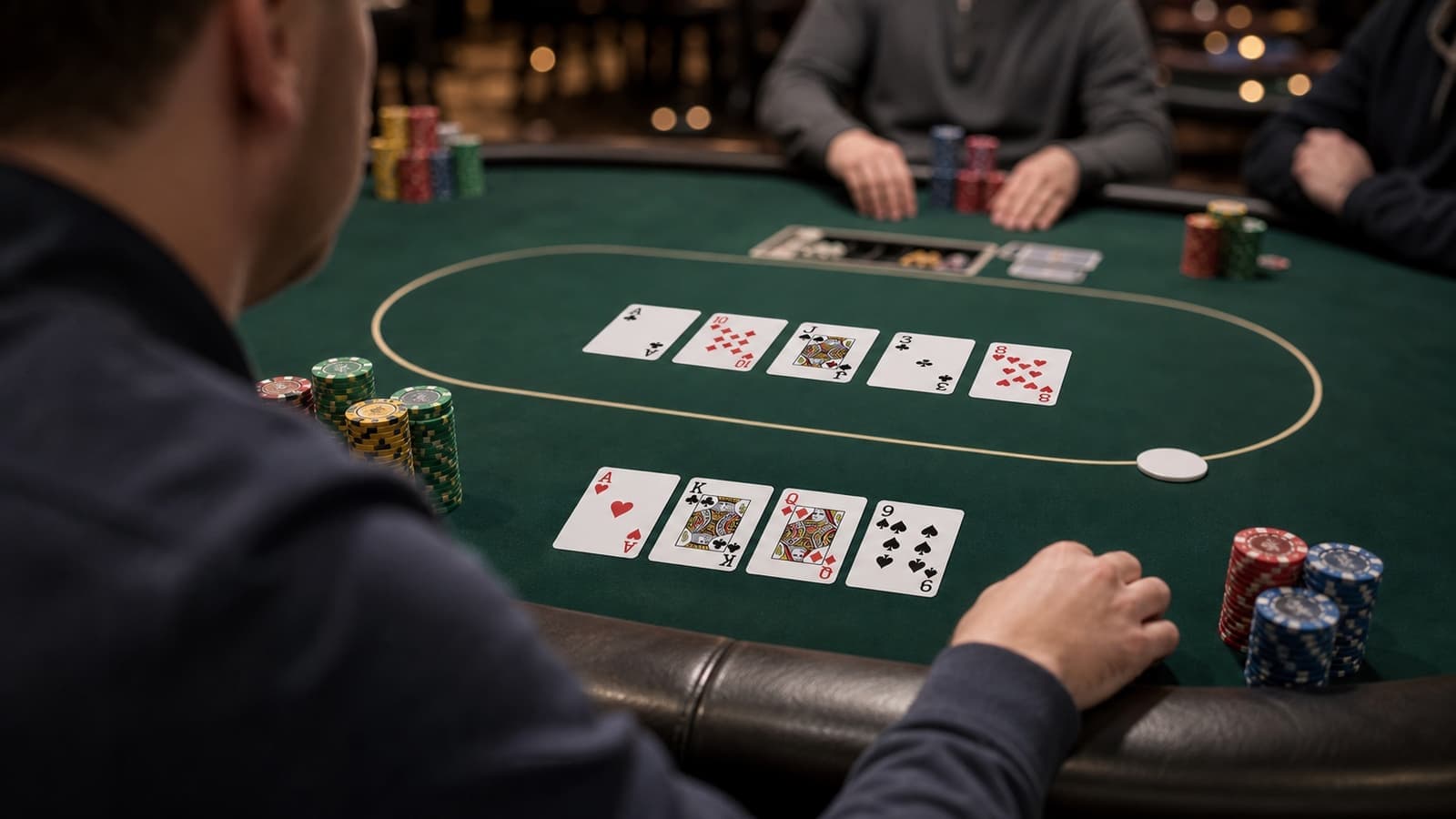
Four Cards, One Stricter Rule
Pot-Limit Omaha is a community-card poker game that looks familiar to Hold'em players until the first real decision arrives.
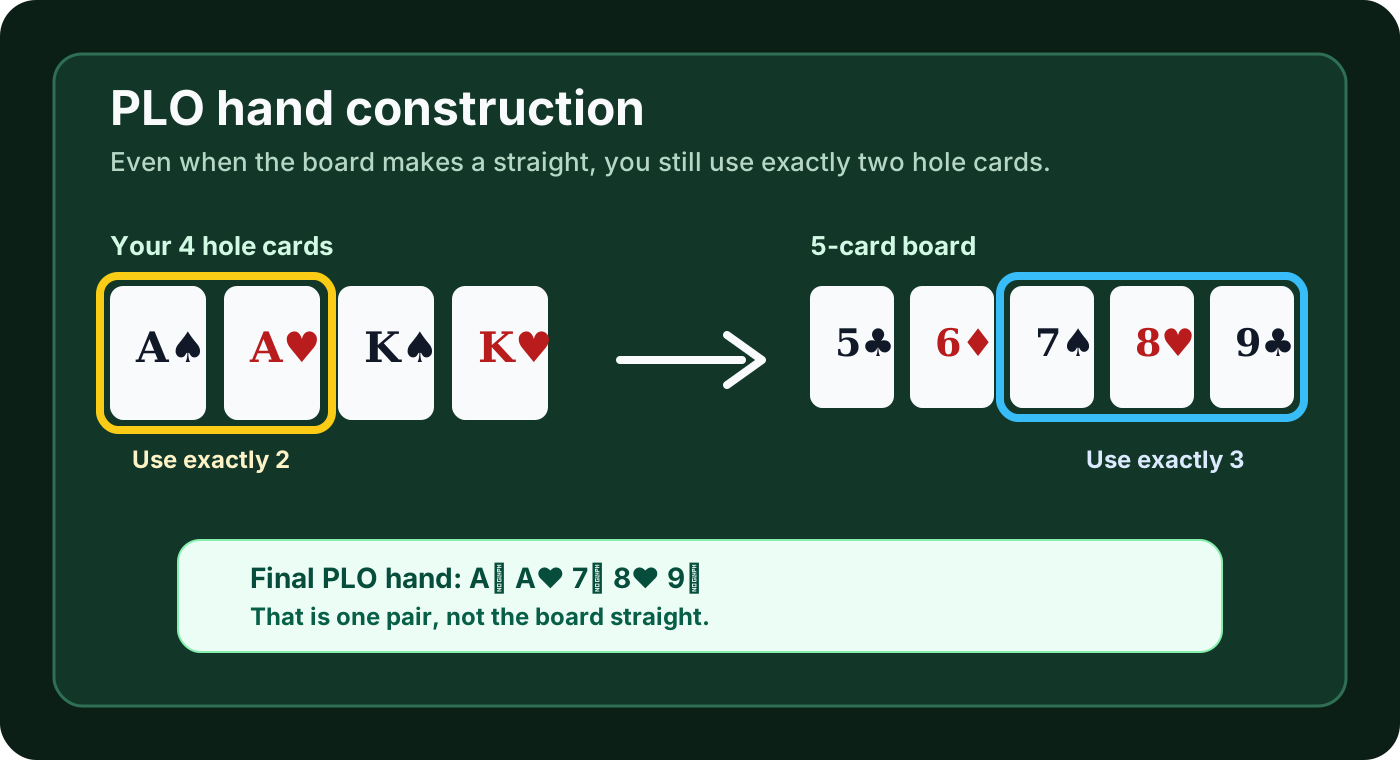
You still play blinds, preflop, flop, turn, river, and showdown. You still make the best five-card poker hand. The difference is that each player receives four private hole cards, and every final hand must use exactly two of those private cards plus exactly three board cards.
That is the first piece of PLO basics to make automatic. Do not ask, "How many ways did the board hit me?" Ask, "Which two cards from my hand are actually doing the work?"
Once you learn to answer that question, PLO stops feeling like chaos. You begin to see why some beautiful four-card hands are traps, why ordinary-looking connected hands can print, and why the best hands usually need nut potential plus redraws before stacks go in.
How a PLO Hand Works
A hand of PLO follows the same street sequence as Hold'em:
- Blinds are posted.
- Every player gets four private cards.
- Players bet preflop.
- The flop, turn, and river are dealt.
- Remaining players show down the best five-card hand using exactly two hole cards.
The betting structure is pot-limit, not no-limit. At any point, the biggest legal bet or raise is tied to the size of the pot. If the pot is $100 and your opponent bets $100, a pot-sized raise is to $400 total: you call the $100, the pot is treated as $300, and you may raise by that amount.
That cap does not make PLO small. It makes pots build geometrically. A preflop raise, a 3-bet, a flop pot bet, and one call can create a turn where the remaining stacks are already under heavy pressure. This is why PLO rules and stack planning belong together from day one.
The Exactly-Two Rule
The exactly-two rule is where most beginner mistakes come from.
Suppose the board is 5♣6♦7♥8♠9♣ and you hold A♠A♥K♦K♥. In Hold'em, the board itself makes a straight. In PLO, you cannot play the board. You must use two private cards, so your actual hand is only one pair of aces with three board cards.
The same logic applies to flushes. If four spades are on the board and your hand contains only one spade, you do not have a flush. You need two private spades because one hole card plus four board cards is illegal in PLO.
Here is the beginner checklist:
- Count your real five-card hand before counting outs.
- Name the two private cards you are using.
- Ask whether those two cards make the nuts, a redraw to the nuts, or a bluff-catcher.
- If the answer is unclear, avoid building a giant pot with a fake Hold'em hand.
That habit alone prevents a large share of early PLO losses.
Example: The Hand You Think You Have
You hold A♠K♥T♠9♥ in a 100bb single-raised pot. The flop is Q♠J♦T♦.
A Hold'em player might say, "I have Broadway and a pile of draws." A PLO player breaks the hand into usable two-card pieces:
- Ace-king makes the Broadway nut straight right now.
- King-nine makes a second, lower straight on the same three board cards.
- King-ten and ten-nine can matter on later straight textures.
- The suited ace gives a backdoor nut-flush path, but not a made flush.
The key is that your current strength comes from one specific two-card component. You are not using all four cards at once. You are using the ace and king with three board cards to make Broadway.
That is a value hand with redraw awareness, not a vague "big draw." If stacks are deep, you still care about board pairs, flush turns, and who can freeroll you with the same straight plus better backup.
Example: Same Shape, Different Quality
Compare Q♠J♠T♥9♥ with K♠8♦4♥2♣.
The first hand is connected, double-suited, high enough to make strong straights, and coordinated across all four cards. Its two-card pieces work together: queen-jack, jack-ten, ten-nine, queen-ten, and jack-nine all create useful coverage.
The second hand is four cards, but barely one hand. The king is isolated, the low cards do not connect cleanly, and the suits do not point toward nutted flushes. It may win a small pot when it pairs, but it has poor visibility when the pot grows.
This is the core of PLO starting hand selection: do not rank hands by the highest card alone. Rank them by connectivity, suitedness, position, and how often they make the nuts.
After you compare those hand shapes, open the equity calculator and swap the weak hand for a coordinated ace-high hand. The point is not to memorize one percentage. It is to see how structure changes equity before the flop and playability after it.
Use the PLO hand rankings guide when you need the next layer, but keep the beginner rule simple: pretty cards are not enough if the pieces do not cooperate.
Why PLO Plays Bigger Than Hold'em
PLO produces more action because equities run closer and strong-looking hands are easier to challenge.
In Hold'em, one premium pair can be a massive preflop favorite. In PLO, even premium aces are often much closer against coordinated rundowns because four-card hands create six two-card combinations. More combinations mean more ways to flop pair-plus-draw, wraps, flush draws, blockers, and redraws.
That is why bare one-pair hands shrink quickly. Aces without suits, connectivity, or backup may look powerful before the flop, then become uncomfortable on coordinated boards. Top two pair can be strong, but it can also be a bluff-catcher against sets, wraps, and nut redraws.
This is also why position matters in PLO. When equities are close, acting last lets you choose whether to pot control, apply pressure, or realize equity. Out of position, the same hand class becomes harder to play because you must make large decisions with less information.
If you are moving over from Hold'em, read PLO vs NLHE after this guide, then use the Hold'em-to-PLO transition guide to rebuild your first-session assumptions. The rules look adjacent. The risk profile is not.
The First Three Beginner Leaks
1. Overvaluing Bare Aces
AAxx is not one hand class. Double-suited connected aces are premium. Dry aces with weak side cards can become one pair in a bloated pot. Before 3-betting, ask what happens when you miss the flop and face pressure.
2. Chasing Non-Nut Draws
Second-best flushes and dominated straights are expensive in PLO. Drawing to "a hand" is not enough. You want to know whether your draw can make the best hand, whether you have redraws, and whether worse hands can pay you.
3. Forgetting SPR
Stack-to-pot ratio tells you how committed the hand is becoming. In a low-SPR pot, a strong made hand plus nut redraws can justify fast play. In a deep pot, the same one-pair hand may need control. The pot-limit structure rewards planning before the turn creates a forced decision.
For a broader list of early traps, use beginner PLO mistakes.
What to Study Next
Do not try to learn all of PLO at once. Use this sequence:
- Learn the PLO rules until the exactly-two requirement is automatic.
- Study hand rankings and hand reading so you stop overvaluing fake board-made hands.
- Build a starting-hand filter around connectivity, suitedness, rank, and nuttiness.
- Practice a few close spots in the equity calculator instead of guessing.
- Add position and SPR once the hand-building rule no longer takes mental effort.
Your first table goal is simple: before you put in a big bet, name the two private cards doing the work and the best hand they can realistically make by the river.
FAQ
Do I have to use exactly two hole cards in PLO?
Yes. Every final PLO hand must use exactly two private cards and exactly three community cards. You cannot use one hole card, three hole cards, or the board by itself.
Is PLO just Hold'em with four cards?
No. The extra cards create more two-card combinations, closer equities, more redraws, and more pressure to make nutted hands. Hold'em instincts help with position and board texture, but hand value changes dramatically.
Why is Pot-Limit Omaha so swingy?
PLO is swingy because strong hands are less dominant, draws carry more equity, and pots grow quickly across streets. Even good players need disciplined bankroll rules and better stop-loss habits than they might use in Hold'em.
What should a beginner learn first?
Start with the exactly-two rule, then learn which starting hands make nutted straights and flushes. After that, study position, SPR, and equity comparisons so your big pots are built around robust hands rather than surface strength.