
The Invisible Card Advantage
You are on the river in a $2/$5 PLO game. The board reads T♠8♠5♥3♣7♠. Three spades, a possible straight. You hold A♠K♦Q♥J♣. You missed everything. No pair, no straight, no flush. In Hold'em thinking, this hand is absolute garbage.
But look again. You hold the A♠. That single card means your opponent cannot have the nut flush. They might have a flush -- but not the best one. And if they do not have the nut flush, they have to worry that you do.
You pot the river. Your opponent tanks with the king-high flush and folds.
This is the power of blockers in PLO, and understanding them is what separates a player who bluffs profitably from one who bluffs randomly.
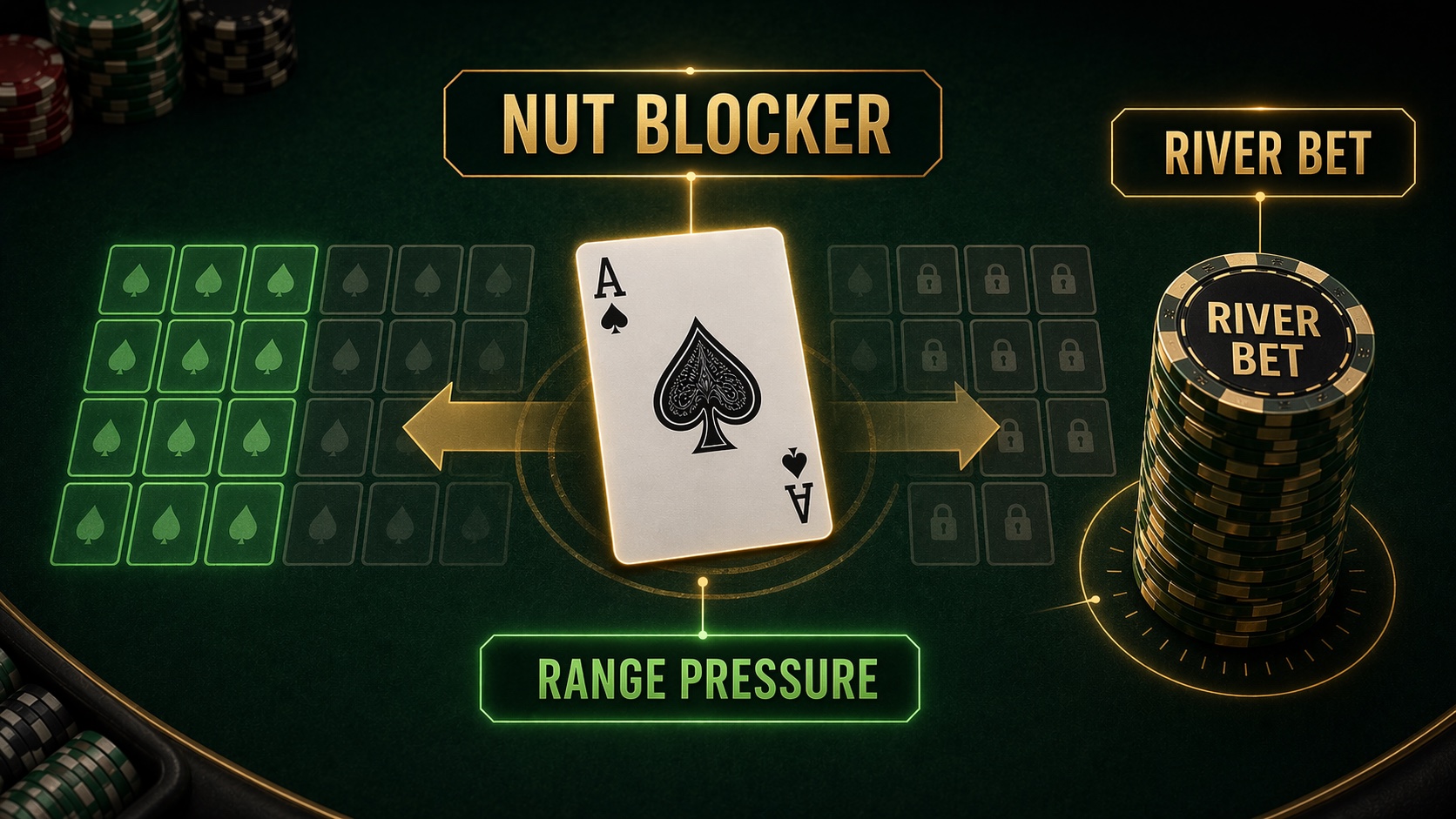 Inline visual: the nut blocker does not make your hand valuable by itself; it removes the hands your opponent most wants to call with.
What Blockers Actually Do
A blocker is any card in your hand that reduces the probability of your opponent holding a specific hand. The concept is simple: if you have the A♠, your opponent cannot have the A♠. If you have K♥K♦, your opponent cannot have pocket kings.
In Hold'em, blockers matter occasionally -- mostly in preflop shoving decisions (holding AK makes it less likely someone has AA or KK). In PLO, blockers are central to postflop strategy because with four cards in every hand, the specific cards you hold dramatically reshape what your opponent can have.
There are two sides to the blocker coin:
Offensive blockers -- cards that improve your bluffs. When you bluff, you want to block the hands that would call you. Holding A♠ on a spade board blocks the nut flush, the hand most likely to call.
Defensive blockers -- cards that improve your bluff-catches. When you are deciding whether to call a river bet, you want to block the hands your opponent would bluff with. If you hold cards that make their bluffs less likely, their range skews toward value, and you should fold.
Nut Blockers: The King of PLO Bluffs
The most valuable blockers in PLO are nut blockers -- cards that remove the nuts from your opponent's range. Let me walk through the major categories.
Flush blockers. Holding A♠ on a board with three spades means your opponent cannot have the nut flush. This is the most common and most powerful blocker scenario. It appears in nearly every session and should trigger an immediate mental calculation: can I credibly represent this flush?
Straight blockers. On a board of J-T-8-5-3, the nut straight is Q-9. If you hold Q♥9♣ (but do not have the straight because you need exactly two cards from your hand to make it and your other two cards do not cooperate), your opponent is less likely to have the nut straight. Straight blockers are subtler than flush blockers but equally powerful.
Full house blockers. On a paired board like J-J-8-5-3, having a jack in your hand blocks your opponent from having trip jacks or jacks full. If you are considering a bluff representing a full house, holding the card that pairs the board is an enormous asset.
How Blockers Change River Decisions
Let me show you a practical example where blockers flip the correct decision.
Board: K♠9♠4♥7♦2♠. The flush completed on the river. Your opponent pots it.
Hand A: You hold Q♥J♥T♦8♣. No spade. No blocker. Your opponent's pot-sized bet could easily be the nut flush, and you have no information suggesting otherwise. This is a fold.
Hand B: You hold A♠J♥T♦8♣. You have the A♠. Your opponent cannot have the nut flush. Their pot-sized bet is now either a non-nut flush going for value, a set hoping you do not have the flush, or a bluff. This is a much more interesting decision. If your read suggests bluffs are part of their range, your A♠ blocker makes calling significantly more attractive.
Compare equity with and without the nut flush blocker. Notice how the blocker fundamentally changes the math.
Hand C: You hold A♠J♣T♦8♣ and want to bluff. Now the A♠ works offensively. You pot the river representing the nut flush that you provably block your opponent from having. They face a pot-sized bet, they cannot have the nuts, and many non-nut hands will fold. This is one of PLO's highest-EV bluffs.
The Double-Blocker Play
Sometimes you hold two blockers simultaneously, creating an unusually strong bluffing situation.
Board: T♠9♣7♥6♦3♠. The nut straight is J-8. You hold J♥8♠A♠K♣. You block the nut straight (J-8) and you have the A♠ blocking the nut flush if the board were to... wait. Two spades on the board. Not three. But you do block the nut straight and hold the A♠ for a potential spade runout.
The double blocker is most powerful when the board has two completed draws. On T♠9♠7♥6♦8♠, both the straight (J-x) and the flush (A♠-x♠) are possible. If you hold J♥A♠Q♦2♣, you block both the nut straight and the nut flush. A pot-sized river bet here puts enormous pressure on any non-nut hand.
Blockers for Bluff-Catching
Blockers work defensively too. When facing a river bet, ask: does my hand block what my opponent would be bluffing with?
In PLO, the most common river bluffs are missed draws. If the flush did not get there, opponents with busted flush draws might bluff. If you hold two cards of the suit that missed, you block some of those bluffing combinations, meaning your opponent's range is more weighted toward value.
Conversely, if you hold T♥8♦J♣3♦ -- no spades at all -- you do not block any busted spade draw bluffs. Your opponent is more likely to be bluffing with those holdings. Lean toward calling.
Common Blocker Mistakes
Overvaluing weak blockers. Not all blockers are equal. Blocking the second-nut flush (holding K♠ when the nut flush is A♠-x♠) is far less valuable than blocking the nut flush itself. When bluffing, you want to block the hand your opponent would never fold, and that is the nuts, not the second nuts.
Ignoring your story. Blockers do not override a nonsensical betting line. If you checked every street and then suddenly potted the river, your opponent will call regardless of what you block. Blockers enhance credible lines -- they do not rescue incredible ones.
Using blockers in multiway pots. Blocking one opponent's nut hands is useful. Blocking one of three opponents' nut hands is far less useful -- the other two might still have it. Reserve blocker-based plays for heads-up situations. For more on multiway dynamics, the math changes dramatically.
Forgetting about board blockers. Cards on the board are also blockers. If the A♠ is on the board, nobody has the nut flush draw in spades -- the K♠ is now the nut draw. Always account for board cards when evaluating your blockers.
Practical Blocker Exercises
To build your blocker intuition, try this exercise after each session:
- Find three hands where you faced a river decision.
- List the nuts and second-nuts for that final board.
- Check which of those cards you held.
- Ask: did my blockers suggest calling or folding? Did I make the right choice?
Use the equity calculator to verify. Plug in your actual hand and a likely opponent range to see how blockers shift the equity math.
This post-session review builds the pattern recognition that eventually becomes automatic during play.
FAQ
Do blockers matter on the flop, or only on the river? Blockers matter most on the river because that is where bluffing and bluff-catching decisions are most binary. On the flop, blockers have some influence on semi-bluffing decisions (having A♠ makes your flush draw semibluff stronger because your opponent is less likely to have a dominating flush draw), but equity from draws and redraws typically matters more than blockers at that stage.
How many blockers do I need to make a profitable river bluff? One strong blocker (A♠ on a spade board, or the exact cards that make the nut straight) is usually sufficient when combined with a credible betting line. Two blockers make the bluff even more profitable but are not required. The key is quality over quantity -- one nut blocker is worth more than three irrelevant blockers.
Can my opponent use blockers against me too? Absolutely. Good PLO players think about blockers from both sides. When you bet the river, your opponent considers what they block in your range. If they hold cards that block your value hands, they are more likely to call because your range skews toward bluffs. This is why blocker-aware play is a cat-and-mouse game at higher stakes -- both players are using the same information simultaneously.
The Core Principle
Blockers turn garbage hands into profitable bluffs and medium hands into informed calls. They are the hidden information layer of PLO that most players ignore. You do not need to calculate precise probabilities at the table -- just train yourself to ask two questions before every river action: "What do I block?" and "Does that make my action more or less profitable?" Those two questions alone will add substantial value to your game.