
The $2,000 Lesson in "Close Enough"
A player at a $2/$5 PLO table looks down at Q♠J♠8♥7♥. The flop comes K♠T♠4♦. He has a queen-high flush draw and an open-ended straight draw. He gets it all in against A♠9♠K♥K♦ -- the nut flush draw with top set. The turn brings 3♠, making both flushes. The queen-high flush loses to the ace-high flush, and a $2,000 pot ships away.
Was the queen-high flush draw reasonable to stack off with? In Hold'em, absolutely. In PLO, it was a disaster. This hand illustrates the single most important concept in Pot-Limit Omaha: nuttiness is not a bonus -- it is a requirement.
What "The Nuts" Means in PLO
The nuts is the best possible hand given the current board. But what makes PLO different is that the nuts changes on every street, and someone almost always has it.
In Hold'em, the nut hand is often unclaimed. The board reads Q♠7♣3♦ and the nuts is a set of queens -- but with only two hole cards per player, the odds of someone holding Q-Q are relatively low. In PLO, each player has six two-card combinations. In a four-way pot, 24 combinations interact with the board. The probability that someone holds the nuts or is drawing to it is drastically higher.
This math means you should assume someone has (or is drawing to) the nuts in any multiway pot. Your strategy should revolve around whether you can be that person.
The Nut Flush Problem
Second-best flushes are the most common way PLO players torch money. In a four-way pot, the probability that at least one opponent holds the ace of the flush suit is high enough that you should expect serious domination problems by the time the flush completes.
Check this spot: Q♠J♠ versus A♠9♠ on a K♠6♠4♦ board. The ace-high flush draw dominates the queen-high draw. When the flush comes in, you lose your stack. When it does not, neither wins a big pot. The non-nut flush draw has terrible risk-reward.
The adjustment: in multiway pots, do not invest heavily in flush draws unless you hold the ace of that suit.
Nut Straights vs. Sucker Straights
On a board of 9♠8♣7♦, the nut straight is J-T (making J-T-9-8-7). A player holding T-6 also has a straight (T-9-8-7-6), but it is the sucker end -- any opponent with J-T has them crushed.
PLO creates these second-best straight situations constantly because four hole cards mean more straight possibilities per player. When you hold the bottom end, ask: is there a higher straight possible? If yes, and the pot is significant, proceed with extreme caution.
Dynamic Nut Changes: Turn and River Danger
The nuts on the flop is often not the nuts on the turn. You flop the nut straight on a rainbow board. Then the turn pairs the board and anyone with a set has filled up. Or a third suited card appears and suddenly a flush beats your straight.
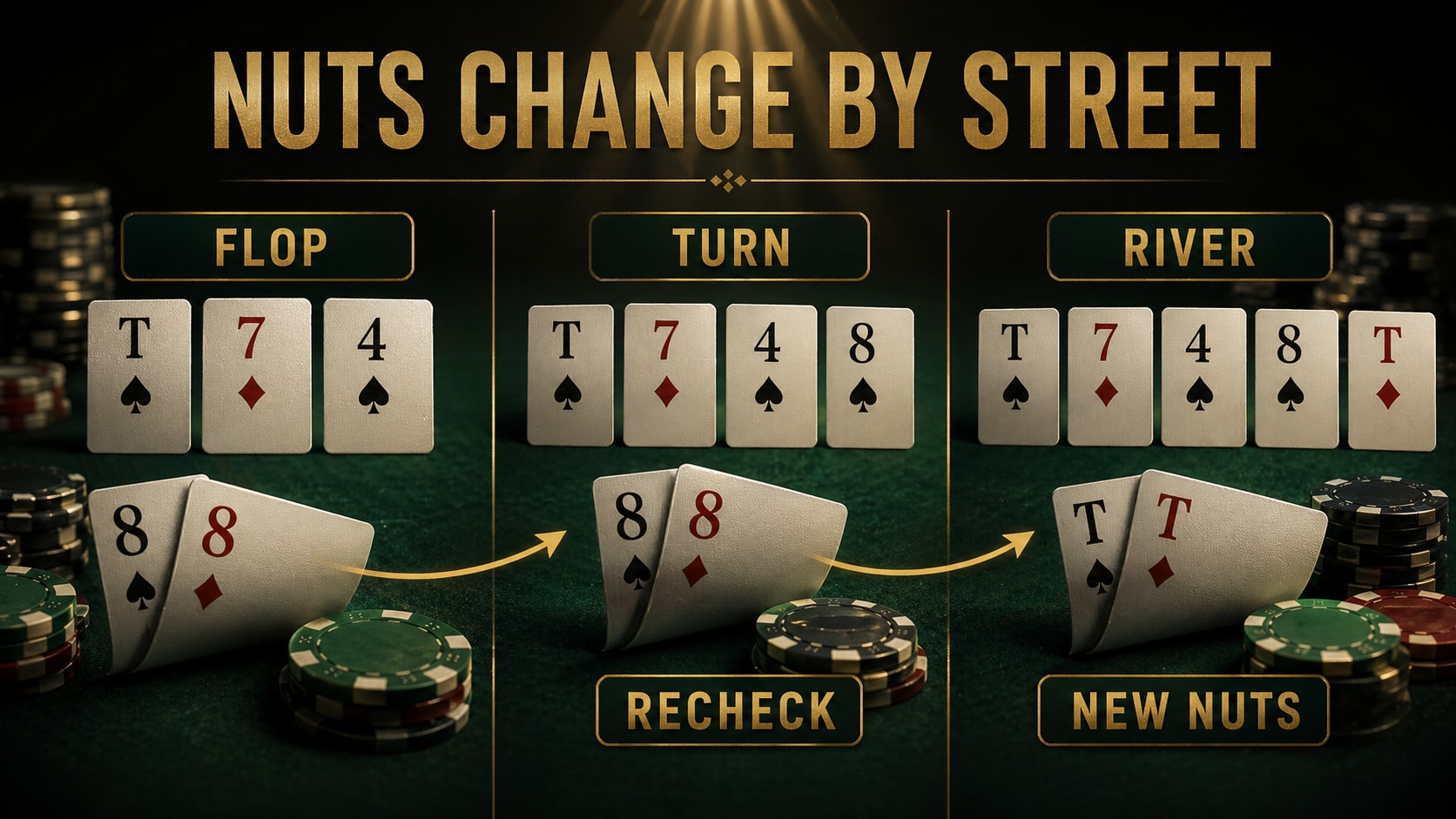 Inline visual: treat every turn and river card as a new nut hierarchy, not as a small update to the flop.
See this evolution: equities shift wildly depending on turn cards. An 8 gives one player a straight; a spade changes flush dynamics; a board pair creates sets. This dynamic quality of nut hands is one of the core reasons PLO is harder than Hold'em.
Nuttiness in Your Starting Hands
Nuttiness begins with hand selection. Before the flop, ask: if this hand connects, will it make the best version of whatever it makes?
- A♠K♠Q♥J♥ makes nut straights (A-high) and nut flushes (ace-high in two suits). Maximum nuttiness.
- 9♠8♠7♥6♥ makes nut straights in the mid range but only non-nut flushes. Still strong because straight nuttiness compensates.
- Q♥J♣7♦3♠ makes marginal straights, no nut flushes, and has two danglers. Fold.
The best starting hands consistently make the nuts when they connect.
Applying Nuttiness Postflop
When deciding whether to continue on a flop, run through this checklist:
- Do I currently have the nuts? Extract maximum value while protecting against board changes.
- Am I drawing to the nuts? How many outs, and what price is the pot offering?
- Am I drawing to the second-best hand? Proceed with extreme caution. The payout when you hit is often negative.
- Can the nuts change on the next street? If the board can pair, flush, or bring a higher straight, factor that in now.
Test your thinking with this spot: A♣K♣Q♠J♦ has the nut straight on T-9-8, but A♠K♠Q♥J♥ has the same straight plus the nut flush draw -- a freeroll. Who is actually ahead?
This checklist sounds simple, but consistently applying it separates winning PLO players from break-even ones. The discipline to fold a strong-but-not-nut hand when the pot is large is the hardest skill to develop -- and the most valuable.
FAQ
Is it ever correct to stack off with a non-nut flush? Rarely. Only in heads-up pots on dry boards where your opponent's range is unlikely to include the nut flush draw, or when you have additional equity like a straight draw alongside your flush. In multiway pots, non-nut flushes are almost always a fold facing significant action.
How do I know if my straight is the nut straight? Look at the board and ask: is there a higher two-card combination that makes a better straight? On 9-8-7, the nut straight uses J-T. If you hold T-6, you have a straight but not the nuts. Always count up from the board to find the highest possible straight.
Does nuttiness matter as much heads-up as multiway? It matters less heads-up because one opponent has fewer combinations that can hold the nuts. But PLO pots are large relative to stacks, and losing one big pot to the nut hand erases many small pots won with marginal holdings. Even heads-up, respect the role nuttiness plays in keeping you out of the biggest losing spots.