Start with position and stack depth
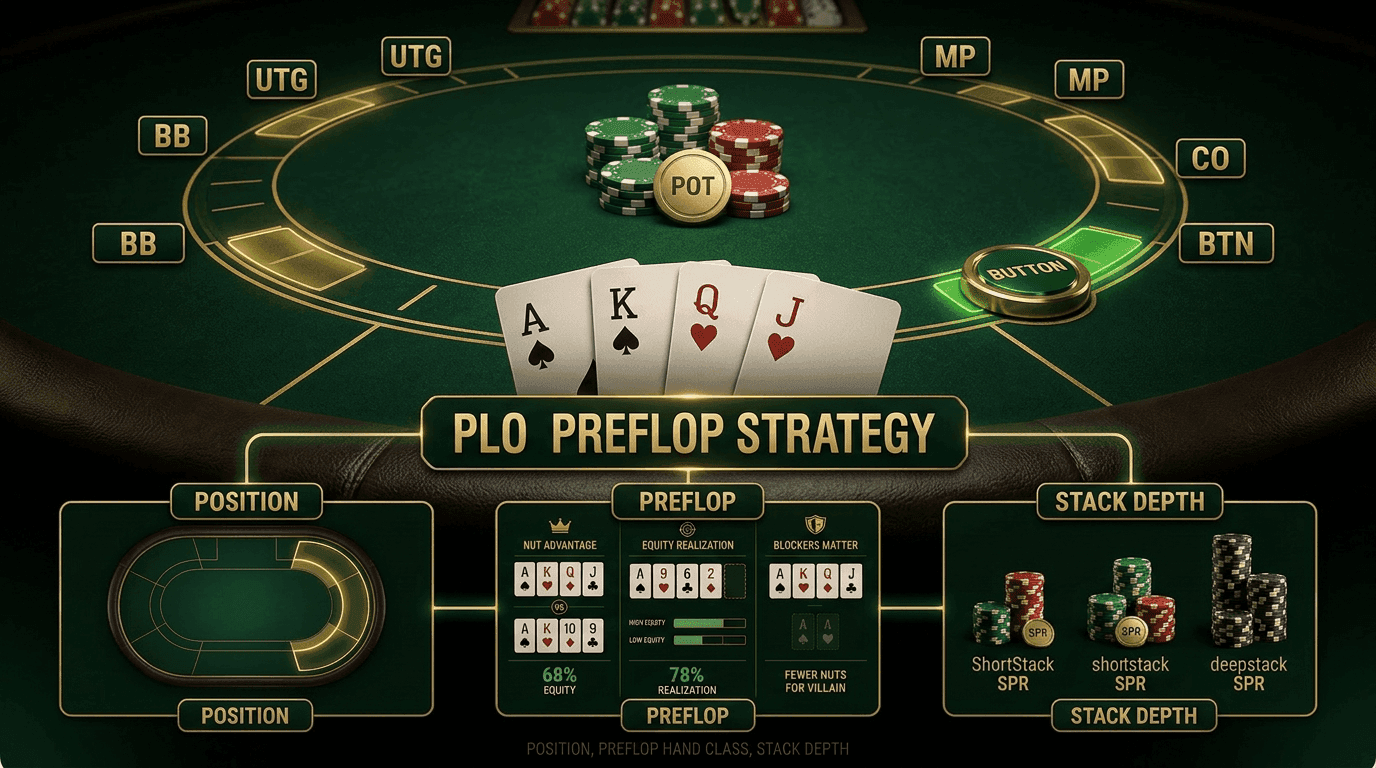
Position decides how much of your equity you get to realize. Stack depth decides whether you need nut potential across streets or can commit earlier with strong equity.
Strategy Hub
A practical framework for opening, defending, 3-betting, squeezing, and building pots before the flop in Pot-Limit Omaha.
Ask first
Will this preflop action create a postflop spot my hand can actually realize?
Good PLO preflop strategy is not just choosing pretty four-card hands. It is choosing hands that make nutted equity at the stack depth and position you are creating.
Strategy frame
Position decides how much of your equity you get to realize. Stack depth decides whether you need nut potential across streets or can commit earlier with strong equity.
The best preflop hands combine suits, connected ranks, high-card blockers, and side-card quality. A hand that flops one strong draw plus backup equity plays far better than a one-plan hand.
Every raise lowers SPR. Before reraising, ask whether the hand benefits from a lower SPR or becomes awkward when called.
Decision path
These checks keep the topic tied to an actual action, not just a definition.
Check suits, connectivity, pair value, blockers, and whether all four cards work together.
A marginal hand on the button can be a fold in the blinds because realization collapses out of position.
Open, call, 3-bet, or fold based on the SPR and player pool you are about to create.
Common leaks
Reading path

Seat-by-seat PLO opening ranges anchored to the solver: UTG opens 17.6% of hands, the button 48.6%. With hand examples, free preflop charts, and stack-depth adjustments.

Learn when to 3-bet in Pot-Limit Omaha, which hand classes work best, and how stack depth and position should guide aggression.

Learn how short, medium, and deep stacks affect preflop hand values, aggression, and implied odds in PLO.
Practice spots
Position, suitedness, connectivity, nut potential, side-card quality, and stack depth matter more than raw high-card strength.
No. Weak disconnected AAxx can become difficult at low SPR, especially out of position or multiway.