
Bigger pots punish pretty but disconnected hands. The preflop question is not, "Do I have a premium-looking hand?" It is, "Does this hand actually want a low-SPR pot against the range that continues?"
A♠A♥K♠Q♥ double-suited usually does. A♣A♦9♣5♦ usually does not. Both contain aces, but only one keeps making top set, nut flushes, high straights, and redraws after the money goes in. Once stacks compress, speculative side cards get less room to realize, dominated suits become expensive, and one-pair aces lose their margin fast.
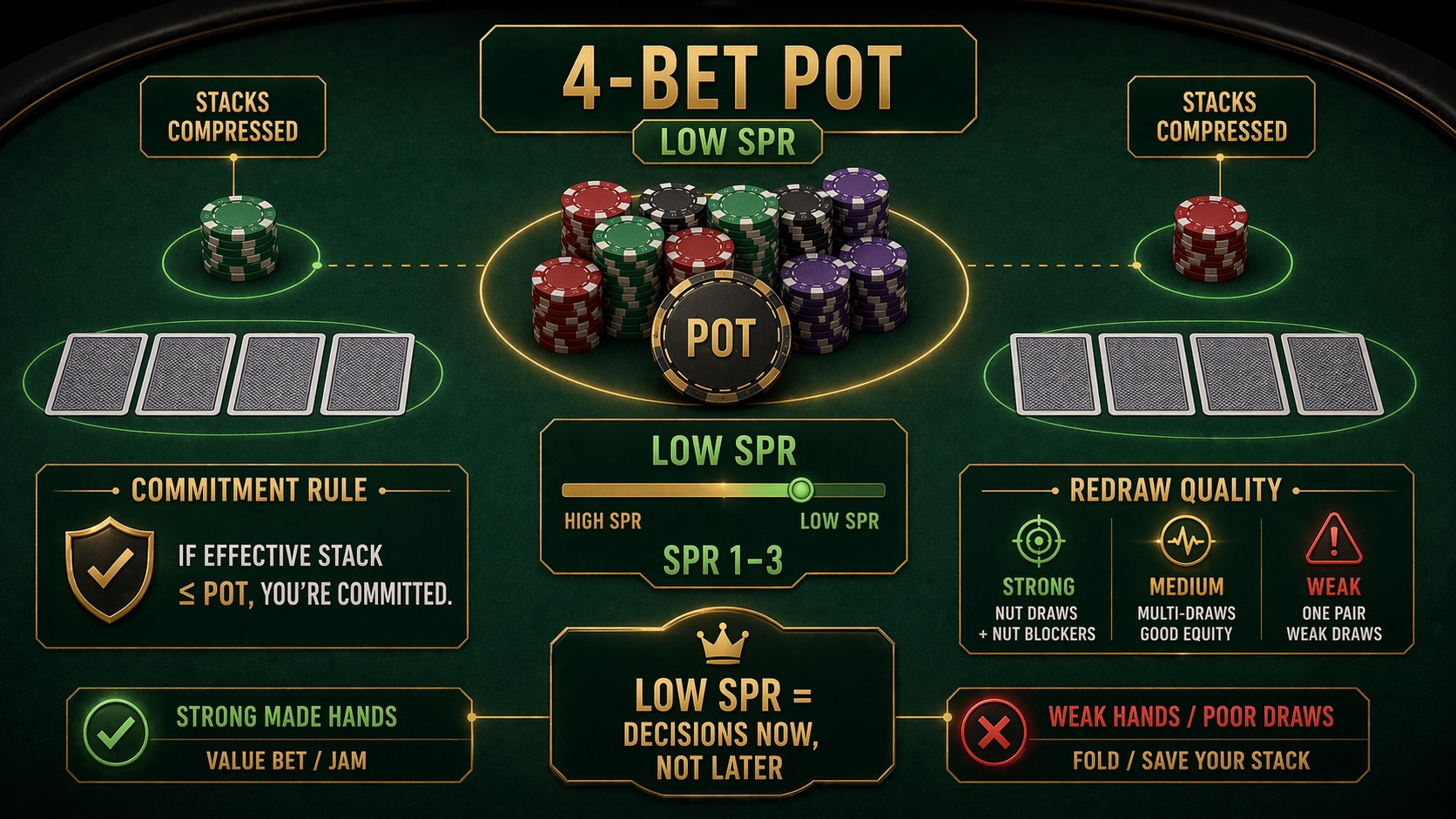 Inline visual: 4-bet pots compress SPR quickly, so preflop hand quality has to include redraw quality, not just raw pair strength.
A hand filter for 4-bet pots PLO players can use
The core of 4-bet pots PLO strategy is a four-part structural check.
- Pair and blocker quality: AAxx is strongest when the aces are supported by connected high cards. Ace-blocker non-AA hands need extra help.
- Nut-suit quality: Nut suits matter more than low flush potential because dominated flush draws lose value quickly in inflated pots.
- Connectivity type: K-Q-J-T, A-K-Q-J, and A-Q-J-T structures make top-end straights and strong redraws. Low rundowns make more vulnerable nutted hands.
- Low-SPR fit: The hand should be comfortable committing with overpair-plus-redraw, top pair-plus-wrap, nut flush draw-plus-pair, or similar high-equity structures.
That creates clear buckets. A♠A♥K♠Q♥ and A♣A♦J♣T♦ are value 4-bets. A♠K♠Q♥J♥ and A♣Q♣J♥T♥ are mixed candidates when position, depth, and opponent range help. K♠Q♠J♥T♥ often calls at full depth because it realizes well with position. A♣A♦9♣5♦, weak single-suited aces, and gappy rainbow broadways should not build the same pot just because they have one attractive feature.
If the spot feels close, compare the hand against realistic continuing ranges in the equity calculator. Raw equity is not the whole answer, but it will expose hands that look premium while performing poorly versus tight continuations.
Formation and stack depth decide the mix
Your 4-bet range has different jobs by formation. Heads-up in position, it can pressure a wide 3-bettor while preserving enough calls to use position. Heads-up out of position, it should reduce realization problems with hands that keep playing well at lower SPR. Cold 4-bets need the tightest construction because two strong ranges can continue and squeeze out thin blocker aggression.
| Spot | 4-bet more often | Mostly call | Usually decline |
|---|---|---|---|
| Heads-up IP, 100bb+ | Best coordinated AAxx | A♠K♠Q♥J♥, K♠Q♠J♥T♥ | Weak AAxx, gappy non-AA |
| Heads-up OOP, 100bb+ | Best AAxx, some A♠K♠Q♥J♥ | Premium rundowns, A♣Q♣J♥T♥ | Weak AAxx with poor side cards |
| Cold 4-bet, 100bb+ | A♠A♥K♠Q♥, A♣A♦J♣T♦ | Very little non-AA | Most pairless broadways and weak AAxx |
| 60-100bb | Best AAxx, elite ace-blocker double-suited broadways | Premium rundowns less often | Weak AAxx still decline often |
| Under 60bb | Best AAxx and best ace-blocker broadways increase frequency | Few calls | Deep-realization hands lose appeal |
For non-AA hands, be precise. In position, A♠K♠Q♥J♥ mostly calls at 100bb and mixes 4-bets against wide 3-bettors or shorter stacks. Out of position, that same structure can 4-bet more often because calling creates tougher realization. Cold, it is usually a call or fold, not a default 4-bet, unless the opener and 3-bettor are both demonstrably too wide.
Use the preflop charts as a baseline check, then adjust for stack depth, rake, and pool tendencies.
Two formations that change the action
CO opens, BTN 3-bets to 11-12bb, SB holds A♠A♥K♠Q♥ double-suited at 100bb
Default: cold 4-bet and continue versus a 5-bet. If called, the pot often reaches an SPR around 1.5 to 2. This hand wants that: premium pair, two nut suits, broadway connectivity, and side cards that keep dominating continuing ranges.
On K♣7♠2♥, keep betting often. You have overpair strength, top-pair interaction, nut-suit coverage, and a board that misses many non-AA continuations. On J♦T♣9♦, slow down much faster. Your aces still have equity, but the board smashes broadway wraps, sets, two pair, and diamond-heavy continues. If the hand were A♣A♦9♣5♦ instead, the cold 4-bet becomes much worse because the side cards do not protect you on enough flops.
LJ opens, CO 3-bets to 10-11bb, BTN holds A♠K♠Q♥J♥ double-suited at 100bb
Default: mostly call. The hand has an ace blocker, two strong suits, position, and elite connectivity, but no pair. Keeping the pot playable lets you realize the parts of the hand that make it powerful.
On T♣5♦2♠, continue aggressively against reasonable sizing. You have top-end straight coverage, backdoor nut-flush equity, and enough board interaction to float or raise selectively against over-c-betting. On 9♥8♣7♦, avoid treating "big cards plus suits" as automatic permission to stack off. That board favors sets, straights, and wrap-heavy ranges; your hand can continue versus some sizes, but it should not blindly turn into a low-SPR commitment hand.
Upgrade this hand toward a 4-bet around 70-80bb, out of position, or versus a loose CO 3-bet. Downgrade it when single-suited, less connected, or facing a tight 3-bet range.
The commitment rule
The winning 4-bet pots PLO habit is to connect the preflop reason to the flop plan. If you built the pot with premium pair quality plus nut coverage, pressure boards where that range advantage remains. If you built it mostly because the hand contained aces, stop donating on connected middling boards, dominated flush textures, and one-pair spots with poor redraws. Initiative is valuable, but only when the hand class still supports it.
Related Study
Use 3-betting in PLO and flatting vs 3-betting to decide how the pot gets built before the 4-bet. Then study SPR in PLO, AAxx strategy, and the preflop charts to keep the low-SPR plan grounded.