
You're Getting a Great Price — and That's the Trap
In a single-raised PLO pot, the big blind often looks like it is getting a tempting price to call. So you start defending with hands like K♥8♦5♣3♠ because "it's suited" and "the odds are right." Fast-forward 45 minutes and you've bled off a stack with a series of flops where you hit just enough to call and not enough to win.
The big blind is the most misplayed position in PLO. Not because players fold too much — because they call too much with hands that can't realize their equity out of position.
What "Equity Realization" Actually Means for the Big Blind
Raw equity and realized equity are different measurements. A hand like 9♥7♦6♣4♠ can have reasonable raw equity against a button opening range, but out of position and without the initiative it realizes much worse than the number suggests.
Hands that realize equity well from the BB share these traits:
- Suitedness (especially nut suits) — you can continue on flush boards without fear
- Connectivity — flopping draws with multiple outs keeps you in pots profitably
- Nut potential — when you hit, you win big pots rather than paying off better hands
Hands that look "fine" but realize terribly: Q♥9♦4♣3♠, K♠7♥6♣2♦, J♥J♦4♣2♠. They flop weak one-pair hands and gutshots that cost money.
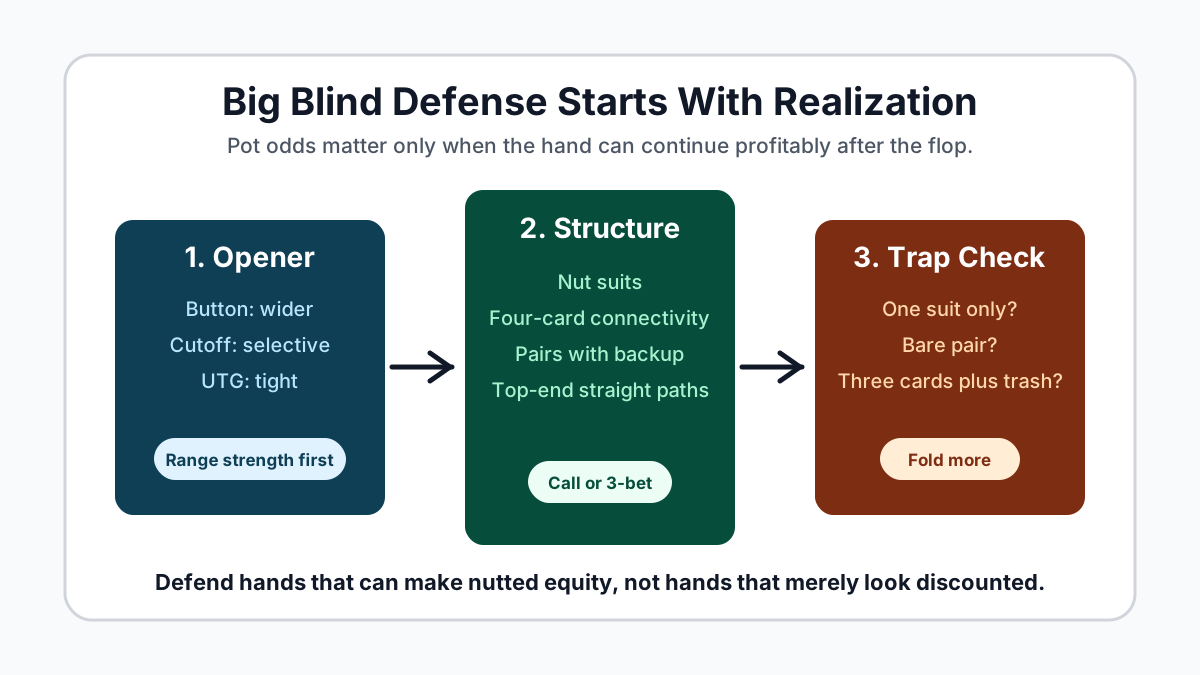
The Big Blind Defense Matrix
Start with the opener's position, then adjust for suits, connectivity, stack depth, and the players left in the pot.
| Opener | Defend more with | Tighten against | Best 3-bet candidates |
|---|---|---|---|
| Button | Connected suited hands, nut-suited aces, pairs with rundowns | Disconnected high cards and weak pairs | AAxx, A-K-Q-J type hands, high double-suited rundowns |
| Cutoff | Stronger versions of button defends | Single-suited medium trash and weak low rundowns | Premium aces, nut-suited broadways, Q-J-T-9 type hands |
| Hijack / middle position | High rundowns, premium pairs with backup, nut-suited broadways | Hands that need position to realize | Strong AAxx and select double-suited high-card hands |
| UTG | Nutted, clean structures only | Most medium speculative hands | Mostly premium AAxx and elite double-suited structures |
The table is not a command to defend every example. It is a filter. The earlier the opener, the less credit you get for being in the big blind and the more your hand must make strong nutted hands.
Defending vs. a Button Open: Your Bread and Butter
Against a button open, you can defend noticeably wider than you would against early position. But your hands still need structure.
Strong BB defends vs. button:
- T♠9♠8♥6♣ — connected, suited, flops well
- A♣5♣7♥6♦ — nut flush draw potential plus low connectivity
- K♠Q♥J♦9♣ — high connectivity, makes nut straights
- 7♠7♥6♦5♣ — small pair with rundown backup
Fold these despite the price:
- K♠8♦3♥2♣ — one card doesn't make a hand
- A♥J♦5♣3♠ — suited ace with zero connectivity below
- Q♠Q♥4♦2♣ — bare pair, terrible postflop
These examples work for different reasons. T♠9♠8♥6♣ is a connected rundown, A♣5♣7♥6♦ has nut-suit value with some wheel coverage, and K♠Q♥J♦9♣ is closer to a high-card hybrid. If you are choosing between broadway-heavy hands and connected rundowns, the broadway vs rundown PLO guide shows how board texture changes the winner.
Defending vs. Early Position: Tighten Significantly
When the UTG player opens, their range is tight — premium pairs, top rundowns, strong suited aces. Your pair of sevens with a gutshot is in bad shape against that range.
Against UTG or UTG+1 opens, tighten significantly. Stick to hands that can make the nuts against strong ranges: A♣K♣J♥T♦, Q♠J♠T♥9♣, double-suited rundowns, and premium pocket pairs that can flop sets with redraws.
One useful discipline: if you would hate facing a continuation bet on most ace-high, king-high, and low connected boards, the hand is probably not a good defend against early position. You are not trying to prove the pot odds are close. You are trying to avoid entering a pot where every common flop creates a guessing game.
The 3-Bet Decision: When to Fight Back
Defending doesn't just mean calling. From the big blind, 3-betting accomplishes three things: it builds the pot with your best hands, it reduces the field (critical in PLO), and it takes the initiative.
3-bet these from the BB:
- AAxx — often, especially when the hand benefits from isolation or lower SPR
- Double-suited premium hands — A♠K♠Q♥J♥, K♣Q♣J♦T♦
- High rundowns with a suit — Q♠J♠T♥9♣ against late-position opens
Don't 3-bet garbage as a "bluff" from the BB. Unlike Hold'em, squeeze plays with weak hands create bloated pots where you're out of position with no nut potential. That's a recipe for losing big.
Call, 3-Bet, or Fold?
Use the action that matches the hand's job.
Call when the hand realizes well but does not benefit from inflating the pot: medium rundowns, small pairs with connected side cards, and nut-suited hands that want to see flops.
3-bet when the hand benefits from isolation, lower SPR, and initiative: premium AAxx, nut-suited broadways, and high double-suited structures that can continue on many boards.
Fold when the hand has one attractive feature and three passengers. A suited ace with no connectivity, a pair with no backup, or a disconnected broadway hand will often lose more after the flop than it saves preflop.
For a baseline by position, compare your hand to the PLO Preflop Charts, then adjust for rake and player tendencies.
Postflop Survival: The Check-Raise as Your Weapon
Out of position with a calling range, you need a postflop weapon. That weapon is the check-raise.
You defend with T♠9♠8♥7♣ from the BB. The flop comes J♦8♠6♣. You've flopped a pair plus an open-ended straight draw plus a backdoor flush draw. The raiser c-bets. This is a check-raise. You have 8 clean straight outs, a pair, and fold equity against the part of their range that's bluffing.
That does not mean every draw becomes an automatic check-raise. Prefer attacking when your draw can make the nuts, when you have blockers or backup equity, and when the opener's c-bet range includes enough hands that cannot continue. Against tight players who c-bet only strong connected holdings, the same draw may become a check-call or even a check-fold on bad turns.
Compare that to flopping Q♥4♦2♠ with the same hand. Now you have nothing. Check-fold and move on. The discipline to fold bad flops and attack good ones is what separates profitable BB defenders from guys who donate money.
Multiway Pots: Tighten Your Continuing Range
When three or four players see the flop, the bar for continuing goes up dramatically. That middle pair with a gutshot that might be worth a call heads-up is a clear fold in a multiway pot. You need top pair plus a draw, two pair plus, or a strong combo draw to put money in.
This matters before the flop too. If the cutoff opens, the button calls, the small blind calls, and you are closing action, the price looks excellent. But you are also guaranteed to play out of position against several ranges. Defend hands that can make nut straights, nut flushes, sets with redraws, or big combo draws. Throw away the hands that only make a weak pair or a dominated flush.
The One Adjustment That Saves the Most Money
Stop defending hands with one "feature." A suited ace alone isn't enough (A♥8♣4♦2♠). A pair alone isn't enough (T♠T♥3♦2♣). A connected three-card chunk with a dangler isn't enough (9♥8♦7♣2♠). You need at least two things working together — suitedness plus connectivity, a pair plus a rundown, suited cards plus gap connectivity.
This single filter — "does my hand have two good things going for it?" — will cut your BB losses by a meaningful amount over time.
FAQ
Should I ever fold the BB to a min-raise? Yes. In PLO, even getting 3.5:1 doesn't justify calling with disconnected trash like K♠7♦4♣2♥. You'll spend far more postflop trying to realize nonexistent equity than the discount is worth.
How wide should I defend against a small blind complete? Very wide compared with normal raised pots. The SB completing signals weakness, the pot is small, and you have position for the rest of the hand. But you still do not need to play pure trash.
Is defending with small pairs like 5♠5♥4♦3♣ profitable from the BB? Only if the side cards connect. 5♠5♥4♦3♣ is a fine defend — the pair can flop a set, and 5-4-3 gives you low straight potential. But 5♠5♥J♦2♣ is a fold. The pair alone doesn't justify the call when the other two cards add nothing.