
The Bankroll That Works for Hold'em Will Destroy You in PLO
You have been winning at $1/$2 NLHE for six months. You have 25 buy-ins saved. You read that the PLO games are softer and more profitable, so you take your $5,000 bankroll and sit down at $1/$2 PLO.
Three weeks later, you are broke.
This scenario is common. PLO variance is materially higher than No-Limit Hold'em, which means bankroll rules that feel comfortable in NLHE are often too aggressive for Omaha. Understanding why -- and building a bankroll plan that accounts for PLO's variance profile -- is the difference between a sustainable poker career and a short, expensive hobby.
Want to see the numbers for your own win rate? Plug your stats into the PLO Variance Simulator to see realistic downswings, probability of profit at your sample size, and how different bankroll assumptions change your risk.
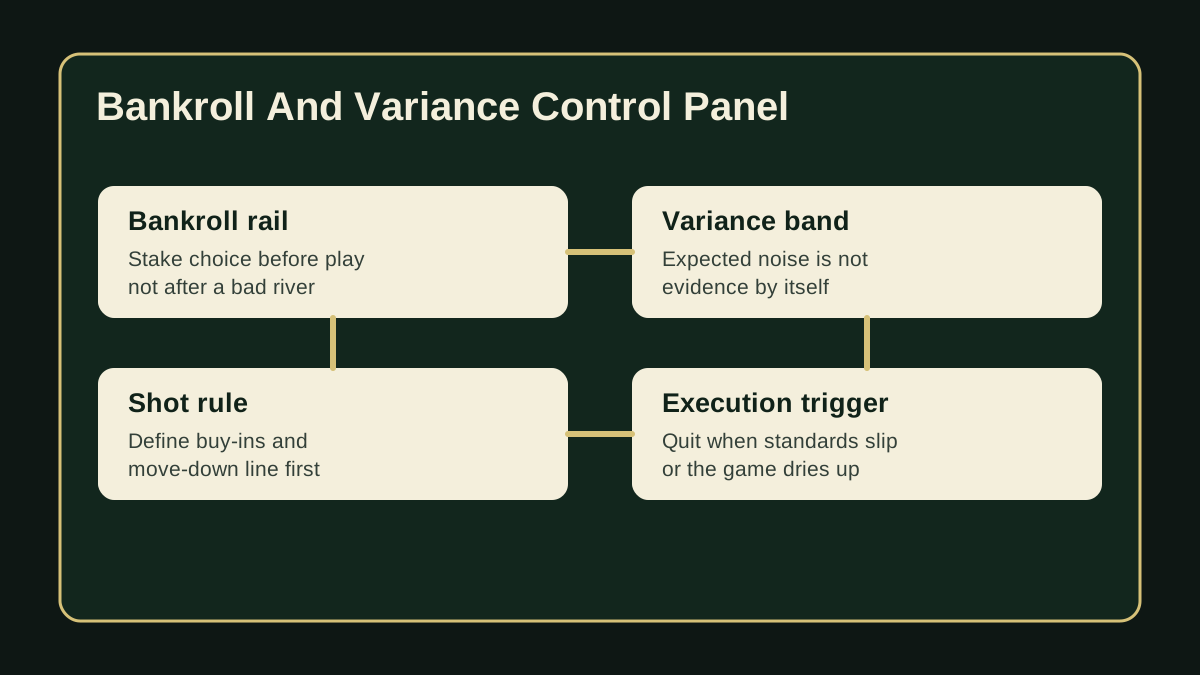 Inline visual: separate the bankroll rail you set before play from the execution trigger that tells you whether to keep playing.
Why PLO Variance Is So Much Higher
Two factors drive PLO's brutal variance:
Equities run close. In PLO, strong made hands are much more often up against large draws with substantial equity. Close equities mean more swingy all-in spots and wider result swings.
Pots are bigger. PLO is pot-limit, and with four cards everyone connects with more boards. This creates larger pots on average, and when pots are bigger, each individual result has a bigger impact on your bankroll.
PLO cash-game results typically fluctuate more sharply than NLHE results, even for winning players. That means bankroll advice has to account for larger short-term swings.
The Numbers: A Conservative Starting Baseline
Here are conservative bankroll baselines for PLO cash games. Treat them as starting heuristics, not universal truth, and pressure-test them with the variance simulator using your own assumptions.
| Stakes | Minimum Buy-Ins | Comfortable Buy-Ins | Bankroll Needed (Min) | Bankroll Needed (Comfortable) |
|---|---|---|---|---|
| $0.25/$0.50 | 30 | 40 | $1,500 | $2,000 |
| $0.50/$1 | 30 | 40 | $3,000 | $4,000 |
| $1/$2 | 30 | 40 | $6,000 | $8,000 |
| $2/$5 | 30 | 40 | $15,000 | $20,000 |
| $5/$10 | 35 | 50 | $35,000 | $50,000 |
These assume you are a winning player at the stake. If you are learning or break-even, you need more cushion because your edge is smaller and variance takes longer to overcome.
For live games with straddles, use the effective stakes, not the posted stakes. A $1/$2 game with a regular $5 straddle plays like $2/$5, so your bankroll should reflect $2/$5 requirements. This is one of the most common bankroll mistakes in live PLO.
Shot-Taking Rules That Actually Work
Shot-taking -- moving up in stakes temporarily to test the waters -- is how most players progress. But without clear rules, shot-taking becomes "playing above my bankroll and hoping it works out."
One workable shot-taking rule: Move up when you have about 30 buy-ins for the next stake. Move back down after a clearly defined loss limit, such as 10 buy-ins. The exact trigger can vary, but the discipline cannot.
Here is how this works in practice:
- You are grinding $1/$2 PLO with an $8,000 bankroll (40 buy-ins)
- You move up to $2/$5 (30 buy-ins for the new stake at $15,000? No -- you have $8,000, which is only 16 buy-ins for $2/$5. You are not ready.)
- You keep grinding $1/$2 until your bankroll hits roughly $15,000
- Now you take your shot at $2/$5 with about 30 buy-ins
- If you drop by your pre-set stop amount, you move back down to $1/$2 immediately
- If you keep building, you are no longer taking a shot -- you are rolled for the game
The discipline to move down is the hardest part. Nobody wants to go back to a lower stake. But playing above your bankroll with a diminishing stack leads to scared money, which leads to bad decisions, which leads to going broke.
Why 20 Buy-Ins Is Not Enough
Some guides recommend 20 buy-ins for PLO. That is an aggressive approach. Here is why.
A solid PLO player can absolutely experience a 20 buy-in downswing while still being a real winner. The exact probability depends on win rate, standard deviation, and sample size, but the practical takeaway is stable: 20 buy-ins is a fragile bankroll in PLO.
Moving from 20 buy-ins to 30-40 buy-ins changes your margin for error dramatically. The extra cushion is not luxury padding. It is what lets you survive normal Omaha volatility without constantly rebuilding.
Separating Your Bankroll From Your Life Money
This sounds obvious but most recreational PLO players do not do it: your poker bankroll must be completely separate from your living expenses.
If losing 10 buy-ins means you cannot pay rent, you are not playing with a bankroll. You are gambling with your financial stability. The psychological pressure of needing to win distorts every decision you make at the table.
Set up a separate account (or envelope, if you play live) designated exclusively for poker. Deposit money in when you want to add to your bankroll. Withdraw money out when you want to move profits to your personal account. Never, ever dip into life money to reload your poker bankroll.
Game Selection as Bankroll Protection
The most underrated bankroll management strategy is not about buy-in counts or shot-taking rules. It is about choosing the right games.
A $2/$5 game with six recreational players and deep stacks is dramatically more profitable -- and safer for your bankroll -- than a $2/$5 game with four aggressive regulars, a tight player, and one fish. Same stakes, completely different risk profiles.
Check how equities and implied odds shift when you are against weaker ranges:
Against weak ranges, your premium hands realize their equity more cleanly, reducing variance and protecting your bankroll.
If you are on a downswing, the instinct is to move up ("I will win it back faster at higher stakes"). Resist this completely. Instead, move down to a stake where your bankroll is comfortable and where the games are softer. A shorter downswing at a lower stake is infinitely better than a catastrophic loss at a higher one.
Tracking and Accountability
You cannot manage what you do not measure. Track every session:
- Date and time played
- Stakes and effective stakes (including straddle amounts)
- Hours played
- Result in dollars
- Running bankroll total
After a meaningful sample of play, calculate your win rate and standard deviation. This tells you two things: whether you are actually a winning player, and how much variance to expect going forward. If your win rate over a significant sample is negative, no amount of bankroll management will save you -- you need to fix your game first.
Run your equity in a typical session-ending all-in to understand how close these spots actually are:
Even with a premium hand, the equity edge in PLO all-ins is often razor-thin. That is why bankroll cushion matters so much.
FAQ
Should I use a different bankroll for live versus online PLO? The buy-in count can be similar, but remember that live effective stakes are often higher than posted stakes due to straddles. Also, live sessions tend to be longer with fewer hands, so your bankroll fluctuations per session can feel extreme.
Can I use tournament winnings to fund my cash game bankroll? You can, but be aware that tournament variance is even higher than cash game variance. If a tournament score represents a significant chunk of your bankroll, treat it as a one-time injection and do not assume you will repeat it. Move up stakes only if the new bankroll total supports the next level under normal guidelines.
How does the bankroll calculation change if I am a part-time player? Part-time players should actually be more conservative, not less. A professional reaches a meaningful sample faster, so their true win rate becomes clearer sooner. A weekend player may not have enough data to know their real win rate for months, which means they need extra cushion to survive losing stretches masked by small samples.