
Two Games Wearing the Same Name
A winning online PLO grinder sits down at a $2/$5 live game for the first time. Within an hour, they are confused. Six players are seeing every flop. There is a mandatory straddle. Someone proposed a bomb pot. The player on the button is openly stalling for time because the cocktail waitress has not come back yet. And somehow, despite all this chaos, the stacks are 300 big blinds deep.
This is not the game they studied for. And that is exactly why many online players struggle live, and many live players get crushed online.
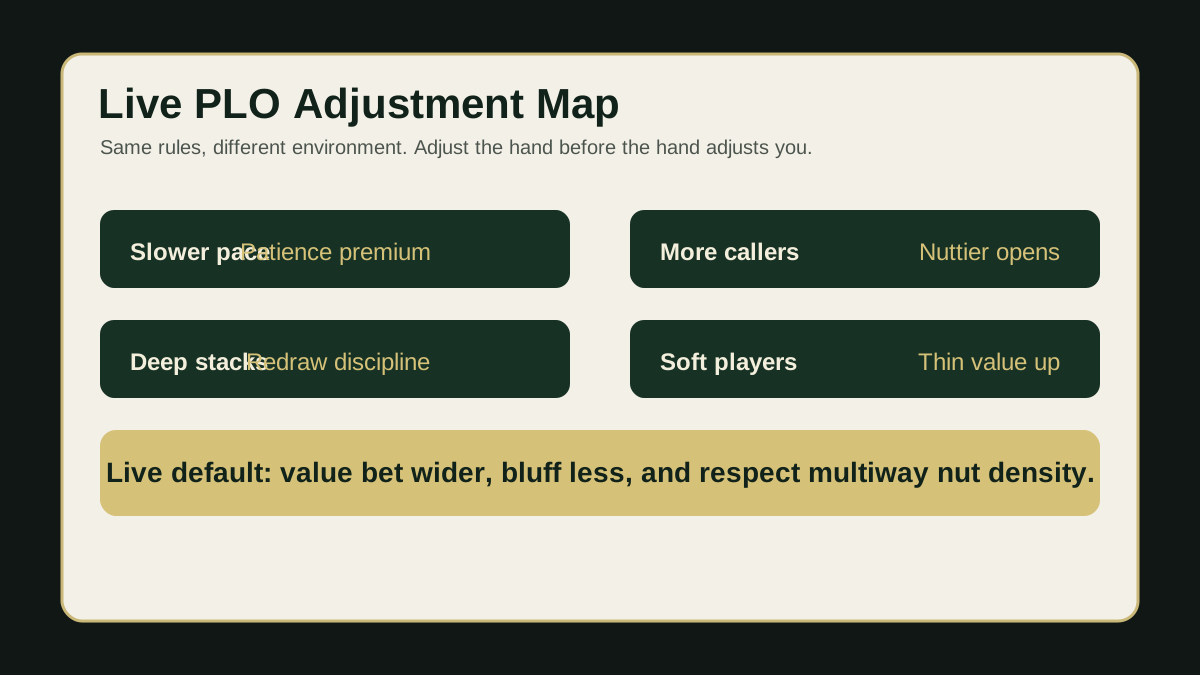 Inline visual: the live adjustment starts with environment, then flows into patience, nuttier opens, redraw discipline, and thinner value.
Pace Changes Everything
The most obvious difference -- speed -- has strategic consequences most players underestimate.
Online PLO deals far more hands per hour than live, especially once players multi-table. Live PLO is much slower. The exact ratio depends on site speed, table count, and room conditions, but the strategic difference is massive.
This means two things. First, patience is far more important live. Online, you can fold 50 hands in a row and barely notice because they fly by in 15 minutes. Live, folding 50 hands takes nearly two hours. The boredom factor is real, and it causes otherwise disciplined players to play hands they should not.
Second, your hourly rate live depends much less on volume and much more on pot size and table quality. Live PLO therefore tends to reward patient, value-heavy strategies more than high-frequency aggression.
Player Pool Differences
The average live PLO player at $1/$2 or $2/$5 is often weaker than the average online player at equivalent nominal stakes.
Live population tendencies:
- Call preflop with almost anything suited or connected
- Rarely 3-bet without aces or kings
- Chase non-nut draws to the river
- Overvalue single-pair hands
- Almost never bluff the river
- Tip the dealer when they win a pot (which is irrelevant strategically but tells you they are recreational)
Online population tendencies:
- Open and 3-bet with structured ranges
- Use position aggressively
- Balance c-betting frequencies
- Fold to river pressure with bluff-catchers
- Study ranges and equity calculations between sessions
The adjustment is straightforward: live, you should value bet relentlessly and rarely bluff. Online, you need a more balanced approach because players will exploit one-dimensional strategies.
Multiway Pots Are the Norm Live
Online, most pots go heads-up or three-way to the flop. Live, four- and five-way pots are common, especially at tables with a straddle.
This changes your hand selection fundamentally. Online, hands like A♦K♥J♦4♠ are playable opens because they perform well heads-up. Live, this hand is trouble -- it makes too many non-nut flushes and non-nut straights in multiway pots where you need the nuts.
Live, prioritize hands with nut potential:
- A♠K♠T♥9♥ -- double suited with nut flush potential and connectivity
- T♥9♦8♥7♦ -- makes the nut straight on a wide variety of boards
- A♥A♠J♥T♦ -- aces with suited backup and connectivity
See how a premium suited hand outperforms a disconnected broadway hand multiway:
The double-suited hand has more ways to make the nuts and therefore thrives in the multiway pots that live games produce.
Straddles and Bomb Pots
Live PLO features two phenomena that online does not: straddles and bomb pots.
Straddles (a blind raise, usually double the big blind) are common at $1/$2 and $2/$5 live PLO. They effectively double the stakes, meaning a $1/$2 game with a $5 straddle plays more like $2/$5. Your bankroll requirements need to account for this. If you are rolled for $1/$2 but the game regularly has a $5 or even $10 straddle, you are underrolled.
The strategic adjustment for straddles: tighten your early position opening range (the pot is bigger and you are likely to play a big pot out of position) and widen your late position range (more money in the pot means better implied odds when you have position).
Bomb pots (every player antes a set amount and sees a flop with no preflop betting) are a different beast entirely. Strategy in bomb pots boils down to: you have no range advantage because nobody had a chance to express one. Play your hand face-up. Bet when you have it, fold when you do not. The complexity of PLO strategy is largely irrelevant when everyone sees a random flop for a set price.
Stack Depths Are Unpredictable
Online, everyone buys in for 100bb and reloads to 100bb. Live, stack depths are chaotic. One player has 50bb. Another has 400bb. The player who just doubled up has 600bb. You need to be aware of effective stack depth against every opponent, every hand.
Deep stacks (200bb+) favor hands with nut potential and implied odds. Speculative rundowns like 7♠6♥5♦4♠ become more valuable because when you flop the nuts against a deep-stacked opponent, you win a massive pot. Short stacks (under 75bb) favor big pairs and high-card hands because there is not enough money behind to exploit implied odds.
See how a speculative rundown performs against a premium hand when stacks are deep enough to realize implied odds:
The rundown flopped a monster -- an open-ended straight draw with bottom pair -- and is actually ahead of aces. These are the deep-stack live scenarios that make speculative hands so valuable.
This means your strategy should shift hand-by-hand depending on who is in the pot and how deep they are. A hand you might fold 100bb deep could be a raise 300bb deep against the right opponent.
Physical Tells Exist and Matter
Online, you have timing tells and bet sizing tells. Live, you also have physical tells: shaking hands when excited, prolonged staring at the board, chip shuffling speed, verbal tone, and more.
Most PLO players underuse live tells because they are focused on hand reading and equity math. But even basic awareness -- noticing that a player looks genuinely uncomfortable after betting the river -- can save you a full buy-in on a difficult call/fold decision.
Live tells can matter, but treat them as supporting evidence rather than a substitute for hand reading. A player who suddenly changes pace, posture, or speech after betting may be giving away useful information, but population-based reads still matter more.
Making the Transition
If you are moving from online to live, expect an adjustment period of 20-30 sessions before the pace feels natural. Bring headphones for downtime between hands but stay engaged enough to watch the action when you are not in a pot. Note player tendencies in your phone if needed.
If you are moving from live to online, start at lower stakes than you think you need. A winning $2/$5 live player might need to start at $0.25/$0.50 online because the competition is so much tougher. And be ready for the variance -- you will see far more hands in a short period, which makes the swings feel faster and more intense.
FAQ
Which format is more profitable per hour? For many players, live PLO is more profitable per hour at equivalent nominal stakes because the player pool is softer and average pots are larger. The exact number depends heavily on rake, lineup quality, straddles, and your local game.
Do I need a different bankroll for live versus online? The buy-in requirements are similar (30-40 buy-ins), but the effective stakes are different. A $1/$2 live game with a straddle effectively plays as $2/$5, so your bankroll should reflect the actual money going in preflop, not the posted blinds. Online, the stakes are what they say they are.
Should I play differently in bomb pots? Yes. In bomb pots, there is no preflop ranging, so the flop is essentially random versus random. Play straightforwardly: bet strong hands, check marginal ones, and do not try to bluff. The pot is usually large relative to stacks, which reduces the ability to maneuver on later streets. Treat it like a fun gamble with a small edge when you connect hard.