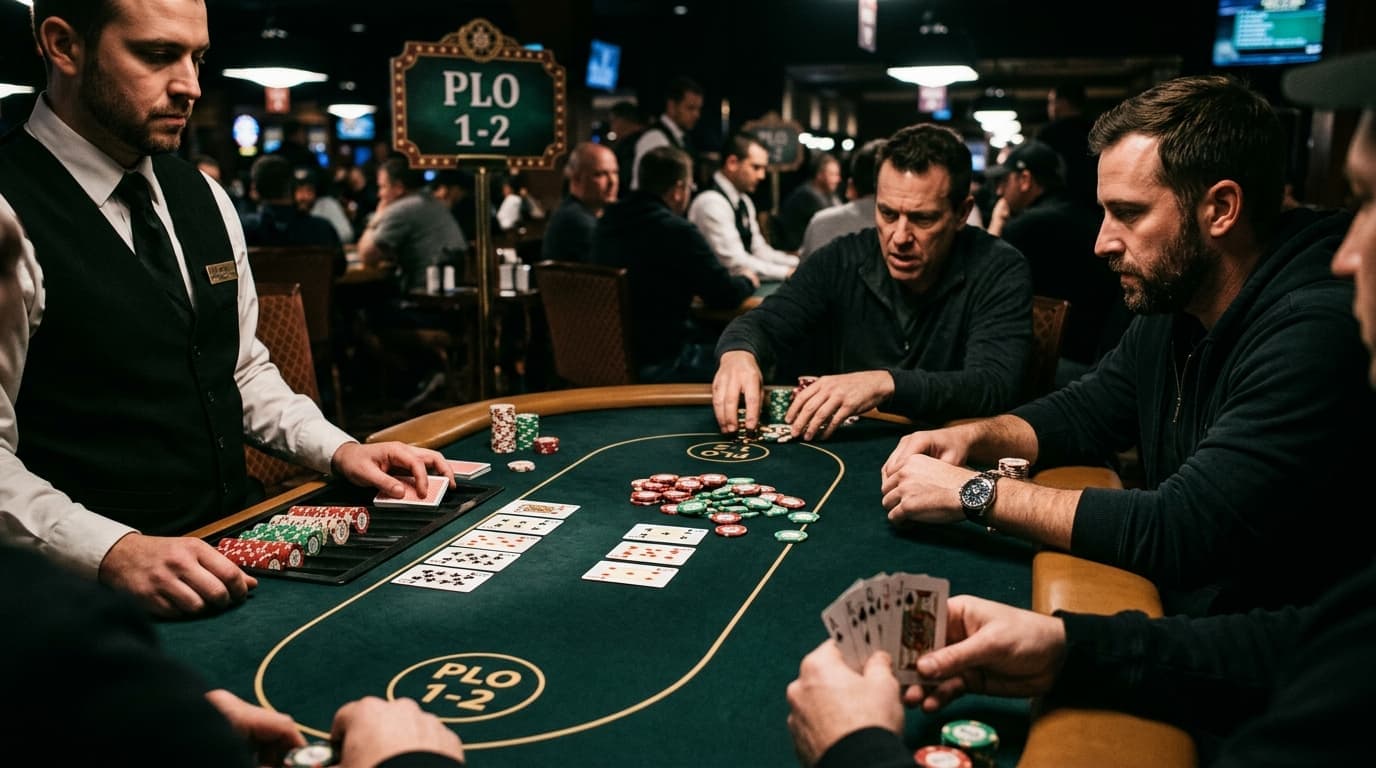
You Are Probably Making at Least Three of These Mistakes
Every player who sits in a live $1/$2 or $2/$5 PLO game thinks they are above average. Statistically, most of them are wrong. The truth is that low-stakes live PLO is full of systematic leaks -- mistakes that players make repeatedly, session after session, without realizing how much they cost. One common version is misplaying short stacked live PLO, where low SPR punishes loose preflop curiosity quickly.
I have coached dozens of players transitioning from Hold'em to PLO, and the same six leaks show up in almost every one of them. Fix even two or three of these and your win rate will noticeably improve.
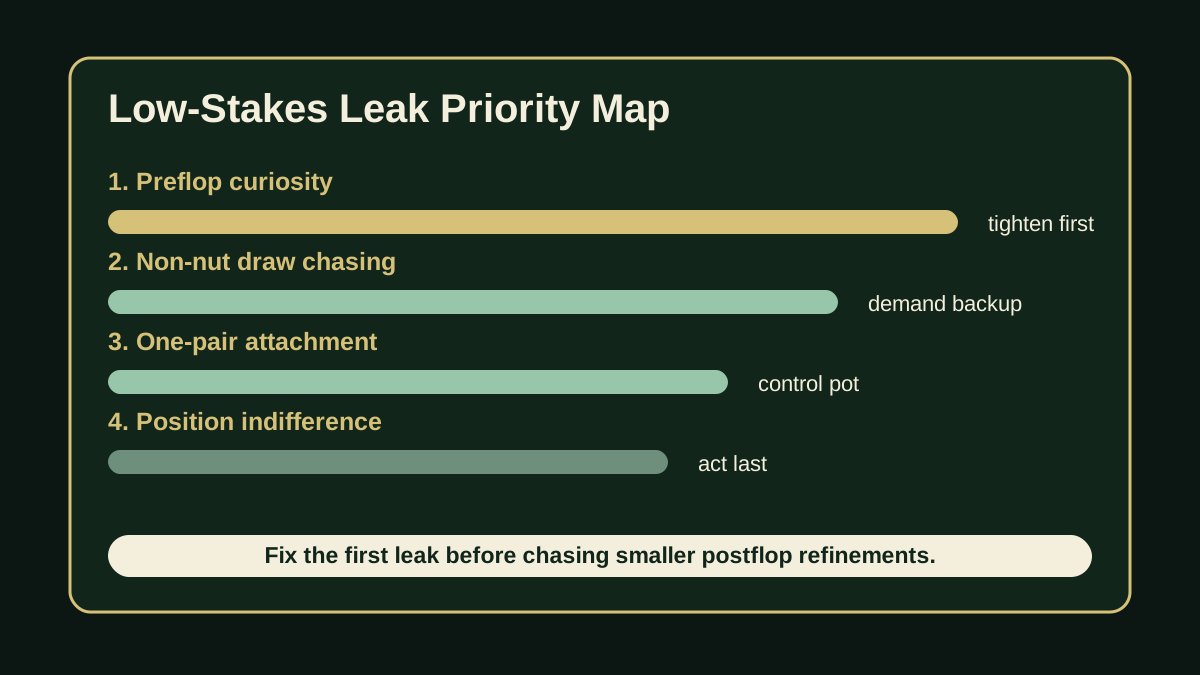 Inline visual: fix the highest-frequency leaks first, because they create the expensive postflop spots that look like bad luck later.
Leak #1: Calling Too Wide Preflop
This is the biggest leak in low-stakes live PLO, period. The action folds to you in middle position. You look down at K♥9♦6♠3♣. You think "king-nine, suited, I can work with this" and call.
You cannot work with this. This hand is trash. It has a dangler (3♣), no connectivity between the 9 and 6, one marginal suit, and a king that will make top pair with a terrible kicker. When you flop a king, you have no idea where you stand. When you flop a flush draw, it is the second-nut flush draw. When you flop a straight draw, it is a gutshot with no redraws.
In PLO, all four cards need to work together. Good hands look like T♥9♠8♥7♦ (connected, double suited, no danglers) or A♠K♦Q♠J♥ (big cards, suited ace, everything coordinates). Bad hands have a card that does not connect to the rest.
A practical test: cover up one of your four cards. If the remaining three cards look like a terrible Hold'em hand, the fourth card probably is not saving you. K-9-6 is garbage in Hold'em. Adding the 3♣ does not fix that in Omaha.
Leak #2: Chasing Non-Nut Draws
You have Q♥J♥8♦5♠ and the flop comes A♥7♥2♦. You have a queen-high flush draw. The player in front of you pots it, and another player calls. You call, thinking "flush draw, I have odds."
You do not have the odds you think. Even if you make your flush on the turn, anyone with a heart higher than a queen has you crushed. In a multiway pot, the probability that someone holds the A♥, K♥, or both is disturbingly high. You are drawing to a hand that will either lose at showdown or win a small pot when nobody else has a heart.
Check how a non-nut flush draw performs against the nut flush draw:
The non-nut flush draw is in terrible shape. And this is a scenario where you know you are against the nut draw. In a real game, you will not know until it is too late.
The rule: If you do not have the ace-high or king-high flush draw, you need additional equity (a straight draw, a set, two pair) to continue. A naked non-nut flush draw is a fold.
Leak #3: Overvaluing One-Pair Hands
In Hold'em, top pair top kicker is a strong hand you can often play for stacks. In PLO, top pair is barely worth one street of value in most situations.
Consider: you have A♠K♥J♦4♣ and the board is A♦9♠5♥. You have top pair with the best possible kicker. Sounds great, right?
The problem: with four cards each, your opponents hit the board harder and more often than in Hold'em. Two pair, sets, and wraps are all common. Against a single opponent who calls your flop bet, there is a reasonable chance they have you beaten already, and the draws that might be behind you (like a wrap or a set draw) have massive equity against your one pair.
Do not build big pots with one pair in PLO. Bet the flop for thin value, check the turn if called, and be prepared to fold to significant aggression. The players who lose the most money in low-stakes PLO are the ones who stack off with aces on an A-9-5 board and are shocked to see they were drawing nearly dead against a set or two pair.
Leak #4: Playing Too Many Hands Out of Position
Position in PLO is not just important. It is the single most significant factor in determining whether a hand is profitable.
The same hand that is a clear open from the button is a clear fold from under the gun. T♠9♥7♦6♠ is a wonderful hand on the button -- you see all the action, you close the betting, and you control the pot size. Under the gun, this hand faces 8 players behind you, any of whom could wake up with a premium hand. Even if you see a flop, you are playing the rest of the hand without position, guessing at what your opponents have.
Live PLO players dramatically underestimate this. They open far too many hands from every position because "PLO is a drawing game and I want to see flops." Yes, PLO is a drawing game -- but drawing from out of position in a bloated pot with marginal hands is how you lose your stack.
A rough opening guide by position for live PLO:
| Position | Hands to Open |
|---|---|
| UTG/UTG+1 | Tightest range (aces, kings, premium rundowns, big suited hands) |
| Middle | Tight but wider than UTG |
| Cutoff | Meaningfully wider |
| Button | Widest opening seat |
Leak #5: Not Value Betting Thin Enough
This is the opposite of the overvaluing one-pair leak, and it is equally expensive. When you do have a strong hand against a loose passive opponent, you need to extract maximum value, and that means betting streets you might check in a tougher game.
Say you have A♠A♥J♦T♠ and the board runs out Q♥7♦3♠-8♠-2♥. You have an overpair with the nut flush draw that bricked. Against a tight player, you might check the river since your hand is just aces. Against the typical low-stakes live opponent, bet. They will call with any queen, any two pair, any busted draw they chased. Your aces are good far more often than you think against a player who would have raised if they had you beat.
Run the numbers against a typical low-stakes calling range:
You are ahead, and against a calling station, you are leaving money on the table by not betting.
Leak #6: Not Adjusting to Table Dynamics
The biggest difference between a break-even player and a winning player in live PLO is table awareness. Every table has its own personality, and that personality shifts throughout the session.
When two fish leave and two regulars sit down, the game gets tighter and more aggressive. Your wide preflop range that was printing money against callers is now getting punished by 3-bets. Adjust.
When a player takes a bad beat and goes on tilt, they start playing every hand and raising light. Now is the time to tighten up and let them donate. Adjust.
When the game becomes short-handed (5 or fewer players), blinds come around faster and hand values change. That T♠9♥7♦6♠ you were folding under the gun at a full table becomes an opening hand. Adjust.
The players who do not adjust are the ones contributing to the rake without realizing it.
The One-Week Challenge
Pick two leaks from this list that you know you are guilty of. For your next five sessions, focus exclusively on those two leaks. Track how often you catch yourself about to make the mistake and stop. You will be surprised at how quickly your results change when you eliminate even one or two systematic errors from your game.
FAQ
I know I have these leaks but I cannot stop making them in the moment. What helps? Write your two biggest leaks on a card and put it next to your chip stack. Physically seeing "DO NOT CHASE NON-NUT DRAWS" during the session creates a trigger that interrupts the autopilot decision. It feels silly, but it works better than trying to remember in the heat of the moment.
Which leak is the most expensive in terms of dollars lost? Calling too wide preflop, because it is a compounding error. Every bad preflop call leads to bad flop calls, bad turn calls, and eventual stack-offs with dominated hands. If you fixed only one leak, this should be it. Use a proper starting hand chart until tighter preflop play becomes automatic.
Are these leaks specific to live PLO or do they apply online too? The leaks themselves are universal, but they are far more common and more exploitable in live games because the player pool is weaker. Online, most regulars have already plugged these leaks through study and tracking software. Live, you will find players making these mistakes for years without correction because they do not review hands or track results.