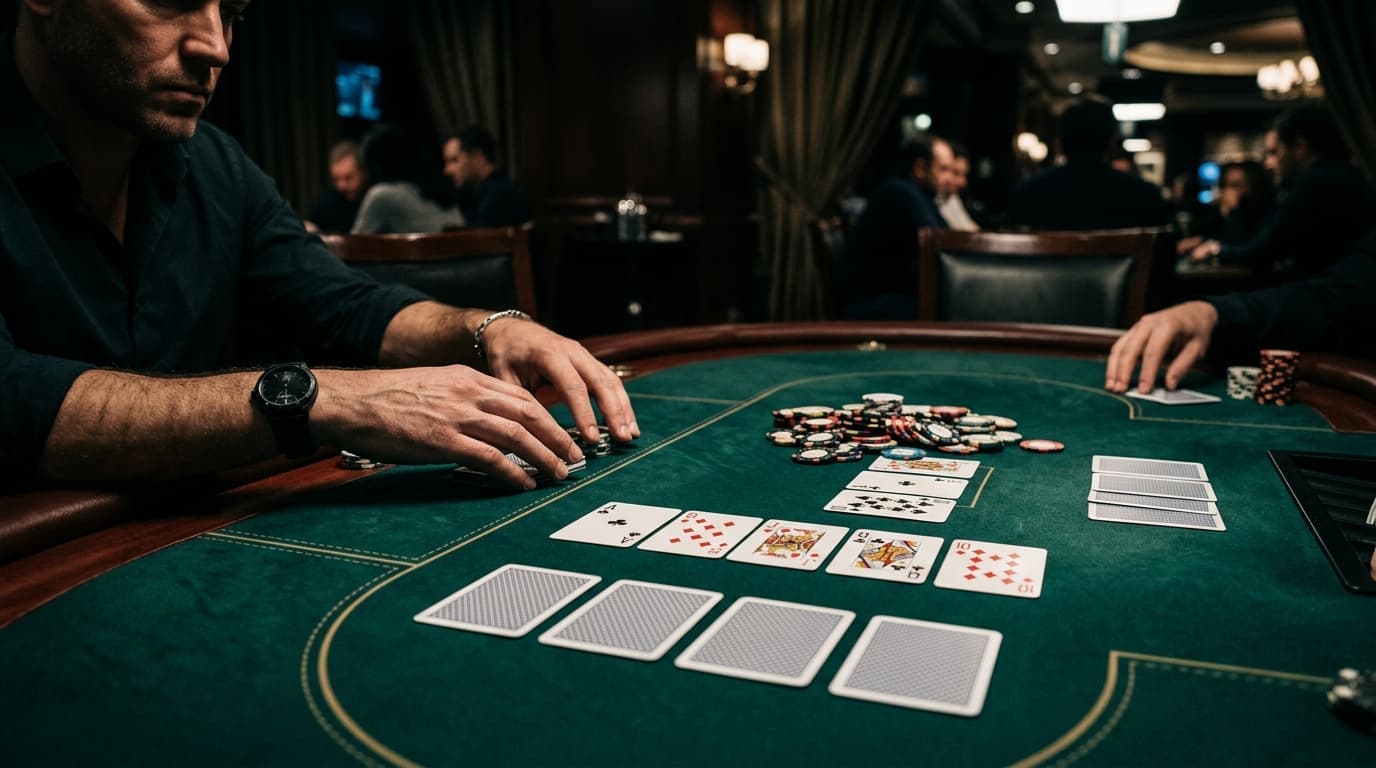
You Played Perfectly and Lost $3,000
Last Tuesday night, you played the best PLO of your life. You folded marginal hands preflop. You value bet with strong holdings. You made two disciplined laydowns on the river that saved you full buy-ins. You got your money in as a clear favorite three different times.
You lost all three. You went home down 15 buy-ins.
This is not a bad beat story. This is just PLO.
Stop guessing whether you're running bad or playing bad. The PLO Variance Simulator lets you model your win rate and sample size so you can see how downswings and breakeven stretches are plausible even for winning players.
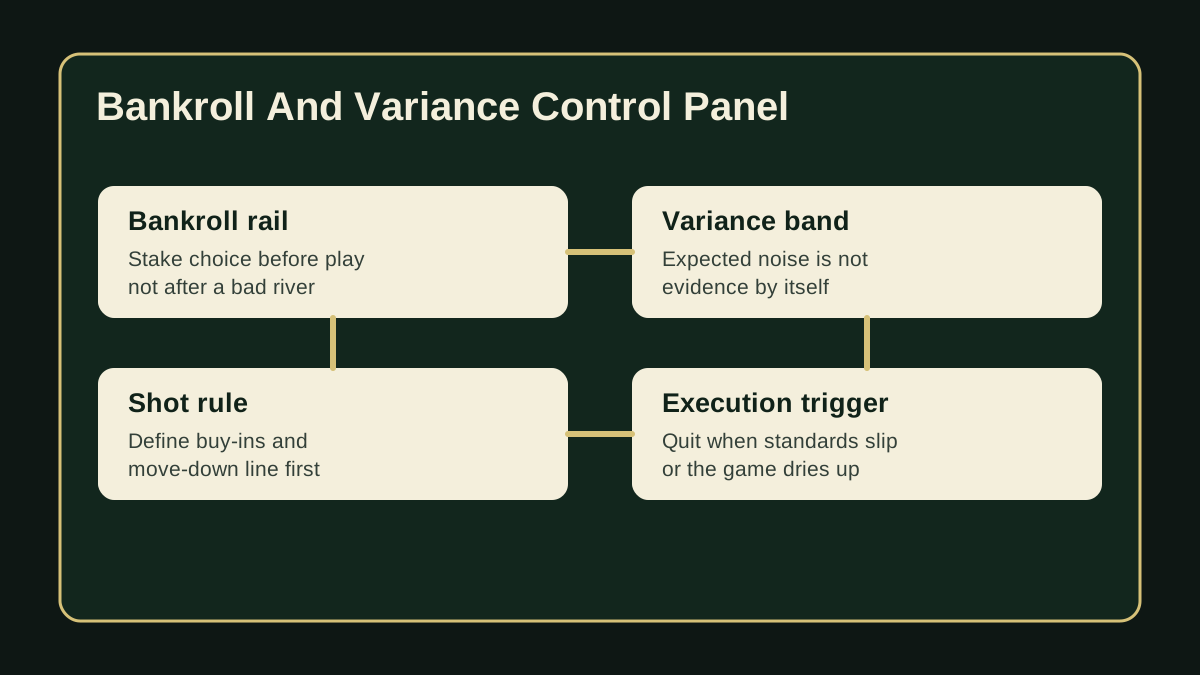 Inline visual: variance explains the result band; execution quality decides whether the session should continue.
The Math Behind the Madness
PLO variance is not a vague concept. It has specific, measurable properties that explain why sessions feel so much wilder than No-Limit Hold'em.
Standard deviation: In practical terms, PLO session results spread out much more than NLHE session results. The exact number depends on game selection, style, stack depth, and format, but the important point is simple: short-term outcomes are much noisier.
What this looks like over 100 hands:
A winning PLO player can easily have a brutal 100-hand stretch while still playing well. The same is true in NLHE, but the day-to-day swings in PLO are usually wider because more money goes in with closer equities.
PLO does not just swing a little more. It swings a lot more.
Why Equities Run So Close in PLO
The root cause of PLO's variance is structural: with four hole cards instead of two, hands connect with boards more often and more deeply. This creates frequent situations where both players have enormous equity.
In NLHE, top set versus a flush draw is roughly 75-25. In PLO, top set versus a flush draw with a straight draw and a pair is often closer to 55-45.
Top set of kings -- the hand you dream about -- can still be only a modest favorite against a huge combo draw. You are getting your money in correctly, but you are nowhere near invincible. Do that five times in a session and losing several of them is completely plausible.
This is fundamentally different from NLHE, where big hands dominate and results follow expectation more quickly. In PLO, even correct decisions produce incorrect-looking results with alarming frequency.
The Downswing You Should Expect
Here is a number that should both scare you and comfort you: even a strong winning PLO player can experience a 20+ buy-in downswing over a large enough sample.
The exact probability depends on win rate, standard deviation, game format, and volume. The practical lesson is what matters: 10-buy-in and 20-buy-in downswings are not evidence that you are necessarily playing badly. They are part of the game.
This is why bankroll management in PLO is non-negotiable. Large downswings are part of the normal distribution of outcomes.
The Danger of Small Sample Sizes
PLO variance creates a particularly insidious problem: it takes far longer to know whether you are actually a winning player.
In NLHE, most estimates suggest you need 50,000-100,000 hands for a reasonably confident read on your win rate. In PLO, because the standard deviation is so much higher, you may need 150,000-200,000 hands for similar confidence.
At live PLO's pace, a truly large sample takes a very long time to accumulate. That means you can run well or badly for months without your results saying much about your true edge.
The reverse is also true, and this is the part nobody wants to hear: you could be a winning player running badly for months. The solution is not to evaluate yourself on results over short periods. Judge your decisions, not your outcomes. Review hands, study equity scenarios, and compare your play against what a strong strategy would dictate.
Multiway Pots Make It Worse
Variance escalates in multiway pots because more players means more cards in play, which means more potential for miracle runouts.
In a heads-up all-in where you are ahead, you still lose often. In a three-way all-in, even strong hands can win far less often than players expect -- and the pot is bigger, so each loss hurts more.
Live PLO games, which tend to be looser with more multiway pots, therefore produce even higher variance than online games where pots typically go heads-up. If you primarily play live, expect the variance to hit harder and prepare your bankroll and your mental game accordingly.
Compare how a three-way all-in distributes equity:
Aces with premium backup -- the best possible starting hand -- have barely a third of the equity in this three-way pot. You are going to lose this spot often, and that is fine. It is the cost of playing PLO.
In tournaments, that same variance pressure needs a different response because chips cannot be reloaded freely. The deep-stack PLO tournament patience guide covers the execution-decay side of those decisions.
What Variance Is Not
Variance is not:
- A reason to play badly. "It does not matter, it is all variance anyway" is a toxic mindset that protects your ego while destroying your bankroll.
- An excuse for every losing session. Sometimes you played badly. Be honest about which sessions were variance and which were mistakes.
- Proof that the game is rigged. Online PLO attracts more "rigged" complaints than any other game. It is not rigged. The equities are just closer than you expect.
- Something that "evens out" over a session. Variance evens out over tens of thousands of hands, not over one evening. Expecting to "get it back" tonight because you have been running bad is the gambler's fallacy.
Practical Approaches to Handling Variance
Track your expected value, not just results. When you get it in as a favorite and lose, note that you still made a +EV play. Over time, your EV graph will usually look smoother than your actual results graph. This separates decision quality from outcome quality.
Set session stop-losses. Decide before you sit down: "If I lose X buy-ins tonight, I go home." This does not reduce variance, but it prevents you from compounding variance with tilt. A 3 buy-in loss is recoverable. A 10 buy-in loss after tilting your face off is catastrophic.
The key is using stop-losses as execution guardrails, not superstition. The deeper breakdown is stop-loss rules in PLO, which separates bankroll protection from quitting good games too early.
Study the math. Run equity calculations on common spots. When you know that your set is only a modest favorite against a combo draw, the losses stop feeling random or unfair. They start feeling like part of the game you signed up for.
Run this common PLO scenario to internalize how close the equities really are:
Top set with a straight draw. Against a nut flush draw with a wrap. You are a slight favorite. This is PLO.
FAQ
How long does a typical PLO downswing last? It depends on your win rate and volume. Some downswings last a few sessions; others last months. There is no fixed timeline because variance is random by definition. The only useful response is to keep making good decisions and track whether your process is still sound.
Should I change my strategy during a downswing? Generally no. If your strategy was winning before the downswing, the downswing is almost certainly variance, not a suddenly flawed approach. The exception: if you notice your play has deteriorated due to tilt or frustration, take a break and refocus. The danger during downswings is not the variance itself -- it is the strategic degradation that tilt causes.
Is PLO variance worse at higher stakes? The variance measured in buy-ins per 100 hands is similar across stakes. But the dollar variance scales linearly with the stakes, and the psychological impact scales non-linearly. A 10 buy-in downswing at $0.50/$1 is $1,000. At $5/$10, it is $10,000. The math is the same but your stress response is very different. This is another reason bankroll management becomes more critical as you move up.