
You Just Flopped 20 Outs. Now What?
You hold A♠J♠T♥9♥ in a $2/$5 PLO game. The flop comes 8♠7♠2♦ and the player in front pots it. You have a wrap to the straight -- any jack, ten, nine, or six makes it -- plus the nut flush draw. Roughly 20 clean outs. This is what PLO players live for: the combo draw.
But not all combo draws are created equal. Misplaying them is one of the costliest errors in Omaha.
The Combo Draw Hierarchy
A combo draw combines two or more drawing components. The hierarchy matters enormously:
- Wrap + nut flush draw -- the king. This hand class is often strong enough to stack off comfortably against made hands.
- Pair + nut flush draw -- strong, especially when the pair can improve to a set.
- Bare wrap (no flush draw) -- playable, but meaningfully weaker than the same hand with flush backup.
- Non-nut flush draw + straight draw -- dangerous. You can make your hand and still lose.
This is not a cosmetic difference. It is often the difference between a profitable stack-off and a marginal continue.
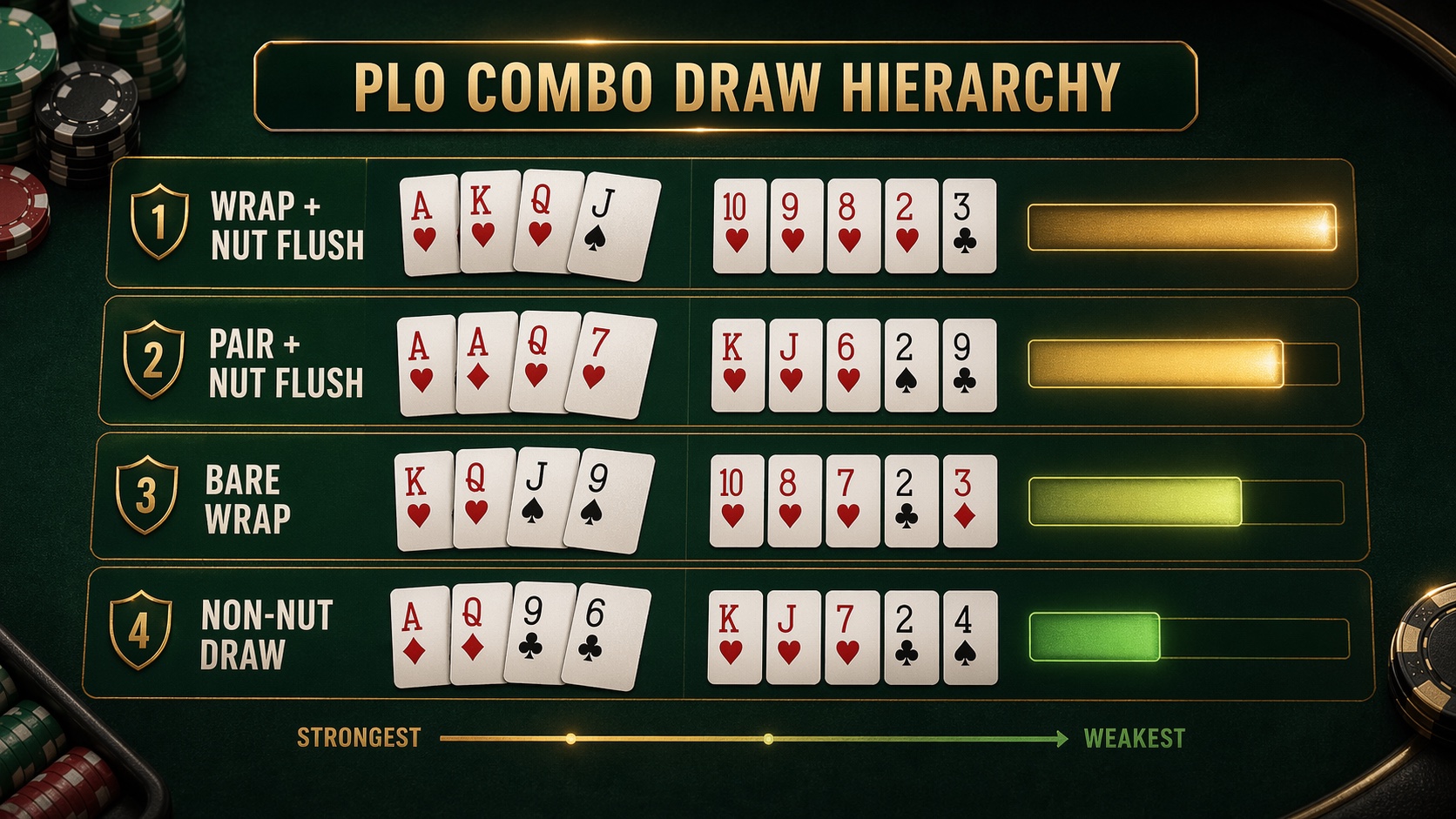 Inline visual: the more your draw makes the nuts and carries redraw backup, the more aggressively it can fight for stacks.
The Stack-Off That Defines PLO
Your A♠J♠T♥9♥ on 8♠7♠2♦ against an opponent with 8♥7♦K♣Q♣ for top two pair:
Now strip away the flush draw. Same wrap, but you hold A♦J♦T♥9♥. Run it without the flush draw. The difference is substantial. That gap is often the difference between a confident raise and a much thinner continue.
This is why the strongest combo draws actively want stacks in on the flop. You are not gambling -- you are making a mathematically sound investment. The key question: would I be happy getting all the money in right now? If yes, play aggressively. If "only if I hit," your draw is weaker than you think.
The Mistake That Drains Bankrolls
The real leak is not misplaying monsters. Most players handle 20-out draws fine. The leak is overvaluing marginal combo draws.
You hold Q♠J♣T♠5♥ on 9♠7♠3♦. You have a flush draw and some straight outs. Looks like a combo draw. Except the flush is not to the nuts (any A♠x♠ dominates you), your straight outs amount to a bare gutshot, and your kicker does nothing. This hand plays like a combo draw but performs like a non-nut flush draw with delusions of grandeur.
The test: how many of your outs make the nuts? If most of them do, you have a real combo draw. If many make second-best hands, you have a trap.
Position and Board Reading
Combo draws in position are significantly more valuable. You can pot the flop when checked to, take a free turn card if the board shifts, and control the final pot size. Out of position, you are guessing. A combo draw that is a clear stack-off in position might only be a call out of position.
Board texture matters too. On 8♠7♠2♦, your wrap is massive because the board is spread out. On J♠T♠9♥, the board is so connected that many opponents also hold straight draws, and your "outs" might give them better hands. Compare a wrap against a set on a connected board:
Watch for two-tone boards where you hold the nut flush draw (your outs are live) versus monotone boards (someone likely has a higher draw). And remember: if the board pairs, your straight and flush draws are still live but now lose to full houses.
FAQ
Is it ever correct to fold a combo draw on the flop? Rarely, but yes. If you have a non-nut flush draw, your straight outs make the low end, and you face a pot-sized bet and a raise multiway, folding can be correct. A "20-out draw" where 8 outs lose to better hands is really a 12-out draw.
How should I play combo draws on the turn when I miss? With one card to come, even a big draw loses a lot of its raw power. In position, a free card can be valuable. Out of position, many turn decisions become much thinner than the flop version of the same hand.
What separates a stack-off combo draw from a call-and-see combo draw? The key distinction is how many of your outs make the current nuts and how many create dominated hands. Wrap plus nut-flush backup is a very different animal from non-nut flush plus weak straight draw.
The One Thing to Remember
Combo draws create situations where the drawing hand is the mathematical favorite against made hands -- something that almost never happens in Hold'em. Master the hierarchy, ruthlessly evaluate how many of your outs make the nuts, and you will find yourself on the right side of the biggest pots at the table.