
A PLO Wrap Gave You 20 Outs. Why Did You Lose Money?
You hold J♥T♥7♣6♣ and the flop comes 9♠8♦2♣. Twenty outs to a straight. You pot it, get called, the turn is a K♠, the river is a 3♥. No straight. You lost a massive pot with the best possible draw.
That happens. Variance is real. But more often, players lose money with wraps because they don't understand which wraps are actually strong, which ones are traps, and when 20 outs aren't really 20 outs. This is the most misunderstood draw type in PLO.
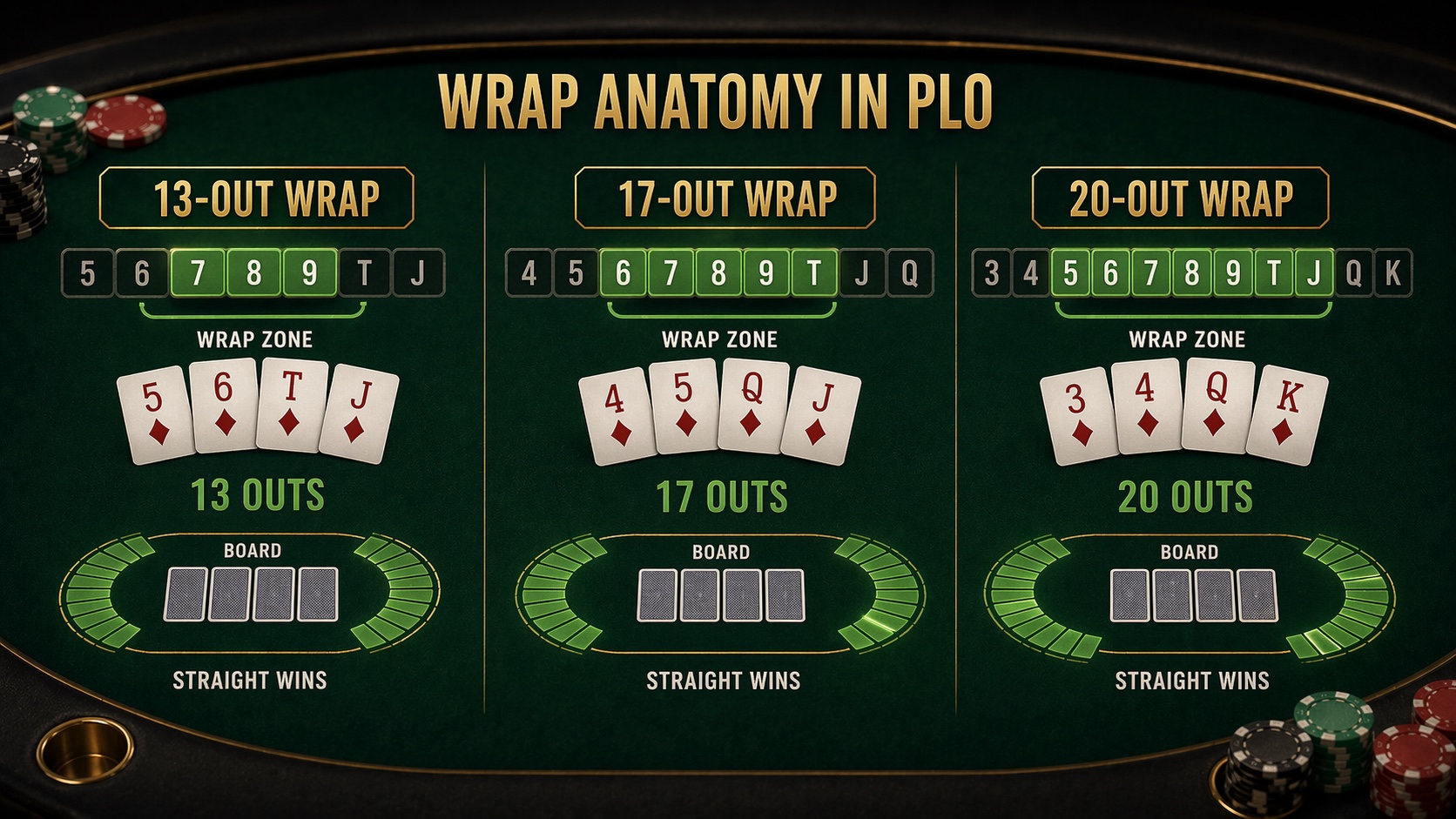 Inline visual: wrap strength starts with out count, but the real question is how often those outs make the nuts.
What Is a Wrap in PLO?
A PLO wrap is a straight draw where your hole cards connect around the board cards, giving you more outs than a normal open-ended straight draw. In Hold'em, the classic open-ender has 8 outs. In Pot-Limit Omaha, a wrap can have 9, 13, 17, or even 20 straight outs because you start with four hole cards and many rank combinations can complete a straight.
Quick answer: a wrap in PLO is a straight draw with extra straight-completing cards because your four hole cards surround the board ranks. Strong wraps make nut straights. Weak wraps make second-best straights that look good until the pot gets big.
The name comes from how your cards "wrap around" the board. On a 9♠8♦2♣ flop, a hand like J♥T♥7♣6♣ can make straights with cards above, between, and below the board ranks. That is why a wrap is one of the most powerful PLO drawing hands.
Example, verified by the site's engine:
- Board: 9♠8♦2♣
- Hand: J♥T♥7♣6♣
- Straight cards: Q, J, T, 7, 6, 5 — 20 outs in total
The key is not only how many cards complete a straight. The key is how many of those cards make the nut straight. Even this max wrap has only 14 nut outs among its 20: a jack or ten completes your straight and unlocks a higher one for hands like Q-J or Q-T. A big non-nut wrap can still be dangerous in multiway pots.
If you only remember one rule, remember this: count nut outs first, total outs second. A pretty PLO wrap that makes dominated straights is not a license to stack off.
How Many Outs Can A PLO Wrap Have?
Most useful wraps fall into four practical buckets. Every example below is enumerated by the site's equity engine — hold the exact hand on the exact board and you can count the outs yourself:
| Wrap type | Straight outs | Example | What matters most |
|---|---|---|---|
| Inside wrap | 9 outs | T♠9♥8♣6♦ on J♣7♦2♠ | All nut outs, but the smallest wrap |
| Gapped wrap | 13 outs | Q♠J♥9♦8♣ on T♣7♠3♥ | Continue carefully, especially multiway |
| Split wrap | 17 outs | A♠T♠9♥6♥ on 8♣7♦2♥ | Strong draw, but 6 of the 17 are non-nut |
| Max wrap | 20 outs | J♥T♥7♣6♣ on 9♠8♦2♣ | Premium draw when outs are clean |
The out count is only the first filter. A 13-out wrap to the nuts can be worth more than a 20-out wrap where several cards make dominated straights.
PLO Wrap Outs: Clean, Dirty, and Dead
Not every straight card is worth the same.
| Out type | Meaning | Example |
|---|---|---|
| Clean nut out | Makes the highest possible straight | A♠K♠Q♥J♥ on T♣9♦4♠: any 8, J, Q, or K — 13 outs, every one the nuts |
| Dirty out | Completes your straight and something scarier | J♥T♥7♦6♦ on 9♣8♣2♥: still 20 outs, but six of them are clubs that put a third flush card out |
| Dead or reverse-implied out | Makes a straight that is often second-best | 6-5-4-3 on 8-7-A: 13 outs, but only the three fours make the nut straight |
This is why PLO wrap strategy is not just arithmetic. Two players can both say "I have a wrap," but one has a nut wrap with backup equity while the other has a trap draw that wins small and loses large.
The Three Big Wrap Categories
The 20-Out Wrap (Max Wrap)
This is the holy grail. It takes two cards above and two cards below a connected pair of board cards, with no gaps against the board — J-T over the 9-8, 7-6 under it.
Classic example: You hold J♥T♥7♣6♣ on 9♠8♦2♣. Any Q, J, T, 7, 6, or 5 completes the draw — 20 cards, 14 of them to the nuts.
The 17-Out Wrap (Split Wrap)
Split your connectivity around the board — three ranks working above the board pair and one below, or a two-piece hand like A-T-9-6 around 8-7 — and you land near 17 outs.
The split wrap is still worth playing aggressively in most situations, especially against a single opponent.
The 13-Out Wrap (Gapped Wrap)
A gap in your hand or a less-than-ideal board relationship gives you a 13-card wrap. This is the equivalent of an open-ender on steroids — still strong, but meaningfully weaker than a max wrap.
Not All Wraps Are Created Equal
Here's the contrarian insight most PLO content ignores: the number of outs is only half the story. The other half is where those straights rank.
High wraps vs. low wraps: Holding A♠K♠Q♥J♥ on a T♣9♦4♠ board gives you a 13-out wrap where any 8, J, Q, or K completes the highest possible straight — all 13 outs are nut outs. Holding 5♠4♥3♦2♣ on a 7♣6♠A♥ board also gives you a 13-out wrap, but only the three treys make the nut straight; every 4, 5, and 8 completes your straight while a higher one is possible for hands like 9-8 or 8-5.
High wraps are generally much more valuable than low wraps. A 13-out wrap to the nuts is often more profitable than a 20-out wrap to vulnerable non-nut straights.
The same logic applies to position. In position, you can take a free card, realize equity, and value bet more accurately when the straight arrives. Out of position, you often have to choose between potting a draw into unknown ranges or checking and letting opponents control the price. A marginal wrap improves dramatically on the button and gets much more fragile from the blinds.
The Three Killers of Wrap Value
1. Flush Draws on Board
You hold J♥T♥7♦6♦ on 9♣8♣2♥. Beautiful 20-out wrap. But six of those twenty cards — the club five, six, seven, ten, jack, and queen — complete your straight while putting a third club on board. Your out count did not change; the value of the outs did. Two-tone and monotone boards reduce the quality of your straight outs unless you also hold the right flush draw.
2. Board Pairing
A wrap gives you straight outs, but if the board pairs, someone with a set makes a full house. Your straight is no good. On paired boards, wraps lose a lot of value because some of the runouts that looked clean no longer are.
3. The Non-Nut Problem
You hold 6♠5♥4♦3♣ on 8♠7♦A♣. It looks like a huge wrap, and the engine does count 13 straight outs — every 9, 6, 5, and 4. But only the three fours make you the nut straight. A nine completes your straight and a higher one for anyone holding J-T or T-6; sixes and fives have the same problem against 9-5 and 9-6. Always ask: "Can I get raised by a higher straight?" If yes for many outs, the wrap is far weaker than the count suggests.
When to Raise, Call, or Fold with Wraps
Raise or 3-bet the flop:
- 17-20 out wrap to the nuts
- Nut wrap with flush draw backup
- Heads-up spots where fold equity adds value
- Wrap plus pair or blockers that improves on many turns
Call:
- 13-out wrap to the nuts
- 17-20 out wrap that is not to the nuts
- Medium wrap in a multiway pot
- Wraps with good implied odds but limited fold equity
Fold:
- Small wrap (under 10 outs) with no backup equity
- Any wrap on a monotone board without the flush draw
- Non-nut wrap when facing a raise and a re-raise
At low SPR, strong wraps can profitably pile money in because you realize equity by seeing both cards. At high SPR, be more selective. Deep stacks make dirty outs and reverse implied odds matter more, especially when the pot is multiway.
Two Common PLO Wrap Mistakes
Mistake 1: saying "I have 20 outs" without asking which ones are clean.
This is the leak behind many losing wrap hands. If some outs complete a flush, pair the board, or make a lower straight, your real stack-off equity is lower than the headline number.
Mistake 2: treating every wrap like a semi-bluff.
A nut wrap with blockers and fold equity can be a great raise. A non-nut wrap against two sticky players is often a call or even a fold. The hand category is not the decision. The decision comes from nut outs, backup equity, position, SPR, and opponent ranges.
Compare Wraps Yourself
Building Wraps Preflop
Wraps don't appear by accident. They come from starting hands with connectivity. The best wrap-flopping hands are smooth four-card rundowns: T-9-8-7, J-T-9-8, Q-J-T-9. One-gappers like T-9-8-6 or J-T-8-7 flop wraps less often, but when they do, the wraps are still strong.
If you want to flop more wraps, prioritize rundowns in your preflop hand selection — especially from late position and deep-stacked. Connectivity is the first of the four questions that price any PLO starting hand, and wraps are the reason why.
FAQ
What is a wrap in PLO? A wrap in PLO is a straight draw with many possible straight-completing cards because your four hole cards connect around the board ranks. Instead of a simple 8-out open-ender, a PLO wrap can produce 9, 13, 17, or 20 straight outs. The best wraps make nut straights; weaker wraps make second-best straights that can lose big pots.
What does PLO wrap mean? PLO wrap means your hand wraps around the board ranks to create more straight outs than a normal open-ended draw. For example, J-T-7-6 on 9-8-2 can complete straights with several ranks above, between, and below the board cards.
How many outs can a PLO wrap have? A PLO wrap can commonly have 9, 13, 17, or 20 straight outs, depending on how your four hole cards connect with the board. The strongest versions are not just the highest-out-count wraps; they are the wraps where most outs make the nut straight and where you have backup equity such as a flush draw.
How much equity does a 20-out wrap have against top set? On a rainbow board, about even money: our verified example runs the bare max wrap at 51.1% against top set. Add the nut flush draw and the same structure becomes a clear favorite — 61.8% in the combo-draw example above. Remove clean outs and the picture worsens quickly.
Should I slow-play a wrap to disguise my hand? Almost never. Wraps need to charge made hands and they need to build a pot while their equity is highest (on the flop, with two cards to come). Slow-playing gives opponents a free card to improve or pair the board, which kills your wrap. Bet, raise, and get the money in while the math is in your favor.
What's the worst mistake people make with wraps? Overvaluing non-nut wraps. A 17-out wrap to non-nut straights in a multiway pot will lose you money over time. You'll make the straight, bet, get raised by a higher straight, and donate a full stack. Count your nut outs — not just your total outs — before committing chips.