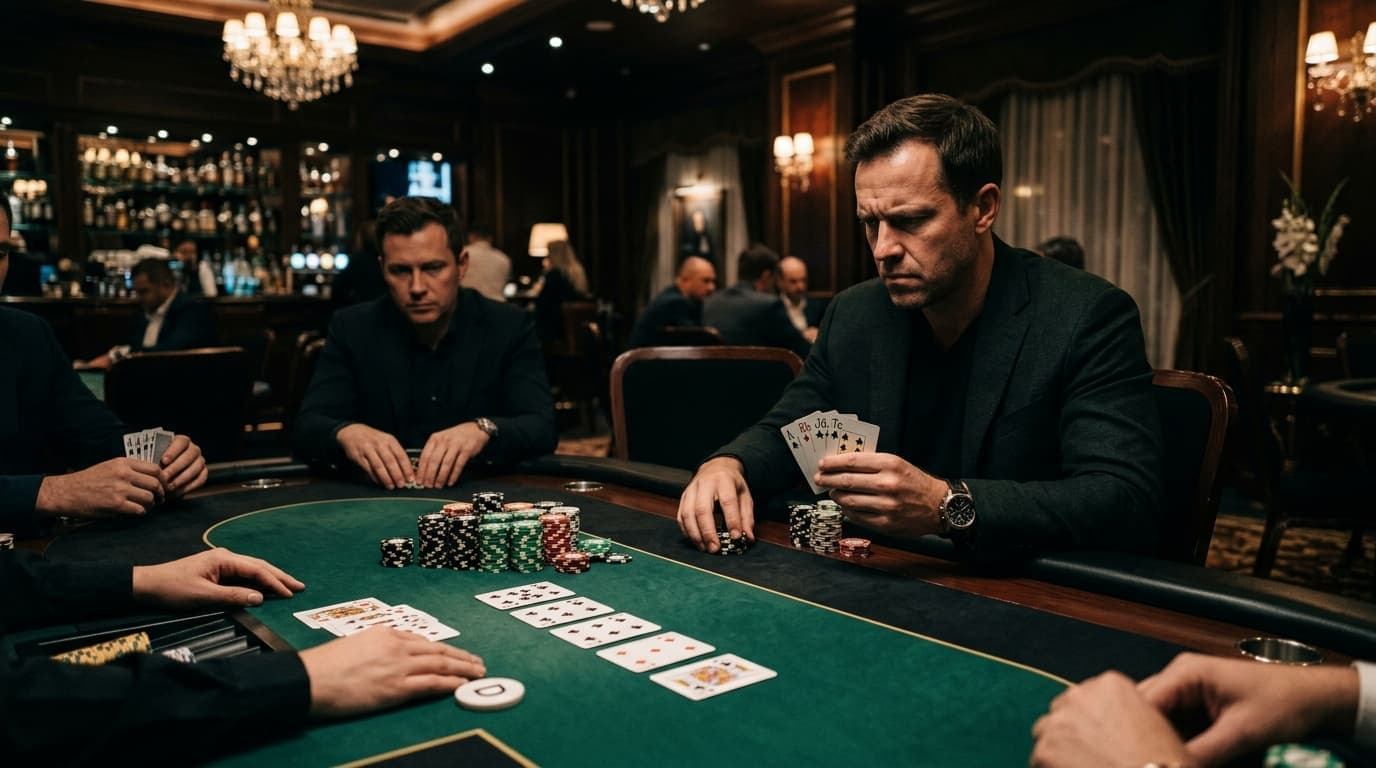
Pot-Limit Omaha looks inviting because every hand seems playable. Four cards create more pairs, more suited hands, more wraps, and more flops where you can say, "I have something." That is the trap. The same structure that creates action also makes PLO brutally precise: small preflop mistakes turn into dominated draws, multiway guessing games, and expensive second-best hands.
If you are asking why PLO is hard, the answer is not just "variance." PLO is hard because you must evaluate more card combinations, use exactly two hole cards, understand close equities, and plan around the nuts before the pot gets large.
The Starting-Hand Scale Is Completely Different
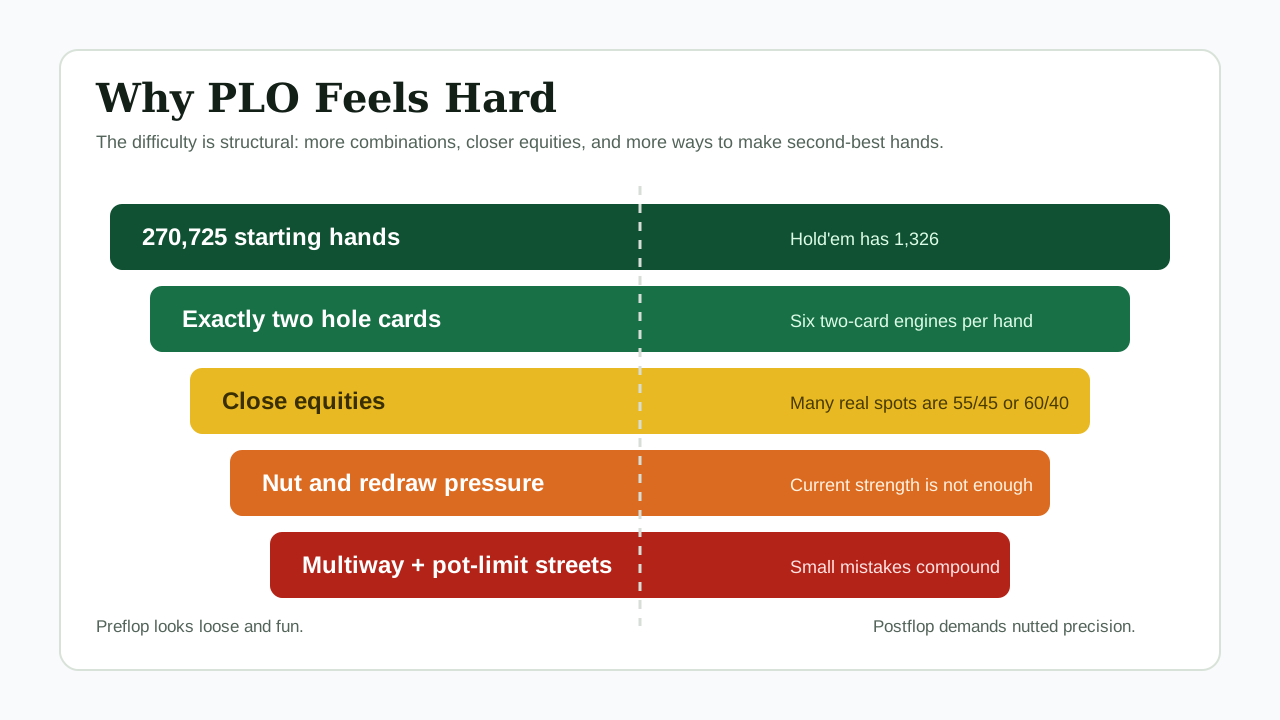
Hold'em has 1,326 distinct two-card starting combinations. PLO has 270,725 distinct four-card combinations. That does not mean you need to memorize 270,725 hands, but it does mean your old Hold'em shortcuts fail quickly.
In Hold'em, a cutoff 3-bet can often be narrowed to a familiar cluster: big pairs, ace-king, suited broadways, and some bluffs. In PLO, that same aggressive range can contain premium aces, double-suited kings, high rundowns, paired rundowns, suited ace blockers, and hands that look similar but play very differently after the flop.
The winning skill is structural hand evaluation. You are not asking, "Do I have four pretty cards?" You are asking:
- Do the cards work together?
- Can they make the nuts?
- Are the suits high enough to win flush-over-flush pots?
- Will this hand survive multiway pressure?
That is why what makes a good PLO hand is a different question from "does this hand look connected?"
Exactly Two Cards Creates Hidden Misreads
The rule that makes PLO unique is also the rule that causes many expensive mistakes: you must use exactly two cards from your hand and exactly three cards from the board.
That changes hand reading in two ways.
First, your hand contains six two-card combinations. A♠K♠Q♥J♥ is not one hand after the flop; it is six possible two-card engines interacting with the board. Some make nutted straights. Some make dominated pairs. Some only matter as blockers.
Second, board texture can invalidate the hand your eyes think you have. On 9-8-7-6-5, holding A-K-Q-J does not let you "play the board" for a straight. You still need exactly two hole cards. If your two cards do not combine with three board cards into the best five-card hand, the board alone does not save you. Review the PLO rules and hand rankings until this is automatic.
Close Equities Make Small Mistakes Expensive
PLO hands run closer together than Hold'em hands. Strong hands still matter, but they rarely dominate in the clean 80/20 way Hold'em players expect.
Using the site's local equity engine, A♠A♥K♠K♥ is about 60.1% against a strong double-suited rundown like 9♣8♣7♦6♦ preflop. Against a random hand it performs much better, but the strategic point remains: many real PLO confrontations are 55/45, 60/40, or multiway equity shares rather than obvious crushes.
That closeness changes the game:
- Thin preflop edges need position and playability.
- Calling too wide becomes expensive because "not far behind" is not the same as profitable.
- Pot-limit betting creates large pots before anyone has a locked-up hand.
- The better redraw usually matters as much as the current made hand.
If you want to see this in your own spots, run premium pairs, rundowns, and pair-plus-draw hands through the PLO equity calculator. The useful lesson is often not the exact percentage. It is how quickly a pretty hand becomes fragile when ranges and boards change.
The Nuts Matter More Than Hand Strength Labels
In Hold'em, top pair top kicker can win multiple streets on many boards. In PLO, one-pair hands are usually temporary bluff-catchers unless they carry serious backup.
The right question is not "Did I flop a strong hand?" It is:
- What is the current nuts?
- Can I make the nuts by the river?
- If I already have the nuts, do I have redraws?
- If I make my draw, can a better version already exist?
That is why nut dependency defines PLO strategy. A king-high flush draw is not just "a flush draw" when the ace-high flush draw can be in multiple opponents' ranges. A low wrap is not just "a straight draw" when some outs make the bottom end. Bottom set is not just "a set" when higher sets and wrap-plus-redraw hands can apply pressure.
The understanding the nuts in PLO, non-nut flushes, and redraws guides all build on this same idea: PLO rewards hands that can continue when the pot gets big, not hands that merely connect once.
Multiway Pots Punish Pretty But Weak Hands
PLO pots go multiway more often because four-card hands connect with flops more often. That makes marginal hands much worse than they appear.
Take A♠A♥K♦4♣ on J♣6♠2♥. Heads-up against T♠9♠8♥7♥, the aces are still in good shape on that dry-ish flop in an exact runout check. But add players who can hold top set, better backdoors, and live side-card equity, and the story changes completely. The overpair is no longer the hand description. The real description is "bare aces in a multiway pot with poor improvement."
This is why multiway pots in PLO punish Hold'em habits. You cannot c-bet every overpair and hope the field missed. Someone usually has a set, a wrap, a pair plus draw, the nut flush draw, or enough equity to continue profitably.
The adjustment is blunt:
- Bet less often with naked one-pair hands.
- Value-bet harder when you have the nuts plus redraws.
- Fold dominated draws earlier when action is multiway.
- Prefer hands that can make nut flushes, nut straights, and top sets.
Pot-Limit Betting Makes Planning Harder
No-limit games let stacks go in immediately. Pot-limit betting usually builds the pot street by street. That gives PLO its tactical depth: you must plan the turn and river before the flop bet goes in.
A flop call with a dominated draw may look cheap. But after a pot-sized turn bet, the price changes. If the river completes your second-best hand, the pot is already large enough to tempt a crying call. This is the reverse-implied-odds pattern: win small when your weak draw gets there cleanly, lose big when a better version shows up.
Stack-to-pot ratio matters more because of this. At low SPR, strong made hands and nut draws can commit. At high SPR, the same hand may need pot control because future streets are still expensive. The SPR in PLO framework is one of the fastest ways to stop treating every strong flop as a stack-off.
The Skills That Actually Make PLO Hard
Strong PLO players are not just better at math. They are better at sorting noisy information under pressure.
| Skill | What it means in practice |
|---|---|
| Structural hand selection | Choosing hands where all four cards cooperate instead of carrying danglers |
| Nut awareness | Knowing the current nuts, future nuts, and whether your draw is dominated |
| Redraw planning | Preferring hands that can improve after making the current best hand |
| Multiway discipline | Tightening value and bluffing thresholds as more players remain |
| Emotional control | Accepting that correct 60/40s lose often without changing into spew |
For new players, the best study path is simple: learn what PLO is, drill common beginner mistakes, then study variance in PLO so normal swings do not push you into bad strategy changes.
PLO is hard because almost every hand has a story it can tell. Your job is to ignore the attractive story and ask whether the hand can make the nuts, realize equity in position, and survive pressure when the pot is no longer small.
FAQ
Is PLO harder than No-Limit Hold'em? For most players, yes. PLO has more starting-hand combinations, more multiway pots, closer equities, and more dominated strong-looking hands. Hold'em has its own depth, but PLO punishes weak hand selection and non-nut continues faster.
Is PLO harder to beat online or live? Online PLO is usually tougher because the average player pool is stronger and hands run faster. Live PLO can be softer, but it is often deeper and more multiway, which increases the cost of non-nut mistakes.
How long does it take to become a winning PLO player? A strong Hold'em player can build a basic low-stakes PLO strategy in a few months, but becoming consistently good takes longer because the hardest skills are pattern recognition, nut discipline, and multi-street planning.
Why does PLO feel so swingy? Equities run close, draws are powerful, and multiway pots create more high-equity collisions. The swings are real, but they are not a license to gamble with dominated hands. Good PLO strategy reduces bad variance by avoiding spots where your made hands and draws are second best.