
The Card That Is Not There
Look at these two hands: T♠9♠8♥7♥ and T♠9♠7♥6♥. At a quick glance, they look similar -- four cards in the tens-to-sixes range, double-suited, seemingly connected. But the second hand is missing the eight. That single absent card is the difference between a premium holding and a marginal one.
Gaps are the silent killers of PLO hand quality. A gap is any missing rank in your four-card sequence. T-9-8-7 is smooth (no gaps). T-9-7-6 has a one-card gap. T-8-6-5 has two gaps. Each gap you introduce strips away straight combinations, and in a game where straights are the primary nut hand, that is an expensive loss.
Counting What You Lose
Here is the math that makes gaps so costly. With a smooth four-card rundown, you can make a straight using many different two-card combinations from the board. Your four cards overlap with the maximum number of possible board textures.
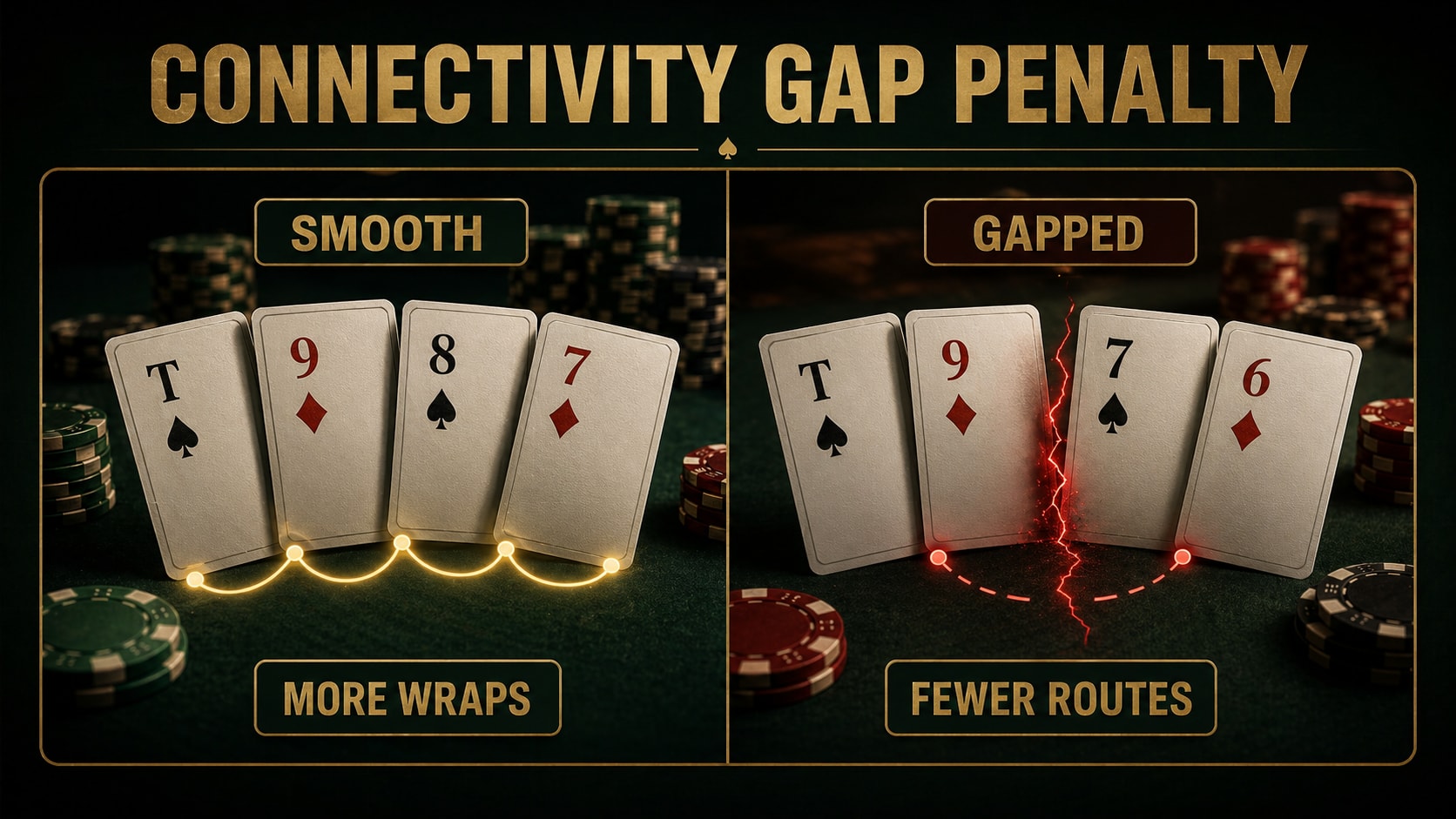 Inline visual: smooth cards create continuous straight routes, while gaps break the route and force the board to repair your hand.
Take T-9-8-7. You make a straight when the board contains: J-6, J-Q, 6-5, Q-J, and several other combinations. On a flop like J-6-x, you have a 20-out wrap -- the most powerful draw structure in PLO.
Now take T-9-7-6 (one gap, missing the 8). On that same J-6-x flop, you no longer have a wrap. You might have some straight outs, but the full 20-out monster is gone because the eight -- the card that would bridge your sequence -- is not in your hand. Your draw went from "near-invincible" to "decent at best."
This is not a minor difference. Losing a wrap on one flop texture after another compounds into a significant equity reduction across all the boards you will ever see.
One Gap vs Two Gaps vs Danglers
Not all structural flaws are equally bad. Here is the hierarchy:
Smooth (no gaps): T-9-8-7, J-T-9-8, Q-J-T-9. Maximum straight potential. These are the gold standard of connectivity.
One gap: T-9-7-6, J-T-8-7, Q-J-9-8. The gap reduces your wraps but does not eliminate them. You still have enough working cards to make straights on many boards, just fewer of them. One-gap hands are playable, especially when double-suited or containing high cards.
Two gaps: T-8-6-5, J-9-7-5. Now two ranks are missing from your sequence. The straight potential drops dramatically. Two-gapped hands rarely make nut straights and almost never flop the big wrap draws that make rundowns so profitable. These are marginal at best and usually folds.
Dangler: T-9-8-3 or J-T-9-2. A dangler is a card that does not connect with any other card in your hand. It is worse than a gap because at least with a gap, all four cards are in the same general range. A dangler turns your four-card PLO hand into a three-card hand, which is a massive structural disadvantage. The good PLO starting hand guide explains why all four cards need to cooperate.
Where the Gap Falls Matters
Not all gaps cost the same. A gap at the top of your sequence is generally worse than a gap at the bottom because the straights you lose are nut straights.
Consider Q-J-9-8 versus Q-T-9-8. Both have one gap, but the missing card sits in a different place. Q-T-9-8 connects more cleanly because T-9-8 forms a smooth three-card base, and the queen adds nut-straight potential with a king on board. Q-J-9-8 needs the ten from the board to bridge the hand, which happens less often.
The practical rule: if you must have a gap, prefer it at the bottom where the straights it costs you are non-nut anyway.
Visualizing the Damage
Let us put two hands head to head to see the equity impact of a single gap.
Now replace the smooth rundown with a one-gap version:
The smooth version picks up wraps on more flop textures, which translates directly into higher average equity across all possible boards. The one-gap version loses a couple of percentage points -- not catastrophic, but significant across a session.
How Suitedness Rescues Gapped Hands
One gap plus double-suited is often still playable. The flush draw equity compensates for the lost straight combinations. T♠9♠7♥6♥ (one gap, double-suited) picks up nut flush draws on spade and heart boards, which fills in the equity gap left by the missing eight.
But one gap plus rainbow? Now both the suitedness safety net and the full connectivity are missing. T♦9♣7♥6♠ has exactly one path to winning: making a straight. And because of the gap, it makes fewer straights than its smooth counterpart. This hand is a fold from most positions.
The formula: one gap = playable if compensated by suitedness or high cards. Two gaps = fold. Gap + rainbow = fold from early position.
For the broader preflop context, compare this with rundown selection and single-suited vs rainbow hands. Connectivity, suits, and position work together; none of them rescues a hand alone.
Practical Reads at the Table
You hold J♠T♠8♥7♥ (missing the 9) and the flop comes 9♦6♣5♠. With a smooth J-T-9-8, this flop would give you a massive wrap. But your gap means the nine is on the board doing work your hand should handle. Your draw is smaller.
Now picture holding the smooth J-T-9-8 on a Q-6-5 flop instead. Now you have a big wrap to the nut straight because all your cards cooperate.
The key insight: gaps cost you most when the missing card is exactly what would complete your wrap. Sometimes the board fills in the gap for you, but you cannot build a strategy around that.
The Quick Connectivity Check
Before calling a preflop raise, ask: how wide is the rank span of my four cards? T-9-8-7 spans four ranks (no gaps). T-9-7-6 spans five ranks (one gap). T-8-6-5 spans six ranks (two gaps). The wider the span, the worse the hand. If you have one gap but double suitedness or high cards, the hand is often still worth playing. Two gaps? No amount of suitedness saves it.
FAQ
Is a one-gap double-suited hand better than a smooth rainbow hand? It is close. Double-suitedness can recover some of the equity you lose from the gap, and the better hand often depends on rank quality and position. In practice, a double-suited one-gap hand is often more versatile than a smooth rainbow hand.
What about ace-high gapped hands like A-Q-T-8? These are dangerous because they look powerful -- you see an ace, a queen, and some medium cards. But the gaps are brutal. A-Q-T-8 has two gaps (missing K-J and 9). It will rarely make a straight and never make a nut wrap. The ace provides some top-pair value, but in PLO, top pair alone is rarely enough. Fold this type of hand from most positions.
Do gaps matter less in heads-up pots? Slightly. In heads-up pots, you do not need the nuts as often, so non-nut straights retain more value. But gaps still reduce the frequency of making any straight at all, which hurts regardless of the number of opponents. Smooth is always better than gapped.