
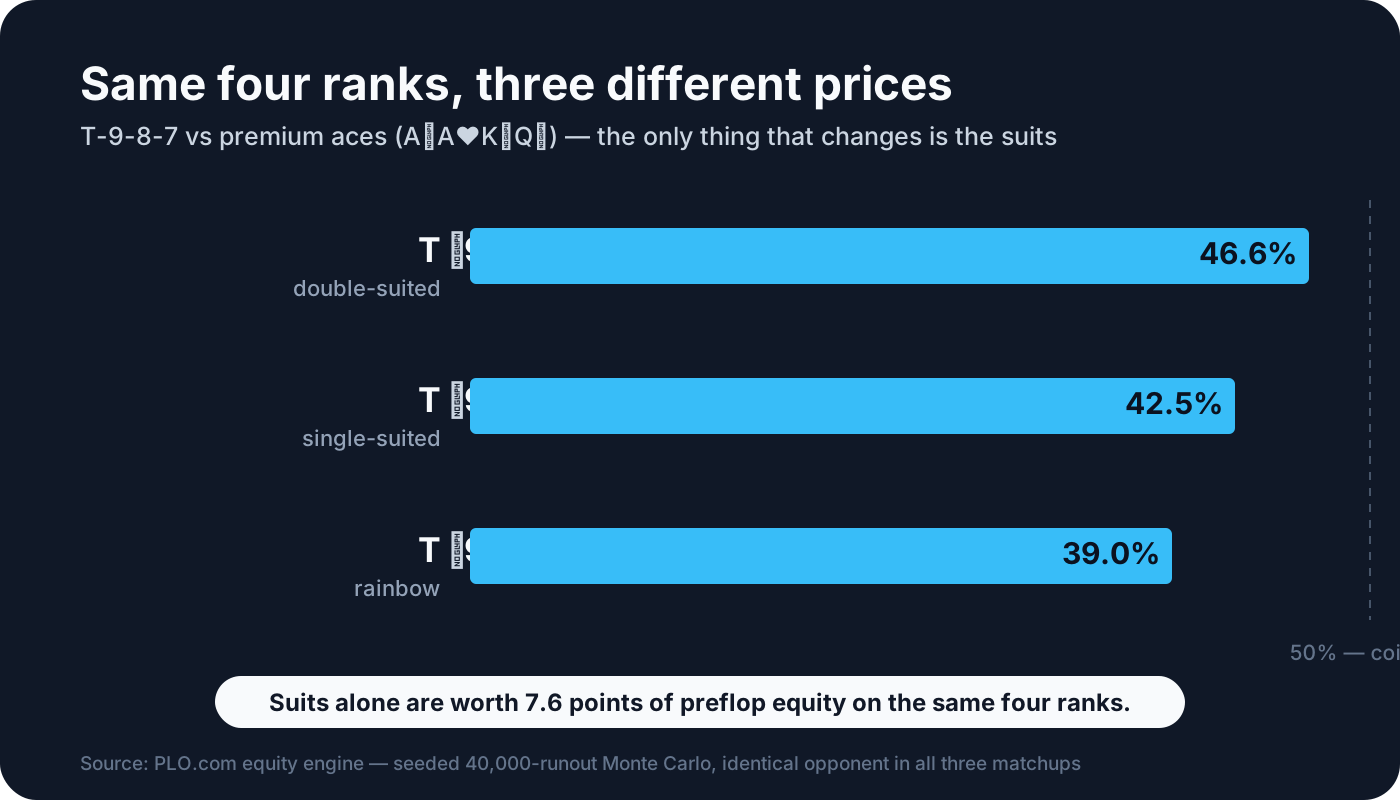
Take the four ranks T-9-8-7 and deal them three ways: double-suited, single-suited, rainbow. Run each against the same premium aces on the site's equity engine and you get 46.6%, 42.5%, and 39.0%.
The ranks never changed. The structure did, and it moved the price by 7.6 points of equity before a single flop. That is the core idea behind every good PLO starting hand: you are not holding four cards, you are holding a structure -- and structure is measurable.
The Four Questions
Every time you look down at a PLO hand, ask four questions:
- Are my cards connected? Can two of them combine with boards to make straights -- ideally many straights?
- Am I suited? Once, or twice?
- Do I make the nuts? When the hand hits, is it the best version of that hand or the second-best?
- Do all four cards cooperate? Or is one card along for the ride?
Each question has a measurable price. Here they are, one at a time.
Question 1: Connectivity Is the Engine
Connectivity decides how often your hand arrives on a flop with something worth playing. The engine's enumeration of all 17,296 flops makes the contrast stark: T♠9♠8♥7♥ flops a made straight on 4.9% of flops and a 13-card-or-bigger wrap on another 18.8% -- roughly one flop in four brings a straight or a monster draw. A disconnected hand like K♠9♥5♦3♣ flops a straight on 1.9% of flops and never flops so much as a nine-out straight draw. Not rarely -- never. There is no flop in the deck that gives it one.
And a monster wrap is not "just a draw." It can be the best hand on the flop against anything, including top set:
Every gap between your ranks thins that picture out -- the gaps and connectivity guide quantifies the penalty rung by rung, and the wraps guide covers how to play the monsters once they arrive. This is why smooth rundowns are the backbone of strong PLO ranges.
Question 2: Suits Are the Insurance
The ladder from the top of the article is the whole argument, matchup by matchup:
Suits are backup equity: flush draws that arrive on flops where the straight cards did not, redraws that let a made straight keep betting when the board pairs the flush card. Double-suited beats single-suited beats rainbow for any fixed set of ranks -- but notice the order of magnitude. Suits moved this hand 7.6 points. Connectivity is the difference between hands that flop monsters and hands that never do. Suits refine a hand; they do not redeem one.
Question 3: The Nuts Are the Product
PLO is a game where both players routinely flop strong hands at the same time -- which means the question is never "did I hit?" but "did I hit the best version?"
This is where high cards earn their premium. A♠K♠Q♥J♥ flops a made straight on just 2.5% of flops -- half the rate of T♠9♠8♥7♥ -- but every straight it flops is the nut straight at that moment, its flush draws are nut flush draws, and its pairs are top pairs. High rundowns trade frequency for nut quality, and in a game where stacks move on nut-versus-second-nut collisions, that trade is usually right. It is why the premium hand families are dominated by broadway structures.
Question 4: Four Cards, One Job
The most deceptive leak in hand selection is the dangler -- three working cards plus a passenger. The deception is that raw equity barely exposes it: J♠T♠9♥8♥ earns 46.3% against premium aces on the site's engine, and swapping the eight for a deuce (J♠T♠9♥2♥, keeping both suits) still earns 45.6%. Less than a point. Looks harmless.
The flop enumeration tells the truth. The four-card version flops a straight or a nine-out-plus draw on 26.3% of flops; the dangler version, 11.2%. The deuce did not tax the headline equity -- it taxed the flops the hand was built to play, cutting the big-draw arrivals by more than half. Equity that can only realize as one weak pair is equity you mostly never collect.
Pairs follow the same cooperation logic: aces with connected, suited side cards are a premium family, aces with two strangers are one street of excitement, and small pairs live or die entirely on their side cards. So do double-paired hands, where the ranks of both pairs decide how safely the hand plays.
The Coordination Test
Put it all together with one matchup. A♠K♠Q♥J♥: every card connected to every other, two nut suits, all-broadway nut potential. K♦8♣5♥3♠: four cards that have never been introduced.
The Price List
| Question | What it is worth, verified |
|---|---|
| Connectivity | A 20-card wrap plays a 54.4% favorite against flopped top set |
| Suitedness | Same four ranks, +7.6 equity points double-suited vs rainbow |
| Nut potential | Bottom straight vs nut straight on the same flop: 4.4% |
| Cooperation | A dangler cuts straight-or-big-draw flops from 26.3% to 11.2% |
The best hands in the game -- A♠A♥K♠Q♥ and its neighbors -- answer all four questions at once. The worst hands -- Q♦7♣4♥2♠ and friends -- answer none of them. Most dealt hands sit in between, and the skill of PLO preflop play is scoring them honestly on all four axes instead of falling in love with one.
FAQ
Is a high pair always better than a rundown?
No -- and the gap is smaller than it looks. Bare aces A♦A♣7♦2♣ vs T♠9♠8♥7♥ shows the aces ahead 56.8% to 43.2% preflop: a real favorite, not the coin flip it is sometimes called. But the rundown flops straights, wraps, and two-suit draws it can continue with, while disconnected aces usually flop one pair and a decision. The raw-equity favorite and the hand you would rather play deep-stacked are not always the same hand.
What is the single most important property of a PLO starting hand?
Connectivity. It is the property that manufactures nut hands and monster draws at the highest rate -- a smooth rundown arrives with a straight or a big wrap on roughly a quarter of flops, while a disconnected hand may never flop a big draw at all. Suits refine; connectivity powers.
How do I evaluate a hand quickly at the table?
Run the four questions as a count: how many of your four cards work with at least two others? Four working cards is a hand. Three is a hand with a tax on it. Two is a fold unless those two cards are a premium pair with a nut suit -- and even then, keep the pot small until the flop cooperates.