Two Hands Walk Into a Pot
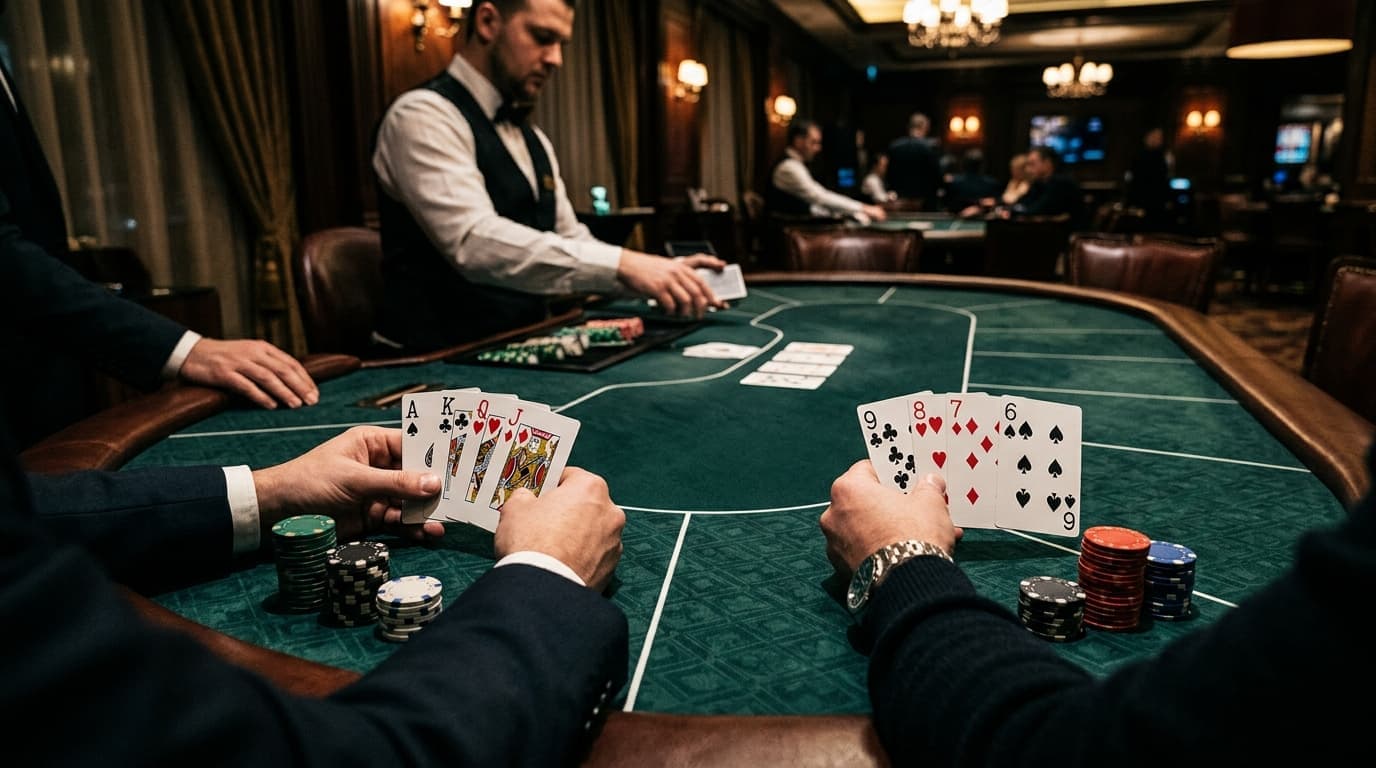
Seat 4 holds A♠K♥Q♠J♦ -- all broadways, single-suited, the kind of hand that looks like pure gold. Seat 7 holds T♠9♠8♥7♥ -- a middle rundown, no face cards, the kind of hand beginners would toss without a second thought.
Who is in better shape?
The answer depends entirely on the situation, and understanding when each hand class outperforms the other is one of the most important concepts in PLO hand selection.
The Fast Comparison
| Hand class | Best pot shape | Best flops | Main danger | Default plan |
|---|---|---|---|---|
| Nut-suited broadways | Heads-up or 3-bet pots | A-K-x, K-Q-x, Q-J-T, A-J-T | Whiffing low connected boards | Push equity on high textures, slow down on low wraps |
| Middle rundowns | Multiway or deep single-raised pots | J-9-6, T-8-5, 8-7-4 | Making non-nut straights when too low | Realize equity in position and pressure big draws |
| Hybrid high rundowns | Almost any clean pot | A-K-T, K-Q-9, T-9-8 | Overvaluing non-nut suits multiway | Build pots when suited and connected |
| Low rundowns | Rare, lineup-specific spots | 6-5-4, 7-6-3 | Bottom-end straights and weak flushes | Prefer position, deep stacks, and soft opponents |
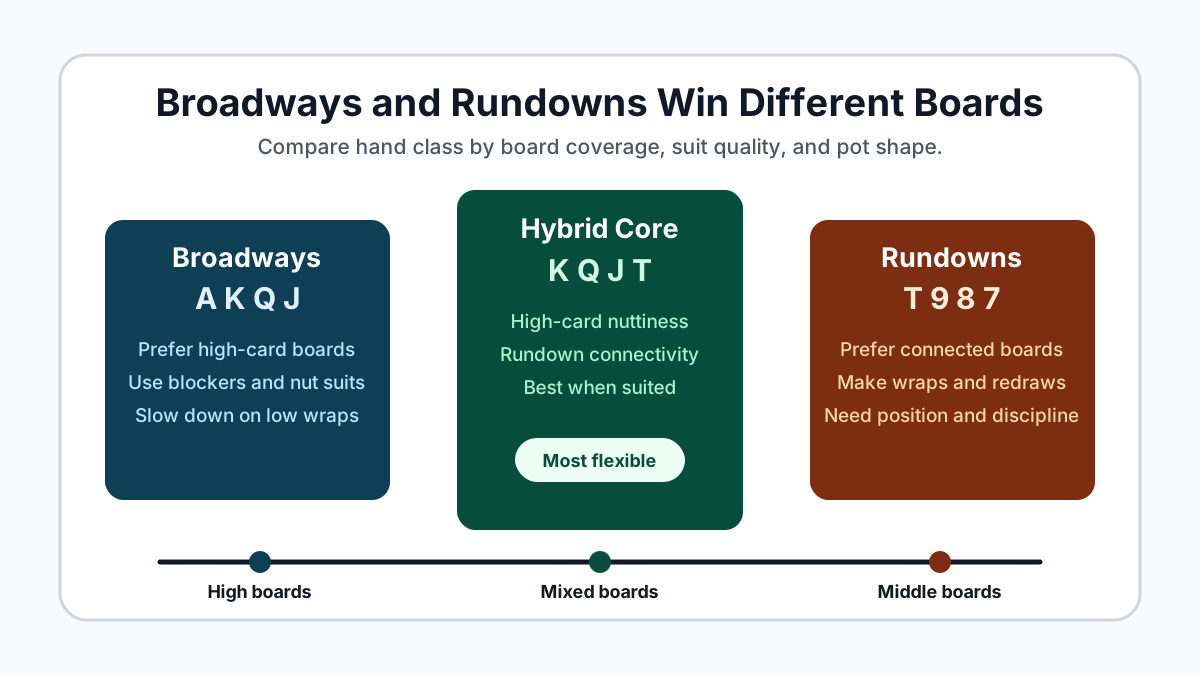
The best way to compare these hands is not rank pride. It is board coverage. Broadways win when the pot centers on high-card nuttiness. Middle rundowns win when the board becomes connected, dynamic, and hard for high-card hands to navigate.
What Broadway Hands Do Well
Broadway hands are holdings where all four cards are ten or higher: A-K-Q-J, K-Q-J-T, A-K-J-T. Their defining characteristic is nut straight potential on high boards.
When the flop comes K-Q-9 or A-J-T, broadway hands often own the board. They make the nut straight, flop top two pair, and dominate opponents who hold lower cards. On high, dry boards -- like K-Q-4 rainbow -- broadway hands can apply pressure with strong made hands, blockers, and clean straight paths. If you hold A-K-Q-J and the board is K-Q-4, you have top two pair with a gutshot to the nut straight and no flush draws threatening you.
Broadways also interact well with 3-bet pots, but not because the deck suddenly deals more high-card flops. The board distribution is the same. The difference is range interaction: 3-bet ranges contain more aces, kings, queens, and nut-suited high-card structures, so high flops are easier to pressure credibly and low connected flops are easier to abandon without guessing. More on the 3-bet dynamic in the 3-betting guide.
What Broadway Hands Do Poorly
The weakness of broadway hands is inflexibility. All four cards cluster in a narrow rank range (T through A), which means they only connect with a small portion of possible boards.
When the flop comes 7-6-4 or 8-5-3, your A-K-Q-J has completely whiffed. You have two overcards and no draws. Meanwhile, anyone holding middle or low connected cards is smashing that board with wraps, two pairs, and sets. Broadway hands turn into bluff-catchers or pure air on low, connected textures.
Even when broadway hands flop draws, those draws often become gutshots or narrow open-enders rather than wraps. The rundown's postflop power on connected boards is in a completely different league because more turn cards change the equity picture.
What Middle Rundowns Do Well
Middle rundowns -- roughly 6-7-8-9 through T-J-Q-K at the higher end, but the "middle" sweet spot is around 7-8-9-T through 9-T-J-Q -- are the most versatile hand class in PLO. They connect with the widest range of board textures.
T-9-8-7 makes straights on boards with cards from 5 through J. That is a massive portion of the deck. And when these hands connect, they tend to make wraps rather than gutshots, giving them equity dominance on flops where they have draws.
The real edge is postflop playability. A middle rundown rarely has an "I have no idea what to do" moment. On connected boards, you have a wrap or a made straight. On flush-draw boards (if you are suited), you have backup equity. Even on boards where you only catch a piece -- like flopping an open-ended draw instead of a wrap -- you still have a clear plan.
Head-to-Head: The Texture Swing
Let us put the two hand classes directly against each other:
Preflop, these two hands are close enough that the next decision matters more than the preflop equity snapshot. The broadway hand usually benefits from high-card rank and blockers. The rundown benefits from smoother board coverage and cleaner equity realization when it sees a favorable flop.
Now watch what happens on different board textures:
On a high board like K♦Q♣4♥: the broadway hand dominates with top two pair.
On a middle-connected board like J♣6♠5♦: the rundown has a massive wrap to the nuts while the broadway hand has a gutshot at best.
Board Texture Is the Deciding Factor
The right question is never "are broadways better than rundowns?" It is "what kind of boards will I see?"
In single-raised pots with multiple callers, the boards are still random, but the caller ranges interact better with middle textures. Flops like 8-7-3, T-6-5, and J-9-4 give connected hands more pair-plus-draw, wrap, and set combinations. The broadway hand whiffs on many of these.
In 3-bet pots heads-up, the flops are not more likely to be high. Instead, the ranges involved contain more high cards, which means boards like K-Q-7, A-J-5, and Q-T-3 interact more favorably with the 3-bettor. Broadways perform well when that range advantage appears.
This means your preflop line should match your hand class. Broadway hands should lean toward 3-betting when they can use blockers, high-card coverage, and nut suits in a lower-SPR pot. Rundowns should lean toward calling when position, stack depth, and field quality let them realize big draws without committing too early. The flatting vs 3-betting guide covers this dynamic in detail.
Suitedness Changes the Winner
Do not compare rank structure while ignoring suits.
A♠K♠Q♥J♦ is very different from A♣K♦Q♥J♠ rainbow. The suited version can continue on spade boards, turn nut-flush pressure into fold equity, and stack dominated flush draws. The rainbow version relies much more heavily on pairing high cards or making straights.
The same is true for rundowns. T♠9♠8♥7♥ is a premium candidate because it brings two suits and connected ranks. T♠9♦8♥7♣ still has connectivity, but it loses the backup equity that lets the hand keep applying pressure on two-tone boards.
When the comparison is close, ask these three questions:
- Which hand makes more nut straights?
- Which hand has the better suit quality?
- Which hand will realize equity better from this position?
If one hand wins all three, the decision is usually clear. If the answer is split, position and pot shape decide.
The Hybrid Hands
The strongest non-aces hands in PLO are the ones that combine broadway ranks with rundown connectivity. K♠Q♠J♥T♥ is the poster child -- it has broadway nuttiness (makes the nut straight with an ace on board) plus rundown connectivity (makes straights with 8-9, 9-A, A-9, etc.).
Q♠J♠T♥9♥ is similarly elite. It bridges the broadway and rundown worlds, making nut straights on high boards and wraps on middle boards. These hybrid hands avoid the main weakness of both categories: they are not inflexible like pure broadways, and they are not playing for non-nut straights like low rundowns.
Common Misclassification Traps
Some hands look like one class but play like another.
| Hand | Looks like | Actually plays like | Why it matters |
|---|---|---|---|
| A♠K♥Q♦7♣ | Broadway | Three-card hand plus dangler | The seven rarely helps your high-card plan |
| K♠Q♠T♥6♥ | Double-suited broadway | Split structure | The suits help, but the six creates awkward turns |
| J♠T♥9♣5♦ | Rundown | Three-card connector plus dead side card | The five misses too many high wraps |
| 8♠7♠6♥5♥ | Smooth rundown | Strong but lower-nut hand | Great in position, dangerous deep when straights are dominated |
This is where many preflop mistakes start. Players name the hand class, then stop thinking. In PLO, the fourth card and suit quality often decide whether the label is profitable.
Building a Balanced Range
Strong PLO players do not pick one camp. A balanced late-position range includes top-tier broadways (A-K-Q-J, K-Q-J-T), premium rundowns (T-9-8-7, J-T-9-8), strong pairs with connectivity (A-A-K-Q, K-K-Q-J), and a mix of suited speculative hands.
The mistake is overloading on one type. All broadways means you are predictable on high boards and hopeless on low ones. All rundowns means you miss the big pots that broadways win on high boards. Check the best starting hands overview for a complete ranking.
FAQ
Which hand class is more profitable overall? There is no universal winner. Middle rundowns can be especially profitable when the player pool undervalues them and overplays high-card hands, but they still need position, suits, and discipline around non-nut straights. The best hand in any specific spot depends on board texture, position, stack depth, and opponent tendencies.
Should I fold all low rundowns like 5-4-3-2? Yes, in almost all situations. The problem with very low rundowns is not connectivity -- 5-4-3-2 is perfectly smooth -- but nut potential. Every straight you make can be beaten by a higher straight. On a board of 6-7-8, your 5-4 makes the bottom end while someone with 9-T has the nuts. You are paying off better hands constantly.
Do broadways play better short-stacked? Yes. With fewer big blinds behind, the equity realization advantage of rundowns (which need multiple streets to realize their draws) decreases. Broadway hands that can flop top pair or top two pair in a low-SPR pot do not need to draw out -- they just need their made hand to hold up. The SPR guide explains this dynamic further, and the short stacked live PLO guide shows how to apply it against common live player types.
Is K-Q-J-T a broadway hand or a rundown? Both. K-Q-J-T is a hybrid: it has broadway rank strength and rundown connectivity. That is why double-suited K-Q-J-T is so valuable. It can make high nut straights, apply pressure on broadway boards, and still connect with middle textures in a way pure A-K-Q-J cannot.