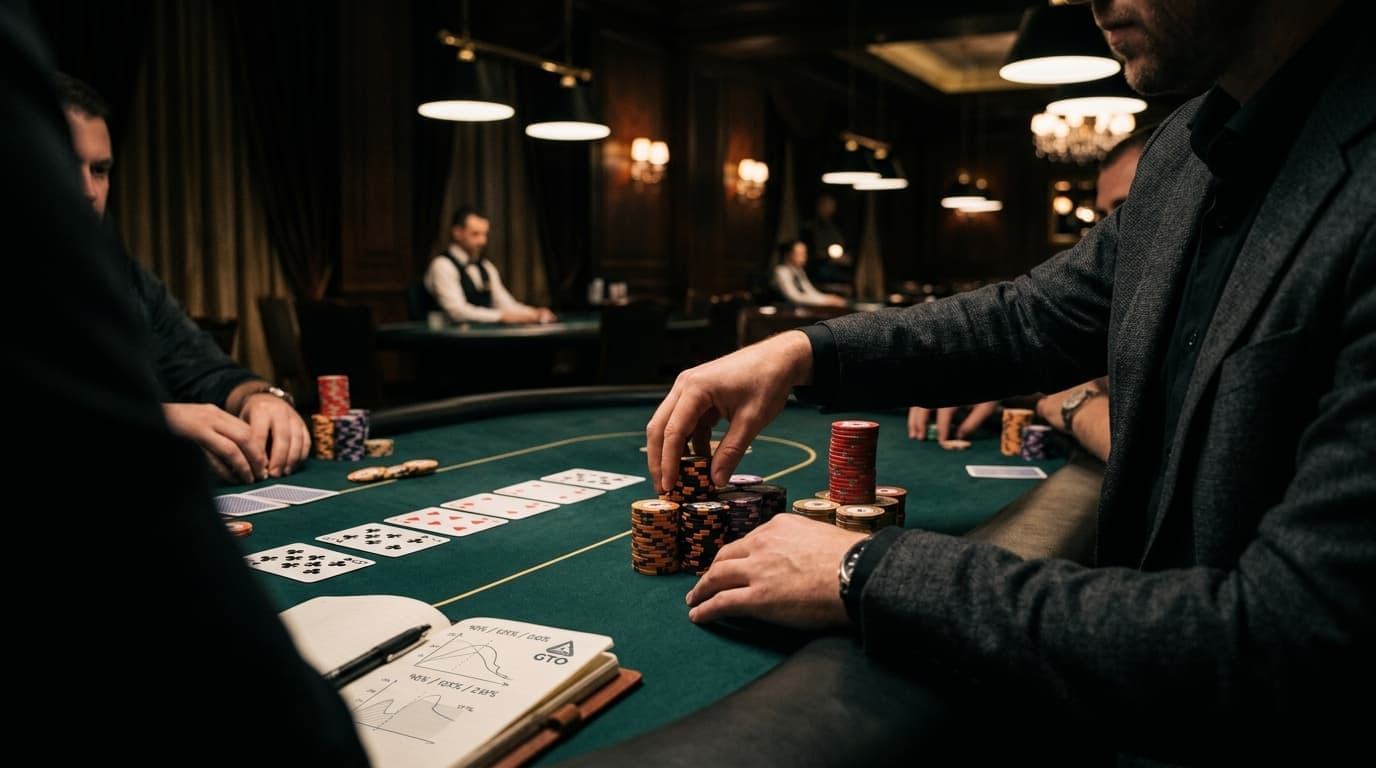
The Counterintuitive Truth: Strong Hands Do Not Always Want A Flop Bet
You're holding A♠K♠Q♥J♥ on the button. UTG opens, two callers, and you 3-bet. Everyone calls. The flop comes T♦9♦2♣. You have a strong double-gutter to the nuts, two overcards to the top pair region, and only a backdoor spade draw. Your first instinct might be to fire a large continuation bet because your hand looks "too strong to check."
They're wrong.
In practice, many strong players and solver users end up checking back more often in multiway spots than older "bet your equity" instincts would suggest. This is not passive play. It is often a way to protect your checking range, avoid bloating the pot against condensed continuing ranges, and preserve stronger turn decisions.
The Solver's Silence on the Flop: Setting the Trap
Why would you check back a hand with A♠K♠Q♥J♥ on a T♦9♦2♣ flop? Because multiway flop betting gets called by ranges that are stronger and more coordinated than they would be heads-up. If you bet large, you often fold out the weakest hands and isolate yourself against pairs, draws, and made hands that continue comfortably. By checking, you keep the pot manageable and arrive on the turn with more flexibility.
The underlying lesson is broader than any one exact solver frequency: not every strong equity hand is an automatic flop bet, and not every check is weakness. In PLO, especially multiway, delayed aggression is often cleaner than immediate aggression.
The Delayed Barrage: When to Fire the Turn C-Bet
The beauty of the delayed c-bet lies in its ability to punish opponents who've taken a passive line on the flop. After checking back a strong hand, the turn card can dramatically shift equities and open up new betting opportunities.
Consider our A♠K♠Q♥J♥ example on T♦9♦2♣. You check the flop. The turn is the K♣. Now you have top pair on top of your straight equity, and many medium-strength hands still hate facing pressure. This is the kind of card that can make a delayed c-bet more attractive because your hand improved while many bluff-catchers did not.
A delayed c-bet on the turn is often larger than a standard small flop c-bet because ranges are more defined by then. It works best when the turn either improves your hand materially, improves your perceived range, or creates a runout where your opponent's medium-strength continues are under real pressure.
Unleashing the River Overbet: Exploiting Inelastic Ranges
The ultimate manifestation of polarized aggression is the river overbet. After a delayed c-bet on the turn, you've often narrowed your opponent's range to hands that either called with strong draws, made strong hands, or are sticky with medium-strength made hands. When the river comes and you've completed a very strong hand, or you hold the right blockers, an overbet can be highly effective.
Imagine you're holding A♠Q♠J♥T♥. You raised preflop, checked a K♠T♦6♦ flop, then bet the 2♣ turn after the flop checked through. The river is the 5♠, giving you the nut flush. This is the kind of runout where an overbet can make sense if your opponent arrives with many second-best flushes, sets, or stubborn two-pair hands that hate folding but do not want to raise.
This sizing works when your opponent's river continuing range is relatively inelastic: the hands that call a pot-sized bet often still call something larger. The point is not that 1.5x pot is always correct. The point is that river size should be driven by range interaction, not by habit.
Integrating Overbets & Delayed C-Bets into Your PLO Game
Mastering these advanced bet sizing strategies requires practice and a fundamental understanding of range construction. Start by analyzing common multiway scenarios and identifying flops where checking back strong-but-non-nutted hands makes sense.
Next, practice identifying turn cards that improve your range significantly or create scare elements for your opponent. These are the spots for your delayed c-bet. Finally, on the river, look for opportunities to overbet when you have the nuts or a strong blocker bluff against a capped calling range. This isn't just about random aggression; it's about making calculated plays based on range advantage and pot geometry. For more on core aggression, check out our guide on continuation betting in PLO.
Common Pitfalls: Where Instinct Fails
Applying these strategies blindly will burn your bankroll. The biggest mistake players make is misjudging opponent tendencies. Overbetting a river against a player who simply doesn't call down without the nuts is burning money. Conversely, failing to overbet against someone who calls too wide is leaving massive value on the table.
Another pitfall is over-bluffing with delayed c-bets or overbets. While these strategies allow for more bluffing, your bluffs must be carefully chosen, typically with strong blockers or hands that have some equity if called. Without a solid understanding of why solvers choose these lines, you'll find yourself spewing chips rather than accumulating them. These are advanced concepts; don't jump into them without first understanding the underlying GTO principles.
Adjust your default flop c-bet frequency downward in multiway pots, look for turns that materially improve your leverage, and overbet rivers selectively when you have a strong value advantage or the right blocker structure.
Related Study
This topic connects directly to multi-street bet sizing, defending against overbets, bluffing with blockers, and playing the turn. Study those together so delayed c-bets do not become isolated tricks.
FAQ
Why do solvers check back strong hands on the flop in PLO? Solvers check back strong hands on the flop in PLO to maintain a balanced range, disguise hand strength, and keep weaker hands in the pot. This sets up larger, more profitable bets on later streets by allowing opponents to catch up with marginal holdings and ensuring your range remains uncapped for future aggression.
When should I consider a delayed c-bet on the turn? Consider a delayed c-bet on the turn after checking the flop, especially when the turn card significantly improves your hand (e.g., completing a draw) or is a scare card for your opponent's perceived range. This is most effective when you have range advantage and your opponent's flop check suggests a weaker, capped range.
What types of hands are best for river overbets? River overbets are best with the absolute nuts or with strong blocker bluffs. With the nuts, you're exploiting an opponent's inelastic calling range. With bluffs, you need strong blockers to reduce the probability of your opponent having a calling hand, making your bluff more effective.
How often should I be using overbets in my PLO game? The frequency of overbets depends heavily on your opponent's tendencies and the specific board runout. Against tighter, GTO-aware opponents, overbets will be less frequent and more balanced. Against loose, calling stations, you should overbet your value hands much more often to maximize extraction, while rarely bluffing.