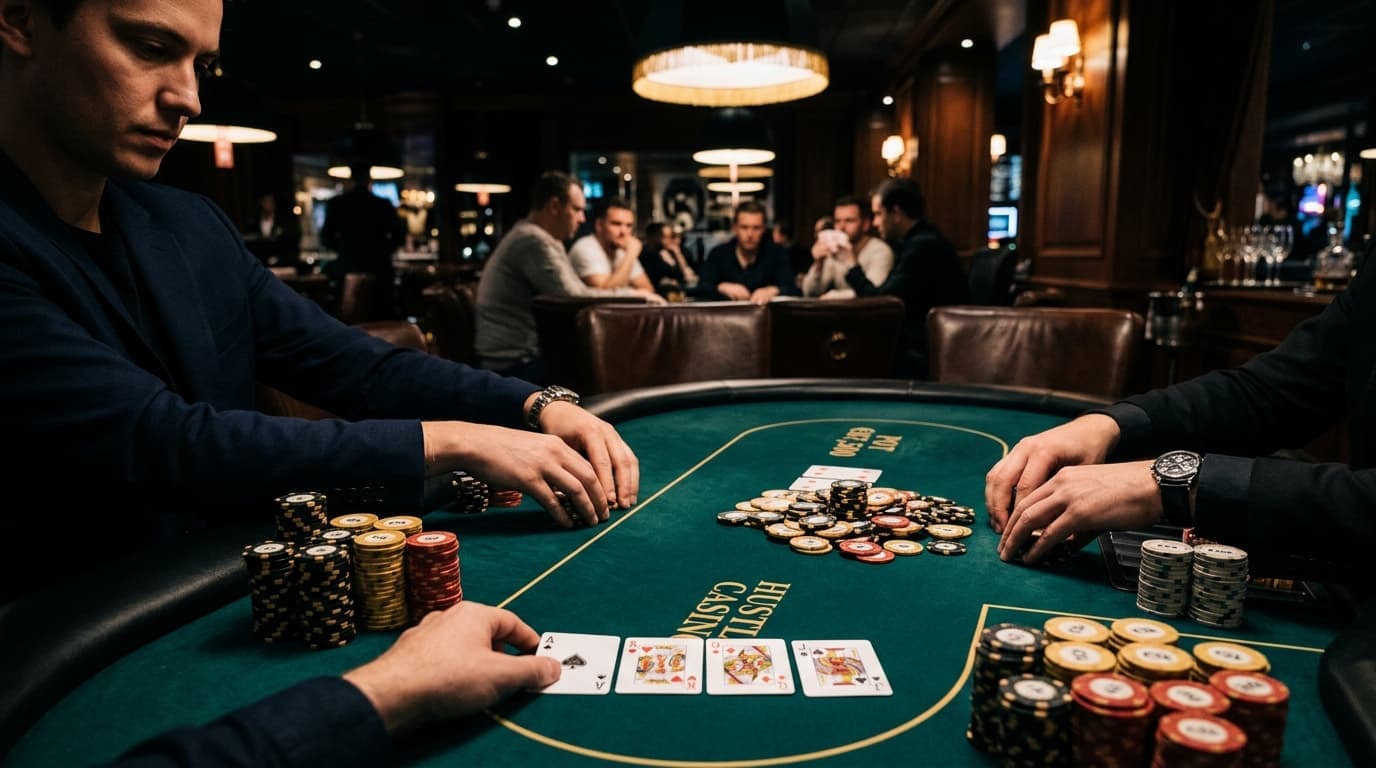
You're sitting at a $5/$10 PLO game online. You're 300 big blinds deep, about $3000, and the action is hot. The player in the cutoff, a regular you recognize from high-stakes streams, opens for $35. The button calls, and you call from the big blind with A♠K♠Q♥J♥. Four players see a flop of T♠9♠2♦. The pot is $140. You check, the cutoff c-bets $100, the button folds. Now the cutoff makes a huge raise that effectively puts you all-in. You have a nut flush draw, a gutshot to the straight, and two overcards. It feels like a monster hand, but can you really put your stack in here against a player who clearly knows what they're doing?
This spot shows up often enough in tough games that you need a real response to it. Overbets and multi-street pressure are now part of serious PLO strategy, especially in aggressive environments. If you're not equipped to defend against these plays, your stack will quickly dwindle. The problem isn't just knowing what to do, but understanding why these lines exist and how to adapt your entire postflop framework.
Why These Lines Exist
Overbets, once treated mostly as live tells or one-off exploits, now appear in serious strategic discussion much more often. They compress ranges, force tough decisions, and can maximize value or fold equity when used in the right structures.
A polarized overbet range usually contains very strong value hands and a thinner bluff region built from hands with useful blockers or decent equity. The goal is to put maximum pressure on the opponent, denying equity realization to draws and getting maximum value from strong holdings. Many players react to these large bets by folding too often, assuming their opponent always has the nuts. That is a critical mistake. If you fold too much, you become an ATM for anyone willing to pull the lever.
Decoding Flop Overbets: Equity and Blockers
When facing a massive overbet on the flop, your first instinct might be to panic. Don't. Instead, break down the situation. What is your opponent's perceived range? What is your actual equity against that range? And most critically, what blockers do you hold?
Let's revisit the scenario: T♠9♠2♦ board, pot $140, cutoff makes a massive flop raise after c-betting into the field. The exact pot odds depend on the sizing, but the core question is the same: how much raw equity does A♠K♠Q♥J♥ have against a polarized range of value hands and strong draws? Quite a lot. You have the nut flush draw, a gutshot, and two overcards. This is not a trivial "draw and hope" hand. It is a hand with real showdown potential against a range that should contain both value and bluffs. Calculate a sample matchup.
Most players fold here too quickly because they think they need a made hand. That is a mistake against opponents who are capable of bluffing or semi-bluffing aggressively. Your A♠ is a huge card because it blocks the nut flush draw, and the K♠ removes more strong spade combinations from villain's range.
Consider another example: You hold 8♥7♥6♦5♦ on a K♠Q♠J♥ flop. UTG+1 opens, you call from the button, and the flop comes. UTG+1 then overbets 2x pot. You have a monster wrap, but no flush draw. Your hand has significant equity against many hands, but against a true nutted holding like A♠A♥K♣K♦, you're a clear underdog. However, the overbet can also come from blocker-heavy bluffs or semi-bluffs. Your raw equity against their entire range is what matters, not just how your hand fares against the nuts.
Navigating Turn and River Multi-Street Pressure
The aggression doesn't stop on the flop. Modern PLO features multi-street pressure, where players fire large bets on the turn and river, often with polarized ranges similar to the flop. Your stack-to-pot ratio (SPR) plays a critical role here. If you called a flop overbet and the SPR is now very low (e.g., 1 or 2), you're often committed to seeing all five cards with any reasonable draw or pair.
Imagine you called a huge flop raise in our initial A♠K♠Q♥J♥ hand on T♠9♠2♦. The turn is the 5♣ and your opponent continues jamming pressure. Your hand is still a nut flush draw, a gutshot, and two overcards. Once the stacks are compressed like this, defense becomes much more about raw equity and blockers than about pretty-looking made hands. If the turn was a blank, your opponent is still representing a polarized range, and you need to decide whether your equity and blockers are enough to continue.
The key to defending against multi-street aggression is to understand that your opponent's range remains polarized. They are betting big with their strongest hands and their best bluffs. Your job is to identify if your hand has enough equity and realization potential to continue. This often means holding blockers to their value range, or having strong redraws that improve your chances on later streets.
Blockers and Counter-Intuitive Calls
Blockers are your shield against modern PLO aggression. They are the single most important factor, outside of raw equity, for making tough calls against overbets. When you hold cards that block the nuts (or strong draws) your opponent might be holding, you reduce the combinations of value hands they can have, increasing the likelihood they are bluffing.
Suppose you hold A♥K♥7♠6♠ on a K♣T♦2♠ flop. Your opponent overbets the pot. You have top pair, but it's a vulnerable hand. Now, if you hold A♣K♣7♠6♠, your A♣K♣ are strong blockers. The A♣ blocks sets of aces, and the K♣ blocks sets of kings. This reduces the number of premium two-pair and set combinations your opponent can have. Similarly, if the board was A♠Q♦J♥ and you held K♠T♠9♣8♣, your K♠ and T♠ block nut straights and flush draws, making it less likely your opponent has those monster holdings.
This is where the contrarian take comes in: many players will tell you to fold marginal top pair against overbets. But with strong blockers, these hands can become calls or even raises. The modern PLO player must be willing to call down with hands that feel marginal if they have strong equity denial. This is a significant adjustment from traditional PLO advice. You are not just calling to hit, you are calling to deny your opponent their fold equity and to realize your own equity against a wider, more bluff-heavy range.
Exploitative Counter-Strategies
While balanced defense matters, you're usually playing against humans, not a machine. This means you can exploit their tendencies. Some aggressive players overbet too often with bluffs, hoping to fold out your entire range. Others only overbet with the nuts, using it as a slow-play or to trick you into calling.
Observe your opponent:
- The Over-Bluffer: If a player consistently overbets and shows up with air, you need to expand your calling range significantly, especially with hands that have good equity and blockers. You might even consider raising more often on the turn or river to put pressure back on them.
- The Nut-Peddler: If a player only overbets with the absolute nuts, you need to fold almost everything except your own absolute nuts. There's no shame in folding if your read is strong. This type of player is rare in high-stakes modern PLO, but still exists in lower stakes.
- The Balanced Aggressor: This is the toughest opponent. They are balancing value and bluffs well enough that you need to stay disciplined and focus on equity, blockers, and SPR.
Remember that understanding opponent tendencies is a skill that takes time to develop. Use tracking software if playing online, or pay close attention to showdowns in live games. This data can inform your exploitative adjustments, letting you deviate from pure GTO in profitable ways. For more on adjusting to different player types, check out our guide on multiway pots in PLO.
Refining Your Defense with Study
To truly master defense against this kind of aggression, it helps to study structured postflop trees instead of relying on instinct alone. Solver work can be useful here, but the point is not brand names or memorizing exact frequencies.
Load up common scenarios where you face overbets on the flop, turn, or river. Study which hand classes call, raise, and fold. You will often find that strong blockers and meaningful redraws matter much more than a hand merely looking pretty at showdown. Pay attention to how the defense changes with different board textures and SPRs.
This isn't about memorizing every output. It's about developing an intuition for why certain hands are defended and others are not. It's about internalizing the principles of polarization, equity denial, and blocker effects so you can apply them in real time at the table.
Next time you face a huge overbet, don't just fold out of fear. Stop, analyze your hand, consider your blockers, and estimate your equity against a polarized range. Ask yourself if your opponent must have the nuts. More often than not, they don't, and you're leaving money on the table by not fighting back.
Related Study
The best supporting articles are multi-street bet sizing, solver-approved overbets and delayed c-bets, blockers in PLO, and river strategy.
FAQ
What is an overbet in PLO? An overbet in PLO is a bet size larger than the current pot. For example, if the pot is $100 and a player bets $150 or more, that's an overbet. These bets are used to polarize ranges, putting maximum pressure on opponents for both value and bluffing.
Why are overbets so common in modern PLO? Because polarized big-bet lines are useful on some board structures, and more players now study those spots seriously. They are not mandatory, but they are a normal part of modern PLO discussion.
How do blockers help defend against overbets? Blockers reduce the number of strong value hands your opponent can hold, making it more likely they are bluffing. For example, if you hold A♠ on a board where a flush is possible, you block many of your opponent's nut flush combinations, which are often part of their overbetting value range. This shifts the odds in your favor for calling.
When should I consider raising an opponent's overbet? Raising an opponent's overbet is a highly exploitative play. You should consider it when you have a very strong hand (the nuts or close to it) and believe your opponent is over-bluffing, or when you have a strong blocker-heavy draw that can deny equity and put them in a tough spot. Raising effectively turns the tables and puts the pressure back on the aggressor.