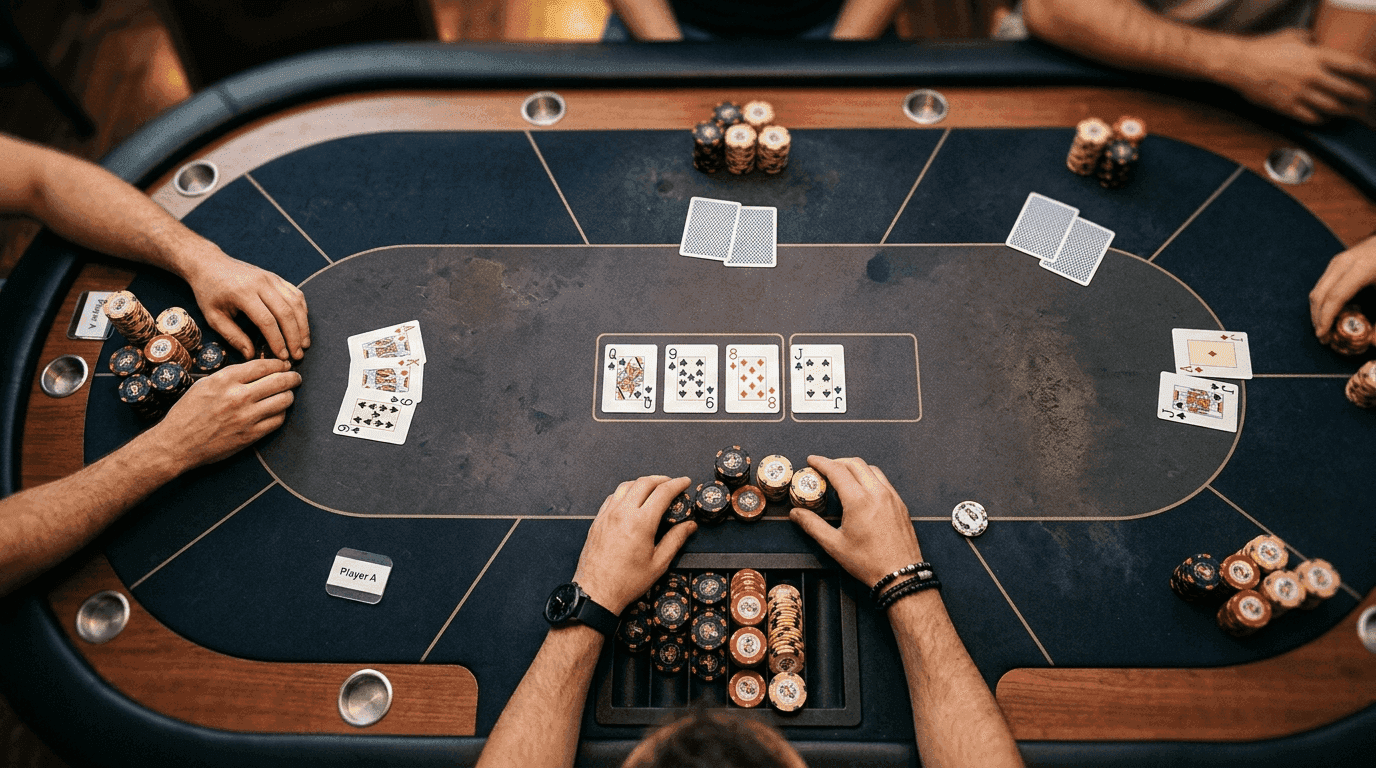
You flop bottom two pair and a weak gutshot in a 3-bet pot. The preflop raiser checks back. Every instinct screams to check again, but the turn changes the geometry of the hand and now leading makes more sense than waiting. That is the version of donk betting in PLO most players miss: not random aggression, but a disciplined way to attack capped ranges when the board starts favoring the caller.
The biggest mistake in small and mid-stakes games is treating every missed c-bet as either automatic surrender or automatic permission to blast. Both approaches are lazy. Good donk betting PLO starts with a narrower question: when does the caller's range improve enough that checking becomes too passive? These five scenarios focus on that problem, especially the delayed turn lead after flop checks through.
A donk bet in PLO is an out-of-position lead into the preflop raiser on a postflop street. In practice, the most useful version to study is the delayed turn lead after the aggressor checks back the flop, because that is where range shifts are easiest to see and where small-stakes players make the biggest mistakes.
Why Donk Bets Exist in PLO: The OOP Range Problem
Donk betting is simple in definition and tricky in execution. You are out of position, the preflop aggressor has position, and instead of checking again you lead. In PLO, the spot that matters most is often: defend from the blinds, check the flop, watch the raiser check back, then decide whether the turn now belongs to your range more than theirs.
Why would you do this? Because many PLO flops and turns interact far better with the caller's connected holdings than with the raiser's high-card-heavy range. Low and middling boards create more two-pair, set, straight, and redraw density for the blinds than broadway-heavy boards do. When the aggressor checks back, their range is also less protected than it was preflop, which makes a well-timed lead more attractive.
Donk betting exists because the balance of power shifts. If you only check and call, you miss value and let equity realize too cheaply. If you only check-raise, you force your range into an unnecessarily narrow shape. The lead is the clean middle option: bet when the runout improves your nut density, your medium-strength value wants protection, or your best bluffs have real blockers and backup equity.
1. Low and Middling Connected Flops: The True Caller Boards
You’re in the big blind with 9♠8♠7♥6♦. CO opens, you call. The flop falls 7♣6♣4♦. You check, CO checks back. The turn is the 5♠. Now what?
Most players misplay this spot by treating the turn lead as either mandatory or spewy. It is neither. This is the classic caller board: the raiser starts with more big pairs and high cards, while the blind defender shows up with far more connected hands, pair-plus-draw holdings, and low two-pair combinations.
The turn 5♠ is exactly the kind of runout that should wake up your leading range. You improve to a straight, keep redraws to stronger made hands, and represent many natural blind-defense holdings at the same time. This is a spot where a substantial lead makes sense because worse made hands can continue, overpairs hate life, and the raiser cannot comfortably attack every river. If you want a concrete hand-vs-hand look, the equity calculator shows 9♠8♠7♥6♦ doing very well against A♠A♣K♣Q♦ on this runout.
By contrast, boards like A♠K♦Q♣ usually remain better for the preflop raiser. They arrive with more top-set, overpair-plus-draw, and nut-broadway coverage, while the caller has fewer hands that want to lead for clear value. That difference matters: you do not donk because the aggressor checked once. You donk because the board class and the runout have actually moved toward you.
2. Turn Texture Shifts: When the Board Runs Out for the Caller
You call a button open from the small blind with J♦T♦9♠8♠. Flop is 6♣7♠K♥. You check, BTN checks back. Turn is 5♦.
The turn 5♦ changes the hand more for the caller than for the button. Blind-defend ranges contain many more 8-x, 9-x, and connected diamond combos that pick up straights, pair-plus-draws, and powerful semi-bluffs here. After checking back the flop, the button is not capped in an absolute sense, but their range is usually less concentrated around strong made hands than it would be after betting.
This is not just a protection bet. It is a value lead with the kinds of hands that are ahead of much of the button's check-back range but still dislike a free river. Think straights, strong two pair with redraws, and some pair-plus-draw hands that gain a lot from folds while still being comfortable when called.
What most players get wrong is defaulting to one line with every strong hand. Check-calling leaves money behind with your clearer value. Check-raising can over-isolate against a range that is already weaker after the flop checks through. The turn lead works because it keeps in worse continues while still charging the button for all the equity they would love to realize for free.
3. Value Leads vs. Protection Leads: Spotting the Difference
You defend the big blind with 8♣7♣6♠5♠. UTG opens, you call. Flop is 9♣6♦2♠. You check, UTG checks back. Turn is 7♦.
This is a classic spot where most players confuse value and protection. Your hand — 8♣7♣6♠5♠ — now has two pair and a gutshot, but it’s not the nuts. Should you lead?
The answer depends on the hand class. Value leads are for hands that beat most of your opponent’s range and want to get called. Protection leads are for hands that are ahead now but vulnerable to being outdrawn — like weak two pair, bottom set, or strong top pair with redraws.
In this spot, the hand class matters more than the headline strength. Strong two pair with redraws can lead for value and protection. Straights clearly want money in. Medium-strength bluff catchers, even when technically ahead right now, often prefer to check because they struggle when raised and do not get called by enough worse hands.
Here is where most players go wrong: they use the donk bet as a blanket protection move and start leading every pair-plus-something hand they arrive with. That turns the line into a confession. Good value leads can still get called by worse. Good protection leads still have equity when called. Weak one-pair hands with no real backup usually belong in the checking range.
4. Structuring Bluff Leads: How Not to Punt
You defend your big blind with Q♠T♠9♥8♣. BTN opens, you call. Flop is 9♣6♦3♠. You check, BTN checks back. Turn is 5♦.
You have top pair and a weak kicker. Is this a bluff lead? Not quite. The best bluff leads in PLO come from hands with equity and blockers — the ability to improve to the nuts or block your opponent from having the nuts.
For example, leading the turn with A♠8♣7♠4♥ on a 9♣6♦3♠5♦ board makes more sense than blasting with Q♣T♥9♥8♣. The first hand has a live straight draw, a nut-flush blocker, and future cards that let you continue barreling. The second mostly turns a marginal made hand into a low-quality bluff. Bluff leads should come from hands that can improve or block strong continues, not from pure frustration after a check-back.
The common leak is simple: players see a missed c-bet and assume the pot is ownerless. It is not. Your bluff leads should be the minority of your leading range, and they should be built from combo draws, nut blockers, and hands that can keep applying pressure on good rivers. If your turn lead range is full of weak pairs and dead-end blockers, you are not "applying pressure"; you are donating.
5. Donk-Bet Mistakes at Small and Mid Stakes
Walk into any $1/$2 or $2/$5 PLO game and you’ll see two mistakes on repeat: (1) never donk betting, and (2) donk betting every time the preflop raiser checks back. Both are losing plays.
The first group — the “never donk” crowd — misses huge value on boards where their range is way ahead. They allow the aggressor to realize equity for free and lose out on protection and thin value. These players often get run over by competent opponents who recognize passive lines and exploit them.
The second group, the "always donk" crew, turns every missed c-bet into a bluff. They lead with weak pairs, bad two pair, or disconnected blockers and get punished by anyone patient enough to continue correctly. This leak gets worse in multiway pots, where the original raiser keeps stronger ranges and the field realizes equity more aggressively.
The fix is to build your donk bets around three filters: board ownership, hand class, and river plan. Does the runout favor the caller? Is your hand strong enough to value bet or good enough to semi-bluff? And if called, do you know which rivers you keep betting and which rivers you shut down on? If you cannot answer those three questions, checking is usually better.
A good donk bet in PLO is never random. It is a targeted lead on boards and runouts where the caller gains enough nut density, protection need, or blocker value to stop checking automatically. Most players leak by never leading or by leading without a river plan. The better regulars do neither. They know which textures belong to them, which hands deserve value, and which bluffs can survive real resistance. Want to see how board ownership really works? Check out our guide to position in PLO or compare with continuation betting in PLO for deeper breakdowns. For more on hand classes, see rundowns in PLO.
FAQ
What is a donk bet in PLO?
A donk bet is an out-of-position lead into the preflop aggressor on a postflop street. In practice, many of the clearest PLO examples happen on the turn after the raiser checks back the flop, because the runout can start favoring the caller much more clearly.
Which board textures are best for donk betting in PLO?
Low and middling connected boards like 7-6-4 or 8-5-4 favor the caller’s range and are prime spots for donk betting. Broadway-high boards (A-K-Q) usually favor the preflop raiser, so donk betting is less effective there unless the turn shifts equity dramatically.
How do I avoid over-bluffing when donk betting?
Build bluff leads from hands with equity and blockers, such as combo draws, nut-flush blockers, or straight blockers that still have good turn-to-river playability. Avoid turning pure air or weak one-pair hands into bluffs just because villain checked back once.
Should I ever donk bet the flop, or just the turn?
Flop donk bets are rare in PLO and usually only make sense on extremely dynamic, caller-favored boards in multiway pots. Most effective donk bets occur on the turn after the preflop raiser checks back the flop, when the board runout heavily favors the caller’s range.
For more on equity breakdowns, try the PLO equity calculator. For related reading, see Continuation Betting in PLO.