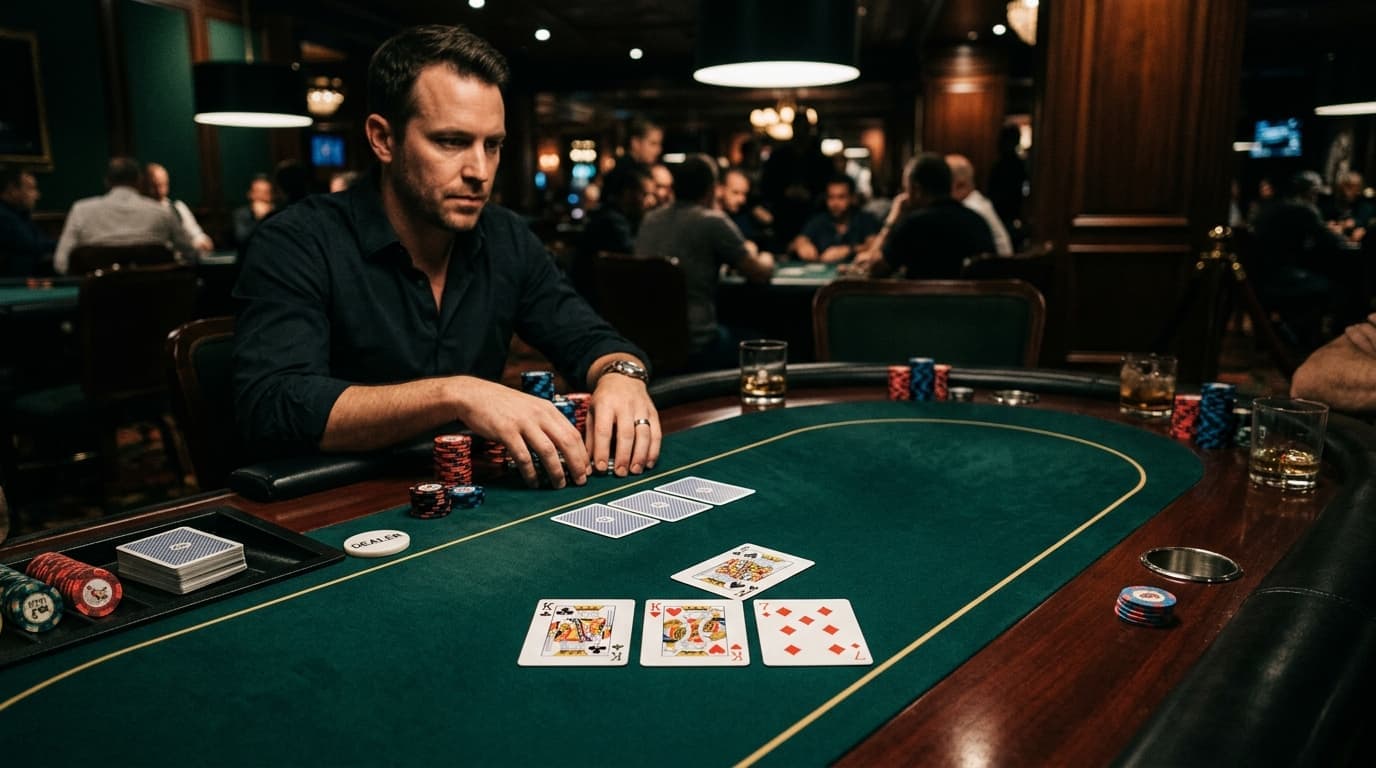
Not All Flops Are Created Equal — and That's Your Advantage
You open A♠K♠J♥T♥ from the cutoff. Two callers see the flop. Before the dealer spreads the cards, you should already know which boards let you fire a continuation bet with confidence and which ones should make you pump the brakes. The difference between A♦7♣2♠ and 8♠7♦6♣ is the difference between betting with a real structural edge and betting into trouble.
Understanding which flops favor the preflop raiser lets you build an automatic postflop gameplan. See a good texture, bet. See a bad one, check. This clarity eliminates most of the costly guesswork.
Why Certain Flops Favor the Raiser
The preflop raiser's range is tighter and skewed toward high cards, big pairs, and premium starting hands. The caller's range is wider and includes more mid-range connectivity — rundowns like 8♠7♥6♦5♣, suited connectors, and small pairs.
A flop "favors the raiser" when:
- The raiser's range connects more often (high cards hit high boards)
- The caller's range whiffs (dry boards miss connectors)
- The nut hands belong to the raiser (top set, nut flush draws)
Flop Type 1: Dry Ace-High (A-7-2 Rainbow)
The single best flop texture for the preflop raiser. Here's why:
You raise with a range full of suited aces, broadway hands, and big pairs. The caller cold-called your open — meaning they often passed on 3-betting their strongest aces. Their range is weighted toward connected hands that often miss A♦7♣2♠ much harder than yours does.
On this texture, a very wide small c-bet strategy is often attractive. The caller has to fold a large amount of air and weak backdoor-heavy holdings, and when they do continue, your strong hands are usually in excellent shape.
Your A♠K♠J♥T♥ on A♦7♣2♠: Top pair, nut kicker, backdoor nut flush draw. Bet small and build the pot.
Even A♠K♣Q♦3♥ on A♦7♣2♠: Top pair, weak side cards. Still a clear c-bet because the board is so favorable.
Flop Type 2: Paired Boards (K-K-4, Q-Q-5)
Paired boards are a goldmine for the raiser, and most players don't realize why.
The caller's range rarely contains the paired card. If the board is K♠K♦4♣, the caller would need to have called preflop with Kx — and there are only two kings left. Meanwhile, the raiser might have KK (quads), AK (trips), or a pocket pair above fours. The raiser has a massive nut advantage.
On K♠K♦4♣, a very small range bet is often attractive. You're representing trips or an overpair, and the caller has relatively few strong continues beyond rare Kx and some pocket pairs.
What makes paired boards tricky: If the paired card is low — like 4♠4♦9♣ — the raiser's advantage shrinks. The caller is more likely to hold a 4 (small cards are in their defending range), and the nine in the middle helps connected hands. High paired boards > low paired boards for the raiser.
Flop Type 3: Dry Broadway (K-Q-3 Rainbow)
Boards like K♦Q♠3♥ or A♣J♦2♠ strongly favor the raiser because opening ranges are loaded with broadways. You'll have KQ, KJ, AK, AJ, and big pairs at a high frequency.
The caller does have some KQ and KJ combinations, but far fewer than you. And their low cards — the 6s, 5s, 4s that come with their rundowns — get no help from a K-Q-3 board.
The nuance: Broadway boards with a flush draw (K♦Q♦3♠) are slightly worse for the raiser because the caller's suited hands have more equity. Still favorable, but the best sizing becomes more hand-dependent than on the rainbow version.
Flop Type 4: High Disconnected (A-9-3, K-8-2)
These are "quietly good" flops for the raiser. Not as dominant as A-7-2 or K-K-4, but the disconnection means the caller's rundowns miss.
A♣9♦3♠: Your aces, AK, AQ, AJ all connect. The caller's T-9-8-7 has a pair of nines but is easily dominated. Their 8-7-6-5 completely whiffed.
Watch for the trap: A♠9♠3♦ (two spades) is less favorable because the caller may have suited spade holdings drawing to flushes. The rainbow version is much better for you.
How to Play These Boards
On all four flop types, the gameplan is similar:
-
Bet small. You're not trying to push people off massive draws because those boards usually do not contain them. You're extracting thin value from the wide range of hands that can call once but not comfortably face continued pressure.
-
Bet with a wide range. On truly favorable boards, even your air has fold equity. A♠K♠J♥T♥ on K♣K♦4♠ is not a "bluff" — it's a value bet against the caller's range.
-
Barrel the turn. When the turn is a brick (say, a deuce on a K-Q-3 flop), keep firing. The caller's range hasn't improved, and your continued aggression represents exactly what your range should have.
Check the Equity Yourself
The Mistake to Avoid
Don't bet big on these boards. When the flop strongly favors your range, a large bet only gets called by hands that beat you or have strong equity against you. Small bets get called by dominated hands — and that's exactly what you want.
Think of it this way: on A♦7♣2♠, a half-pot bet gets called by any pair, any gutshot, any backdoor flush draw. A pot-sized bet only gets called by two pair, sets, and nut draws. The small bet makes you more money over hundreds of hands because it maximizes the number of bad calls your opponents make.
FAQ
What if I completely missed a favorable flop? Bet anyway. On A♦7♣2♠, your K♠Q♠J♥T♣ has almost no immediate made-hand value, but dry ace-high boards still give you profitable bluffing opportunities because the caller misses so often on this texture. Your bluffs on dry boards can work very well.
Does the number of callers change which flops are good for me? Yes. With two callers, your range advantage shrinks because there are more opponent combinations that could have hit the board. The flop types listed above are still favorable, but your c-bet frequency and sizing should decrease. In multiway pots, stick to c-betting your actual strong hands on favorable textures.
Are there flops that look good but are actually traps? J♦T♣5♠ looks like a raiser-friendly board, but it's deceptively connected. J-T gives the caller's rundowns and suited connectors huge equity — wraps, pair-plus-draws, and two pair. Be cautious on "mid-high connected" boards even when they look dry.