Heads-up, a strong made hand often gives you permission to bet hard. Multiway, that shortcut gets expensive. Nut advantage PLO is not just about who can have the current nuts; it is about who can have the nuts, the best redraws, and enough range coverage to keep betting when several players can continue.
Use this three-question filter on every multiway flop:
- Who can have the current nuts?
- Who owns the nut redraws if the board pairs, a flush completes, or the straight changes?
- How many players can continue with strong but second-best hands?
That third question is the trap. In a three-way pot, one player can call with the same current straight while another continues with sets, pair-plus-draws, or freerolls. Your hand can be best right now and still perform poorly against the range that puts more money in.
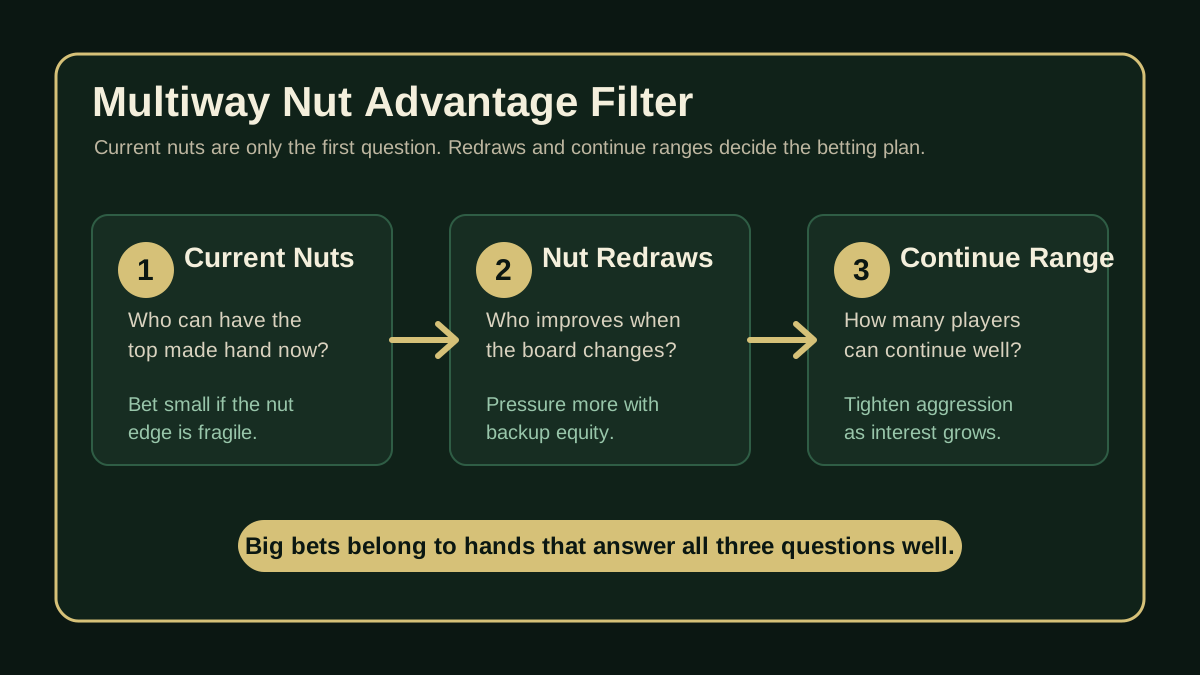 Inline visual: the best multiway bets usually answer all three questions well, not just the first one.
A Multiway Straight Example
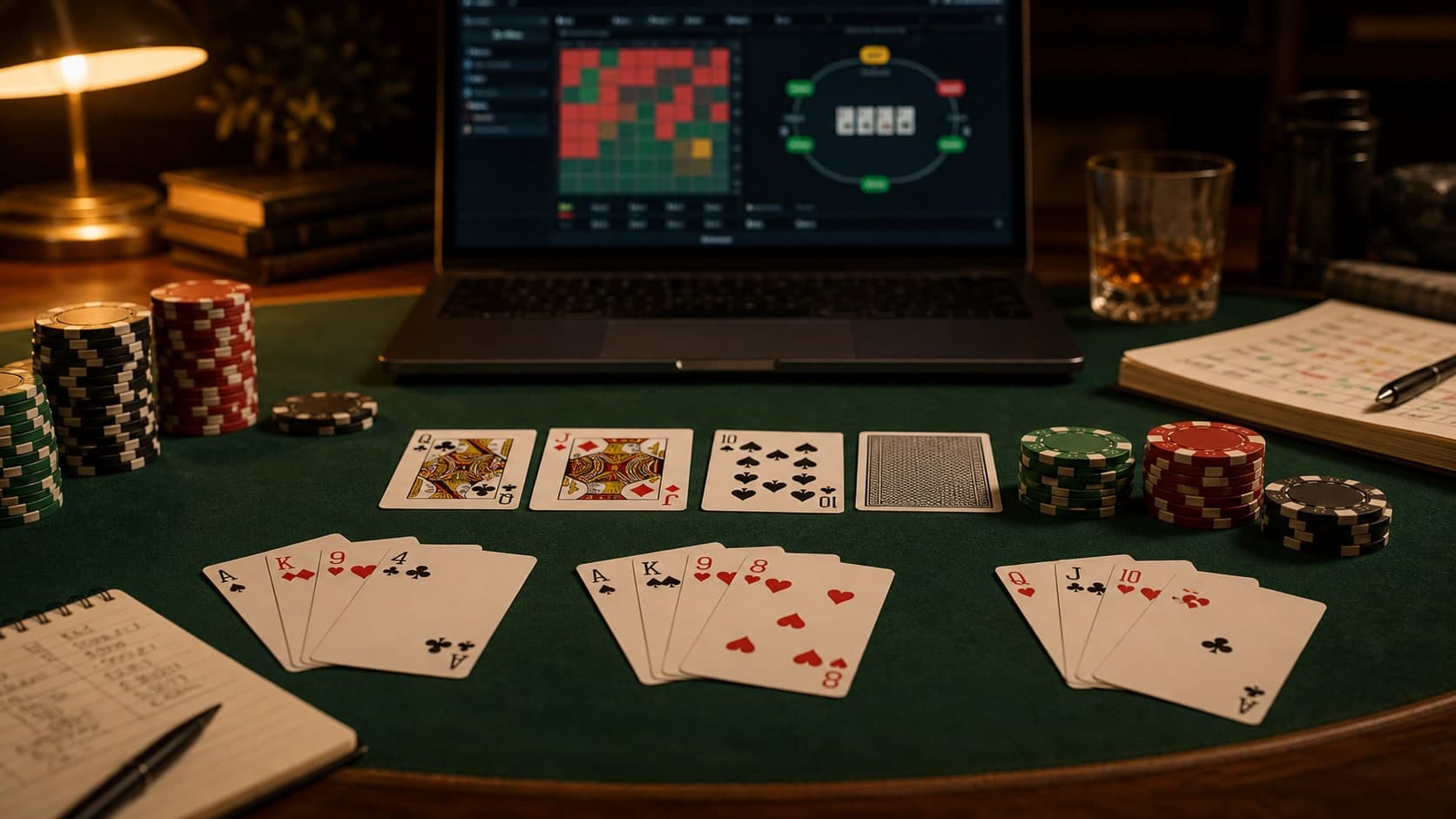
Setup: button opens, small blind calls, big blind calls. Stacks are about 100bb effective. The flop is Q♣J♦T♠, and both blinds check to the button.
If the button has A♠K♦9♥4♣, the hand is the current nut straight. But it is a thin version of the nuts. The 9 and 4 do not add much. When a blind check-raises, that range is not only worse straights. It can include A-K with better side cards, sets such as Q-Q-x-x, J-J-x-x, and T-T-x-x, plus pair-and-wrap hands that retain strong equity.
Now compare A♠K♠9♥8♥ on the same board. This hand still has the nut straight, but the side cards matter. It can share the current nuts while adding backdoor spades, straight extension, and more ways to keep equity when the turn changes the board. It is not immune to board pairs. Sets still improve against both hands. The difference is that the second hand has more side equity and more freeroll potential when another player also has A-K.
That changes the betting plan. At high SPR, with two players behind who can check-raise sets and same-straight-plus-redraw hands, the naked version should check back more often or use a smaller bet. A one-third to one-half pot bet can collect value from dominated continues without forcing you into a giant pot against the strongest part of both blind ranges. Bigger bets belong more naturally to hands that combine the current nuts with blockers, redraws, and turn coverage.
You can test the point in the PLO equity calculator by comparing a naked A-K-9-4 straight against a set and an A-K hand with better side cards. The lesson is not the exact number; it is how quickly the "I have the nuts" label loses meaning once the continue ranges contain freerolls and redraw-heavy hands.
Who Really Owns The Board?
On Q♣J♦T♠, the button has more strong Broadway opens, but the blinds have many defended hands that connect hard: A-K-x-x, K-9-x-x, Q-Q-x-x, J-J-x-x, T-T-x-x, and two-pair-plus-wrap structures. Once both blinds call or raise, their ranges narrow toward the same region the button wants to represent.
So the button's nut advantage is conditional. It is strongest before anyone shows interest. It gets weaker when both blinds continue, because multiway callers do not need one exact hand to punish a bet; they need enough shared coverage of straights, sets, and redraws. Position still helps the button, but position does not turn a naked straight into a clean stack-off.
That is the range-based version of nut advantage PLO: ask who can credibly continue with the top-end cluster, not just who can technically have the best hand.
For a broader version of this problem, start with multiway pots in PLO. This article is the tighter betting lens: once several players remain, current hand class matters less than nut ownership, redraws, and the SPR you create by betting.
Three Betting Buckets
Bet for pressure when your hand owns the current top end plus blockers or redraws. These are the hands that can use larger bets because they still have strong equity after calls and raises.
Bet for value when worse hands continue often enough but your redraw layer is not dominant. In three-way pots, this is often a smaller sizing bucket, especially at medium or high SPR.
Bet only for protection, or check when your hand wants folds but hates action. Non-nut straights, bottom sets on coordinated boards, and overpair-plus-draw hands often land here because the continue range is too strong.
Before choosing a size, name the purpose. Are you pressuring with nut ownership, value betting a robust hand, or trying to deny equity with a hand that does not want a raise? If the answer is mostly protection, building a big multiway pot is usually the wrong goal.
This is the multiway version of the same discipline behind continuation betting in PLO. Bet more when your range can keep pressure on turn changers; slow down when the hand is drifting toward non-nut flush or dominated-draw territory.
A Quick Sizing Test
Before you bet into two or more players, say the sentence out loud:
"If I get called in two spots, my hand still has..."
Good endings sound like this:
- "...the current nuts plus the nut redraw."
- "...top set plus blocker coverage on the straight cards."
- "...position and a turn plan on every flush, pair, and straight changer."
Bad endings sound like this:
- "...a hand that is probably best right now."
- "...a draw that looks big but makes second-best straights."
- "...enough equity if everyone folds sometimes."
That test keeps the sizing honest. A protection bet can be fine, but it should usually be smaller. A large bet needs a hand that keeps equity after resistance.
Two Expensive Multiway Leaks
Overplaying vulnerable current nuts. A straight on Q♣J♦T♠ or a full house on a paired board can still be fragile when several players retain boats, freerolls, or nut redraws. The more players remain, the less automatic your value bet becomes.
Overvaluing dominated redraws. Big wraps and pair-plus-draw hands look powerful, but they lose value when the outs make second-best straights or non-nut flushes. Multiway, dirty outs are not small details; they are where the money goes.
A useful default is to tighten aggression as the board gets more connected, the SPR gets higher, and more players remain. Keep asking the same three questions: who has the current nuts, who has the nut redraws, and how many players can continue with strong second-best hands? If your hand does not answer those well, you may have temporary strength rather than true multiway nut advantage.
FAQ
Is nut advantage the same as range advantage?
No. Range advantage asks which player has the stronger overall range. Nut advantage asks who has more of the strongest hands on this exact board. In multiway PLO, nut advantage often matters more because one extra caller can erase the value of a broad range edge.
Should I always bet when I have the current nuts multiway?
No. The current nuts without redraws can be a value bet, a small protection bet, or a check depending on SPR, player count, and how often opponents can continue with the same hand plus better backup. The deeper the stacks, the more redraw ownership matters.
What is the most common multiway nut-advantage mistake?
Treating "I have the nuts" as the full decision. The real question is whether the hand still performs after a call or raise. Naked straights, low full houses, and non-nut flushes can all be strong enough to continue while still being too fragile to build a giant pot.