
You Do Not Need to Spend $500 to Study PLO
Walk into any poker Discord and ask about study tools. Someone will immediately tell you to buy an expensive solver, subscribe to three training sites, and get a custom HUD. That is overkill for most players -- and it can actually slow your learning down if you get lost in features instead of fundamentals.
The truth is that the most important PLO study tool is free, and you can access it right now. Everything else is an upgrade, not a requirement. Here is a breakdown of every category of PLO tool, ranked by impact, with honest assessments of when you actually need each one.
Top 5 PLO Hand Analysis Tools That Actually Work
If you just want the short list, these are the five tool types that actually move a PLO player's game forward:
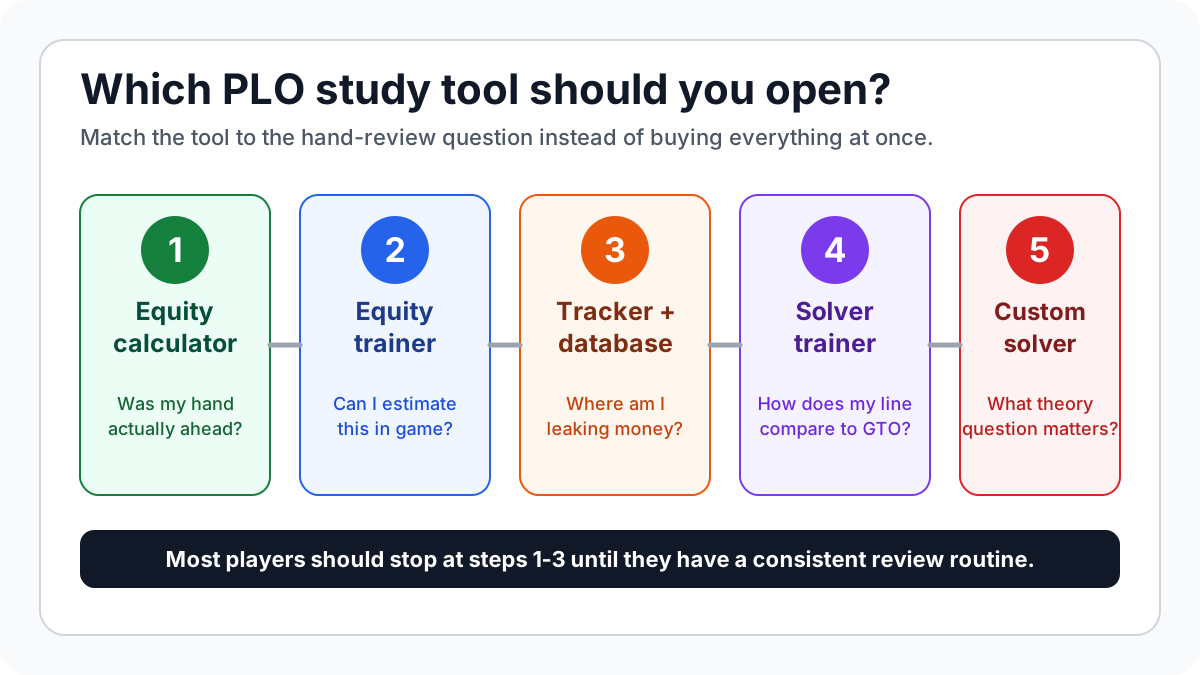
| Rank | Tool type | Best use | Works best for | Skip it if |
|---|---|---|---|---|
| 1 | Equity calculator | Checking close hands, draws, all-ins, and river decisions | Every PLO player | You never review hands after playing |
| 2 | Equity trainer | Building real-time feel for hand-vs-hand equity | Beginners through mid-stakes players | You only want passive study |
| 3 | Tracker and database | Finding your leaks across thousands of hands | Regular online players | You mostly play live and have no hand histories |
| 4 | Pre-solved solver trainer | Comparing your line to strong baseline strategy | Serious students who review exact spots | You will copy frequencies without understanding them |
| 5 | Custom solver / tree builder | Answering narrow theory questions and testing assumptions | Advanced players, coaches, and high-volume pros | You are not already beating your current games |
For most players, the best stack is not five paid subscriptions. It is an equity calculator, a trainer, and one reliable way to review your own hands. Add solver tools only when you have a real question they can answer.
Which PLO Tools Actually Work?
The tools that actually work are the ones that answer a specific study question. If you want the most practical named-tool shortlist, start here:
| Tool | Category | Best for | Verdict |
|---|---|---|---|
| PLO.com equity calculator | Equity calculator | Checking close hands, all-ins, and board runouts | Best free first tool |
| PLO.com equity trainer | Equity trainer | Building real-time equity intuition | Best daily drill |
| Hand2Note / PokerTracker 4 / DriveHUD | Tracker | Finding leaks from hand histories | Best for regular online players |
| Vision / FlopHero | Pre-solved trainer | Repeating common PLO spots without building trees | Best for structured solver reps |
| MonkerSolver / GTOTools workflow | Custom solver | Building and testing custom PLO trees | Advanced only |
The ranking is deliberately practical. A beginner who reviews five hands a day in an equity calculator will usually improve faster than a player who pays for an advanced solver and never asks a clear question.
Which PLO hand analysis tool should you use first?
Start with the free plo.com equity calculator. It is the fastest way to answer the question behind most PLO mistakes: did my hand have enough equity against the range I was actually facing?
After that, add tools based on the problem you are trying to solve:
- If you misjudge draws: use the equity trainer for 10 minutes a day.
- If you do not know where you are leaking money: use a tracker such as Hand2Note, PokerTracker 4, or DriveHUD.
- If you want to analyze uploaded hands against a baseline: use your tracker filters first, then compare recurring spots against a solver or trainer workflow only when the formation is actually supported.
- If you want browser-based PLO drilling: use a pre-solved trainer such as Vision or FlopHero, especially when you want repeated reps instead of building your own trees.
- If you need custom PLO trees: use a solver workflow such as MonkerSolver, often with tree-building help from tools like GTOTools. This is powerful, but it is the last step, not the first one.
The practical rule: choose the cheapest tool that answers today's hand-review question. PLO study goes wrong when players buy advanced tools before they have a repeatable review habit.
Tier 1: Equity Calculators (Essential, Free)
An equity calculator is the single most important tool for PLO improvement. It answers the question that matters most: "How does my hand actually perform in this spot?"
The plo.com equity calculator is free and purpose-built for Omaha. You plug in two or more hands and a board, and it tells you exactly who is ahead and by how much.
Why this matters: PLO players carry around wildly inaccurate equity assumptions. You think your wrap is a monster, but against top set with a flush redraw, it may have far less equity than you expect. You think your bare aces are crushing, but against a double-suited rundown on a connected flop, you could be behind.
Use the equity calculator after every session to check the spots you were unsure about. This habit alone will make you a significantly better player within weeks.
Tier 2: Equity Trainers (Essential, Free)
Knowing how to use a calculator is one thing. Being able to estimate equity at the table in real time is another. That is what the plo.com equity trainer is for.
It gives you random hand-vs-hand scenarios and asks you to estimate the equity. You get immediate feedback. Over hundreds of reps, you develop an intuitive feel for how different hand types interact -- wraps vs. sets, flush draws vs. two pair, combo draws vs. overpairs.
This is the PLO equivalent of a basketball player shooting free throws. It is not glamorous, but it is the single best use of short study sessions. Even 10 minutes a day will sharpen your table instincts.
Tier 3: Tracking Software (Important, Paid)
Once you are playing regularly, tracking software becomes very valuable. The main options for PLO:
Hand2Note -- The current standard for serious PLO players. Its custom HUD system is the most flexible, and the popup stats let you build detailed opponent profiles. The PLO-specific stats (like 3-bet frequency by position and c-bet by board texture) are extremely useful.
PokerTracker 4 -- The established veteran. Slightly less customizable than Hand2Note for PLO but easier to learn. Good filters for reviewing specific spot types.
DriveHUD -- A simpler, more affordable option. Solid for tracking your own results and basic opponent stats. Good entry point.
What to use tracking software for:
- Identifying your own leaks by filtering for specific situations
- Building HUD profiles to exploit opponents in real time
- Tracking your win rate by position, by stake, and over time
- Reviewing sessions with hand replayers
You do not need tracking software to start playing PLO. But once you are playing regularly, the investment can pay for itself quickly.
Tier 4: Solvers (Advanced, Expensive)
PLO solvers compute game-theory-optimal strategies for specific spots. They are incredibly powerful and incredibly easy to misuse.
There are strong local and cloud-based solver options on the market. The exact product matters less than the tradeoff: local tools usually demand more hardware and setup, while cloud tools are easier to access but may lock useful work behind subscriptions.
Advanced solver study is most useful when it answers a concrete question, such as how to split multi-street bet sizing, when overbets and delayed c-bets appear, or how node locking exposes population leaks.
When you actually need a solver: Not until you are beating your current stake and want to understand why certain plays work. Solvers answer "what" and "how often" but not "why." If you cannot explain why a solver recommends check-raising a certain board texture, the output will not help you at the table.
Most small-stakes players will get more value from equity calculator work and hand review than from solver study.
Tier 5: Training Sites and Courses (Supplementary)
PLO-specific coaching content can accelerate your learning, but only if you use it with intention. The best approach:
- Identify a specific leak in your game (e.g., you lose too much money with bare overpairs on wet boards)
- Find content that addresses that exact topic
- Watch it actively -- pause, take notes, run the example hands in the equity calculator
- Apply the lesson in your next session
Avoid the trap of watching random strategy videos for entertainment. If you cannot name what you learned after a video, you did not learn anything.
Tier 6: Range Viewers and Preflop Charts
Preflop charts and range viewers help you build a disciplined opening strategy. This is more important in PLO than in Hold'em because the number of possible starting hands is vastly larger and the quality differences between them are less obvious.
A good preflop chart will tell you which hands to open from each position and which to 3-bet. Follow it strictly at first. As you gain experience, you can deviate based on table dynamics and opponent tendencies.
If you want a structured review list before using any tool, start with the 10 PLO hand types every serious player should know.
The Minimum Viable Toolkit
If you are just starting out or playing micro stakes, here is everything you need:
- plo.com equity calculator (free) -- check your hands after every session
- plo.com equity trainer (free) -- drill for 10-15 minutes daily
- A notebook or text file -- write down one lesson from each session
That is it. Add tracking software when you are playing regularly, and consider solvers only when you are beating your stake and looking for theoretical edges. Every tool beyond these three is an optimization, not a necessity.
FAQ
What are the top 5 tools for PLO hand analysis? The top five PLO hand analysis tools are an equity calculator, an equity trainer, tracking software, a solver-style hand-history analyzer, and a pre-solved trainer. Start with the PLO.com equity calculator, then add the equity trainer, a tracker, and solver tools only when you have enough hands or specific spots to review.
Is an expensive solver worth the investment for a $0.25/$0.50 player? No. At micro and small stakes, your opponents' leaks are large enough that exploitative play based on equity understanding and hand reading will generate far more profit than GTO solver work. Invest in a tracking tool instead.
Can I study PLO effectively with only free tools? Absolutely. The equity calculator and equity trainer on plo.com cover the two most important study activities: checking your assumptions and building intuitive equity estimation. Pair those with disciplined hand review and you have a complete study system.
What is the single best purchase for improving at PLO? For most regular online players, tracking software is the highest-ROI paid tool. The ability to review your own hands with accurate stats and build a HUD is usually more valuable than jumping straight into advanced solver work.
Start Simple, Add As Needed
The players who improve fastest are not the ones with the most tools. They are the ones who use one or two tools deeply and consistently. Start with the equity calculator. Use it every day. When it stops being enough, add the next tier. That progression -- from essential to advanced, driven by your actual needs -- is how you build a study toolkit that makes you money instead of just costing it.