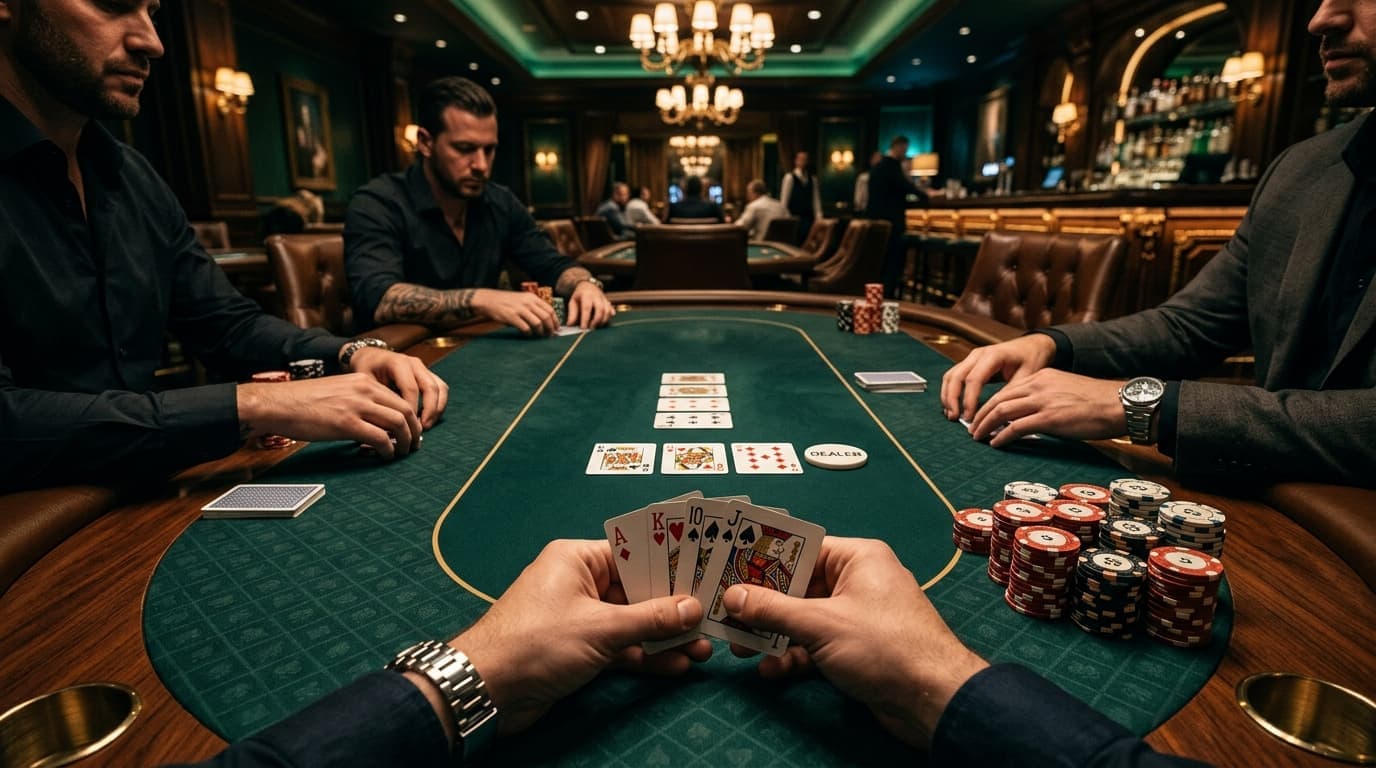
The Hand That Costs Every New PLO Player Money
Picture this: you are playing your first Pot-Limit Omaha session. You look down at A♠J♠T♣5♠ and the board reads K♠Q♠8♠4♥2♦. Three spades on board, three spades in your hand. You proudly table your "flush" and the dealer pushes the pot to your opponent who holds 9♠7♠K♣K♥. You used three cards from your hand -- illegal in PLO.
This scenario plays out every single day at casinos and online poker rooms. Understanding exactly how PLO works before you sit down will save you from embarrassment and, more importantly, from stacking off with hands you do not actually have.
Dealing and Blinds
PLO uses the same dealer button, small blind, and big blind structure as Texas Hold'em. The button rotates clockwise, the player to its left posts the small blind (typically half a big blind), and the next player posts the big blind. Each player then receives four hole cards face down.
Action begins with the player to the left of the big blind (under the gun) and moves clockwise. Preflop, your options are fold, call, or raise -- just like Hold'em. The difference is in how much you can raise.
The Pot-Limit Betting Rule
In PLO, you cannot bet more than the size of the pot. Calculating a pot-sized raise trips up beginners, so here is the formula:
Pot-sized raise = (current pot) + (the call amount) + (the call amount again)
For example, the blinds are 1/2 and you are first to act preflop. The pot is 3 (small blind + big blind). To pot it, you calculate: 3 (pot) + 2 (your call) + 2 (your raise on top) = 7. So you raise to 7 total. In practice, online software handles the math. At a live table, just say "pot" and the dealer will tell you the amount.
This pot-limit cap means preflop all-ins are rare at deeper stacks. A single open, a 3-bet, and a call might create a pot of 25-30 big blinds with 70-75 remaining -- a far cry from the preflop shove-fests common in No-Limit Hold'em. Strategy in PLO is built around this multi-street pot growth.
Building Your Hand: The Exactly-Two Rule
This is the single most important rule to internalize. Your final five-card poker hand must contain exactly two of your four hole cards and exactly three of the five board cards. Not one, not three -- two.
Here are the rule checks that catch most beginner mistakes:
- Flushes: you need two cards of the suit in your hand and three cards of that suit on board.
- Straights: you still use exactly two hole cards, even when four board cards look connected.
- Full houses: you cannot use three paired cards from your hand; only two hole cards count.
Consider this board: J♥T♣9♦8♠2♥.
- You hold Q♠7♠6♦3♦. It looks tempting to say you have Q-J-T-9-8, but that would use only one hole card, the Q♠, plus four board cards. Illegal. You do not have a straight.
- You hold K♦Q♣6♣3♥. Using K♦Q♣ with J♥T♣9♦ gives K-Q-J-T-9, a legal king-high straight because it uses exactly two hole cards and exactly three board cards.
Run a tricky board like this yourself to practice identifying the correct best hand for each player.
The habit is simple: name the two hole cards first, then add three board cards. If you cannot name exactly two hole cards that complete the hand, you do not have that hand.
Betting Rounds: Flop, Turn, and River
After preflop action, three community cards are dealt (the flop), followed by a round of betting. Then a fourth card (the turn), another betting round, a fifth card (the river), and a final round of betting. At showdown, the best five-card hand wins -- always composed of exactly two hole cards and three board cards.
Betting on every street follows the pot-limit rule. Pots grow fast. A pot-sized bet on the flop followed by a pot-sized bet on the turn followed by a pot-sized bet on the river means the final pot can be 20-30 times the initial preflop pot. This geometric escalation is why hand selection matters so much -- a marginal hand that costs you one big blind preflop can cost you 100 big blinds by the river if you do not have the discipline to let go.
Showdown: Reading the Board
At showdown, always go through each possible two-card combination from your hand (there are six) and pick the one that makes the strongest hand with three board cards. The six combinations from a hand like A♠K♥T♠9♥ are:
- A♠K♥
- A♠T♠
- A♠9♥
- K♥T♠
- K♥9♥
- T♠9♥
Each of those pairs creates a different potential hand with the board. In PLO, you are constantly evaluating which of your six combos is relevant and whether that combo makes the nut hand or something weaker.
Common Rule Mistakes at the Table
Mistake 1: Playing three or one hole cards. You hold four spades and there are two spades on board. You do not have a flush. You need exactly two spades in your hand and exactly three on the board.
Mistake 2: Forgetting you can use different cards for different parts. You can use A♠K♥ for a straight while your T♠9♥ sits unused. Each final hand uses only two of your four cards. But you pick the best combination.
Mistake 3: Misreading the pot-limit cap. You cannot overbet the pot. If the pot is 50, you cannot bet 75. The maximum is 50. However, you can bet any amount up to the pot -- half-pot, two-thirds pot, or any other size at or below pot.
Test your hand-reading with this spot: who has the best hand, and what is it? Work it out before clicking.
Quick Rules Checklist
Before you sit in a real PLO game, be able to answer these five questions without pausing:
- Can I explain the pot-sized raise formula?
- Can I identify my best legal hand using exactly two hole cards?
- Can I tell whether my flush draw is legal and nut-quality?
- Can I recognize when a straight on board does not automatically play?
- Can I explain why four cards create more close-equity spots than Hold'em?
Once the rules are automatic, move straight into what makes a good PLO hand and opening ranges by position. The rules tell you what hand you have; strategy tells you whether that hand should put money in.
FAQ
What happens if two players have the same hand at showdown? The pot is split equally. This happens more often in PLO than in Hold'em because with four hole cards, it is more common for two players to arrive at the same straight or flush. Suits have no ranking in PLO (or any standard poker game), so two nut flushes in different suits would split -- though that is impossible since you need three board cards of the suit.
Can I play PLO with five or six hole cards? Yes, those variants exist -- 5-Card PLO and 6-Card PLO (sometimes called Big O and Super O). They amplify everything about PLO: closer equities, bigger draws, even more emphasis on position and nuttiness. The rules about using exactly two hole cards and three board cards remain the same regardless of how many hole cards you receive. If you move into six-card games, start with PLO6 microstakes range tightening before widening too much.
Is there a limit on the number of raises per street? In most cash games, there is no cap on the number of raises (though some casinos cap it at four or five raises per street when more than two players are in the hand). In online PLO, there is typically no cap on heads-up raises. Check house rules at your venue.