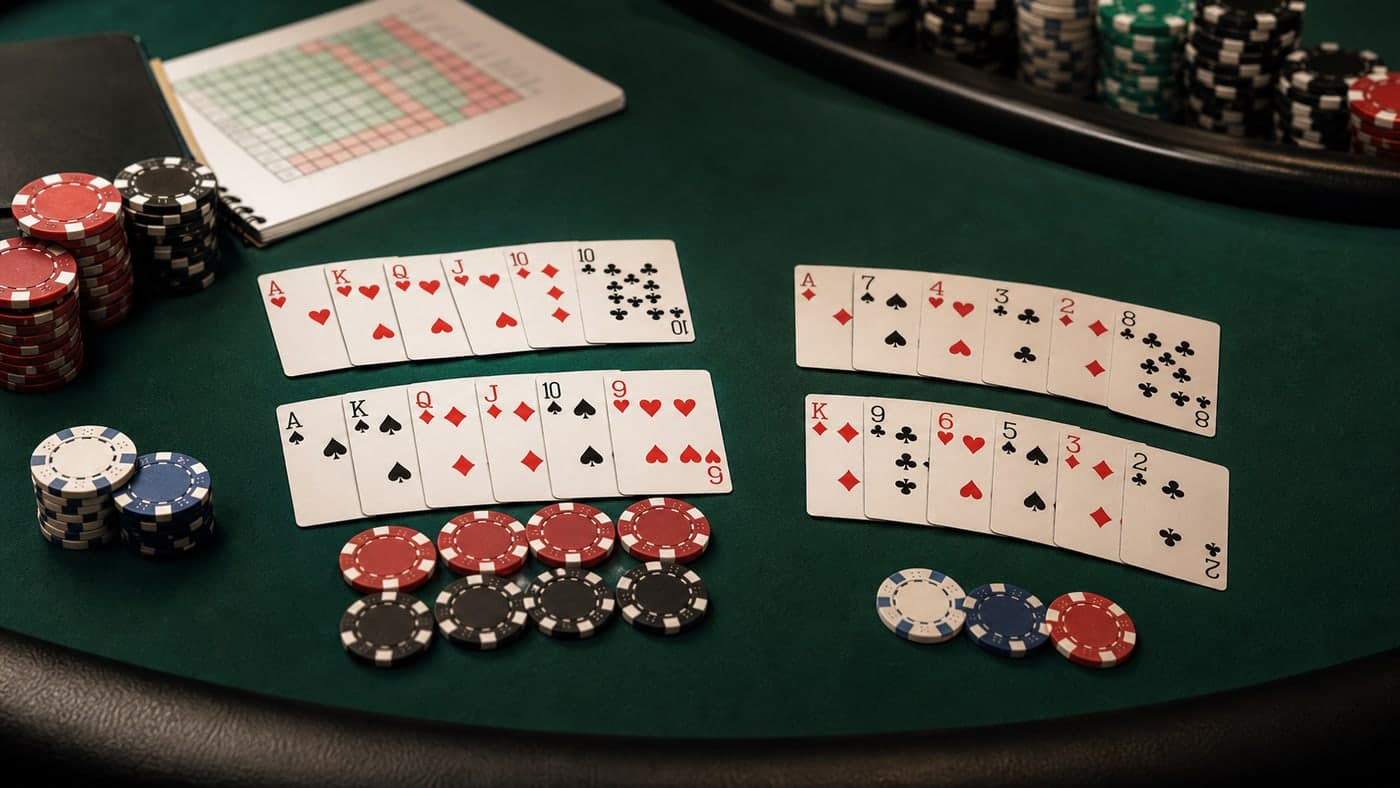
PLO6 microstakes let too many pretty but dominated hands survive. A hand like A-A-T-7-6-4 rainbow can limp along when pots stay cheap and nobody punishes weak continues. Move up, and that same hand starts paying off better aces, higher wraps, and nut-flush redraws. If your baseline is still loose, start with PLO starting hand selection, then tighten harder for six-card games.
Good PLO6 microstakes strategy is not "play scared." It is learning the two-card tax: in six-card Omaha, every card that does not help make the nuts actively makes the hand worse, because opponents also have six cards and will show up with more nut coverage, higher wraps, and freeroll redraws. Structure comes first, seat comes second, and stack depth plus table density decides how much tax you can afford. Here, ds means double-suited, ss means single-suited, and r means rainbow.
The Five Classes
Use five fixed buckets before you decide whether a hand belongs in your range. The practical question is not "does this hand have something?" It is "how many cards work together toward nut hands?"
Nut premiums are hands where five or six cards cooperate toward nut flushes, nut straights, and strong redraws: A-A-K-Q-J-T ds, A-K-Q-J-T-9 ds. Keep them from every seat; they are your cleanest opens and 3-bets because the side cards protect the headline strength.
High rundowns are broadway-heavy connected hands with real suit quality but less ace coverage: K-Q-J-T-9-8 ss+. Keep the smooth versions, especially ds or strong ss with no low passenger; cut the versions where one or two cards fall out of the straight band.
Fragile big pairs are aces or kings with one strong feature and one real flaw: A-A-K-J-9-7 ss, K-K-Q-J-T-6 ss. Keep them only when the side cards create nut straights, nut suits, or strong blockers; cut them when the pair is carrying two disconnected passengers.
Middling rundowns are lower connected hands such as J-T-9-8-7-4 ds or T-9-8-7-6-3 ds. Keep them late in soft games when stacks are shorter or blinds overfold; cut them early because their best flops often collide with higher wraps and better flush draws.
Clutter traps are hands with high-card shine but poor cooperation: A-K-Q-J-9-4 ss, A-A-T-7-6-4 r, K-K-T-8-6-3 ss. Cut these first. They look close to playable, but the disconnected cards create second-best pairs, second-best flushes, and dominated wraps.
The Two-Card Tax
In PLO4, one weak side card can be a small leak. In PLO6, two weak side cards are a strategic tax. They do not just lower equity; they create the illusion of coverage while stronger ranges keep the nut layer.
The same building blocks still apply, but the penalties are larger. Clean double-suited hands matter more because dominated suits appear more often, and loose wraps need stricter rank quality because six-card ranges produce more higher wraps and non-nut flush traps.
Ask three questions before opening:
- Nut suit: do I have an ace-high suit or a suit that supports a premium straight structure?
- Nut straight band: do at least four connected cards work toward the top end of the deck?
- Passenger count: how many cards would I be embarrassed to show down after a big pot?
At 100bb+, one passenger is tolerable only with premium structure. Two passengers means the hand needs position, passive blinds, or a very soft table. Three passengers is usually a fold, even if the hand contains aces or broadways.
The Range-Tightening Matrix
Treat this as a baseline. "Normal density" means most raised pots see two or three players. "Multiway-heavy" means four or more players see flops often, especially in raked games.
| Hand class | LJ/HJ 100bb+ | CO/BTN 100bb+ | 60-80bb normal density |
|---|---|---|---|
| Nut premiums | open/3-bet | open/3-bet | open/3-bet |
| High rundowns | open-fold vs 3-bet | open/3-bet | open/3-bet |
| Fragile big pairs | fold | open-fold vs 3-bet | open-fold vs 3-bet |
| Middling rundowns | fold | overlimp only | open-fold vs 3-bet |
| Clutter traps | fold | fold | fold |
The seat rule is simple: LJ/HJ ranges lose Clutter traps, then Middling rundowns, then most Fragile big pairs. CO/BTN can keep some marginal classes because position realizes equity, but sticky blinds or frequent squeeze pots move every borderline hand down one row. Shorter stacks help connected equity realize; deeper stacks magnify domination.
Compare A-K-Q-J-T-9 ds with A-K-Q-J-9-4 ss. The first hand has nut-flush coverage, broadway wraps, and redraws when the straight changes. The second looks close, but the 4 does not cooperate, the single suit is easier to dominate, and many profitable-looking flops create bad stack-off thresholds. If you want to test exact formations, use the PLO6 equity calculator against a tighter continue range rather than a random hand.
Why Six Cards Punish Loose Ranges
PLO6 adds more ways for everyone to continue. Weak side cards often create false permission: you flop a wrap, but a better range has the higher wrap; you make a flush, but a better range has the nut suit; you stack off top two plus a draw, but another player has the same made hand with cleaner redraws.
That is why preflop discipline matters more before you move up. The leak is not just entering too many pots. It is entering pots with hands that only realize well when opponents fail to isolate, fail to 3-bet, or fail to punish non-nut continues. For a broader foundation, review what makes a good PLO hand and then apply the stricter six-card filter here.
Three Worked Decisions
Premium keep: A-A-K-Q-J-T ds, CO, 100bb.
Class: Nut premiums. Default action: open/3-bet. On Q-J-5 with a backdoor nut suit, this hand can hold overpair value, nut-straight coverage, and turn redraws. If the turn is a T, K, A, or nut-suit card, the hand often improves into a value or pressure candidate rather than a bluff-catcher. That is what premium side-card cooperation buys you.
Context-sensitive keep: K-Q-J-T-9-8 ss, HJ, 100bb.
Class: High rundowns. Default action: open-fold vs 3-bet unless the blinds are weak or under-defending. On T-9-4, it can flop powerful straight equity, but without ace-high suit coverage it hates deep action against stronger 3-bet ranges. The hand performs best when it sees flops in position or against blinds that do not punish non-nut flush equity.
Clear retire: A-A-T-7-6-4 r, MP, 100bb+.
Class: Clutter traps. Default action: fold. On T-7-5, it looks like aces plus backup, but better six-card continues show up with sets, higher wraps, two suits, and cleaner redraws. On an 8 or 9 turn, the hand can improve just enough to pay off a better straight. On a flush turn, it has no nut-suit rescue. The hand wins small pots and loses the ones that matter.
The Move-Up Filter
Before you move from soft PLO6 micros into tougher games, remove hands in this order:
- Three-passenger Clutter traps from every seat.
- Rainbow Fragile big pairs without connected side cards.
- Middling rundowns from LJ/HJ at 100bb+.
- Single-suited High rundowns facing aggressive blinds.
- Any marginal hand in a game where raised pots regularly go four-way.
This prevents the common overcorrection. You are not trying to become a nit. You are keeping hands whose non-pair equity can stand pressure and cutting hands that need passive opponents to realize.
Mistakes To Cut Before Moving Up
Stop opening Clutter traps because they contain familiar high cards. Stop treating Fragile big pairs as automatic raises unless the side cards cooperate. Stop overcalling Middling rundowns from early seats just because they are double-suited. Stop defending hands whose best-case flop still leaves you guessing against a pot-sized bet and a caller. When a room is splashy, raked, or four-way by default, tighten one full step.
Your final checklist is compact: keep Nut premiums, open good High rundowns with positional awareness, downgrade Fragile big pairs without side-card help, reserve Middling rundowns for late soft spots, and cut Clutter traps first. Count the two-card tax before the flop so you are not paying it on the turn.
FAQ
Why are weak side cards worse in PLO6 than PLO4?
Because every opponent also has six cards. Weak passengers do not just reduce your hand quality; they create dominated wraps, dominated flushes, and made hands with poor redraws against ranges that have more ways to continue.
Can I still play middling rundowns in soft PLO6 games?
Yes, but mostly late and with clean suits. Move them down quickly from early seats, deep stacks, and games where raised pots go four-way or more.
What is the first range to cut before moving up?
Cut clutter traps: high-card or pair-heavy hands with two or more cards that do not cooperate. They survive in soft games because opponents let you realize cheaply, but tougher games punish them before showdown.