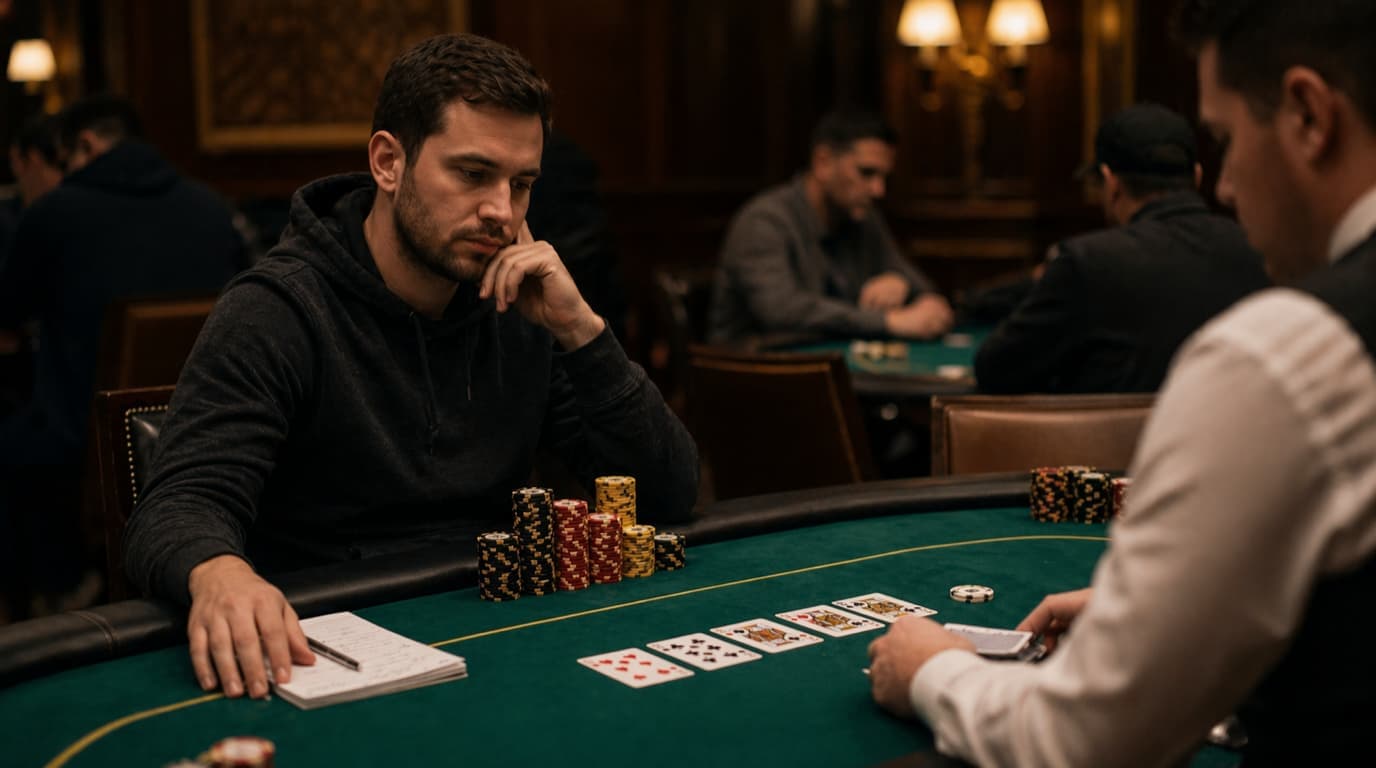
Most stop-loss advice in PLO is backwards. It asks, "How much am I down?" when the better question is, "Am I still making the same decisions I would make fresh?" If you leave every time the session hurts, you turn discipline into avoidance. If you never leave until the number looks catastrophic, you let tilt hide behind toughness.
A bankroll stop and a mental-game stop are not the same rule. Bankroll rails belong in game selection and shot-taking plans before the session starts. In-session quit decisions should usually come from execution decay or lineup deterioration. That distinction is what makes a stop loss PLO rule protective instead of self-sabotaging.
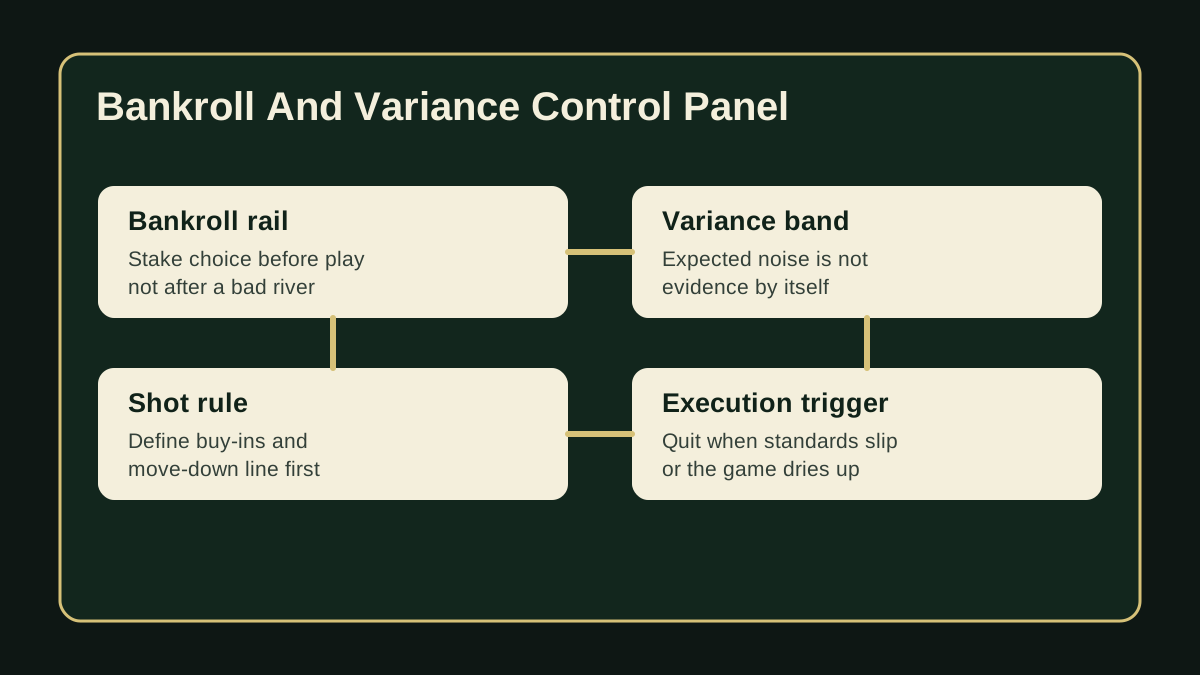 Inline visual: use a bankroll rail before the session and an execution trigger during the session.
A bankroll stop and a mental-game stop do different jobs
A bankroll stop controls exposure. It answers: "Am I rolled for this game, this straddle, and this session?" That is why it belongs next to your broader bankroll management plan, not in the middle of a pot after two bad runouts.
A mental-game stop protects decision quality. It answers: "Am I still choosing hands, lines, and tables the same way I would if I were calm?" That is the part players miss. They treat being stuck as proof they should leave, when the real issue is whether the losses changed their standards.
Here is the useful operating rule:
Use bankroll rails before the session. Use execution and lineup evidence during the session.
That does not mean numeric caps are useless. A player with a thinner roll, a history of punting, or a habit of taking bad shots may reasonably use a 3-5 buy-in backup rail as a baseline heuristic. The point is not that the number is magical. The point is that once fear, urgency, and bankroll pressure all show up together, decision quality usually gets worse. If you are unsure whether your cap matches real Omaha swings, test your assumptions in the variance simulator.
Use the three-bucket test before you stand up
Do not ask whether the session feels bad. Ask which bucket broke.
Technical triggers
-
Trigger: You widen cold-calls or blind defenses with hands that play badly when dominated.
-
What it looks like in PLO: You call out of position with K♦9♣7♥2♠ because the table is soft and you are tired of folding.
-
Immediate action: Sit out one orbit and review your last three non-trivial decisions.
-
Trigger: You start overvaluing non-nut draws or weak redraws.
-
What it looks like in PLO: You stack off on a paired or draw-heavy board because your hand is "too big to fold," even though your redraw situation got materially worse.
-
Immediate action: Pause before the next hand and force yourself to name the nut outcome, the redraw disadvantage, and the river plan.
Emotional triggers
-
Trigger: Recent losses change your appetite for risk.
-
What it looks like in PLO: You turn a marginal bluff-catcher into a hero call because you want one pot to flip the session.
-
Immediate action: Take a five-minute break away from the table.
-
Trigger: Your speed changes for the wrong reason.
-
What it looks like in PLO: Routine flop and turn spots suddenly become snap-calls, snap-folds, or rushed pots because you want the discomfort over with.
-
Immediate action: Step away and do not sit back down until your timing feels normal again.
Game-selection triggers
-
Trigger: The edge you sat down for is gone.
-
What it looks like in PLO: The weakest player leaves, two competent regs take position on you, and the game shifts from loose multiway mistakes to tougher 3-bet and squeeze spots.
-
Immediate action: Re-check the room and table-change if a better lineup exists.
-
Trigger: You are staying for emotional reasons instead of lineup reasons.
-
What it looks like in PLO: Your real thought is not "this table is still great." It is "I am not leaving stuck."
-
Immediate action: Quit. That thought is already the evidence.
If none of those buckets broke, being stuck alone is usually not enough reason to leave. If one of them broke, the size of the loss no longer matters as much as the quality of the next decision.
Stop-Loss PLO Session Checklist
Paste this into your notes before you play:
Stop-Loss PLO Session Checklist
- If my pre-session bankroll rail for this stake is hit, I move down or quit.
- If I make one clear technical or emotional mistake, I pause for five minutes.
- If I repeat that mistake in the next orbit, I sit out one orbit and table-scan.
- If the soft seat disappears and no better lineup exists, I quit.
- Before the next session, I review the biggest process error first.
1 item = pause, 2 items = sit out one orbit and table-scan, 3+ items = quit and review.
That is deliberately simple. A checklist only works if you can actually use it mid-session.
A PLO-specific execution-decay example
Suppose you are in the big blind after losing two large pots. A loose player opens, a second player calls, and you defend with K♦9♣7♥2♠ because you want to "fight for one." The flop comes J♣9♦6♠. On paper, you connected. In practice, you are in a bad seat with a hand that makes too many second-best outcomes. When the turn brings extra heat, you pot into strength because you are tired of folding. That is not standard variance. That is a technical trigger plus an emotional trigger at the same time. The right action is not to prove toughness. It is to pause and review.
Hand breakdown: the turn jam that tells you whether to keep playing
Lineup: competent CO reg opening wider than average, one loose-passive blind who overcalls too much, one tighter blind who does not fight enough postflop.
Hero position: BTN
Villain position: CO
Effective stacks: 100bb
Hero holds A♠J♠T♥9♥ on the button. CO opens. Hero calls in position. One loose-passive blind comes along.
Flop: Q♣8♥7♠
This is a dynamic board. Hero already has a non-nut straight: 7-8-9-T-J. CO c-bets small. The blind folds. Hero calls.
So far, nothing is wrong. Calling keeps weaker hands and bluffs in, and the board is volatile enough that there is no prize for panicking with a made hand that can still be overtaken by redraw-heavy ranges.
Turn: 2♦
The turn is a brick. CO now bets large.
This is the decision point.
Stable-process marker: Hero slows down and asks the right question: "Am I continuing because the line still makes sense against this range, or because I am stuck and hate folding a straight?" The board did not improve Hero. The large turn size from a competent CO on a dynamic flop can still represent sets, stronger redraw structures, and hands that are happy putting pressure on a vulnerable made hand. If Hero continues, it should be because price, range interaction, and river realization justify it, not because the word "straight" feels emotionally binding.
Leak marker: Hero jams immediately because the session hurts and folding a made straight feels intolerable. That jam is not driven by fresh information. It is driven by pain. On this board texture, with this lineup, and with this stack depth, the emotional reason for the play matters more than the label on the hand.
That is the difference between running bad and playing worse. Running bad loses money while your standards stay intact. Playing worse lowers your standards because you are losing.
When hard numeric caps help — and when they become self-sabotage
Hard caps help three player types most:
- under-rolled players taking shots
- tilt-prone players with a real punt history
- players whose game selection gets worse when a session goes badly
They hurt when a strong lineup remains, your standards are intact, and the cap forces you out of your best seat only because the pain crossed an arbitrary threshold. That is where a stop loss PLO rule stops protecting you and starts protecting your emotions instead.
The practical default is simple: execution first, lineup second, numeric cap as a backup rail. If your process is still stable and the table is still worth playing, continue. If your standards slip or the game degrades, quit and review. For that last piece, keep your table selection process as disciplined as your hand selection.
Related Study
Stop-loss decisions sit inside a bigger system: variance in PLO, bankroll management, mental game discipline, and session review. Those pieces keep the rule from becoming either too soft or too rigid.
FAQ
Should I always quit after losing three buy-ins in PLO?
No. Three buy-ins can be a useful backup rail for some players, especially if the roll is thin or the player has a documented punt problem. It is not automatic proof that the session should end. The better question is whether losses changed your standards or the lineup.
What is the best default here?
Set bankroll rails before the session. During the session, use technical, emotional, and game-selection evidence to decide whether to continue, pause, or quit.
What if the game is still soft but I know I am tilted?
Leave. Soft games are valuable, but not valuable enough to justify playing badly in them. A good lineup does not rescue bad decisions.