
The Session That Broke Something Inside You
You opened A♠A♥K♠Q♥ -- one of the best starting hands in PLO -- and got it all in preflop against two opponents. You had strong equity three ways. You lost. Reload.
Next orbit, you flopped a set of jacks on J♦8♠3♥. Your opponent had 8♦7♦6♠5♥ -- second pair with backdoor straight and flush draws. The turn was the T♦. The river was the 4♦. Backdoor flush. You lost. Reload.
Twenty minutes later, you called an all-in on the river with the nut straight on a board with no flush possible. Your opponent turned over a full house that got there with a one-outer on the river. You did not reload. You went home. You lay on your couch staring at the ceiling questioning why you play this game.
Everyone who plays PLO seriously has had this night. The question is not whether it happens. The question is what you do next.
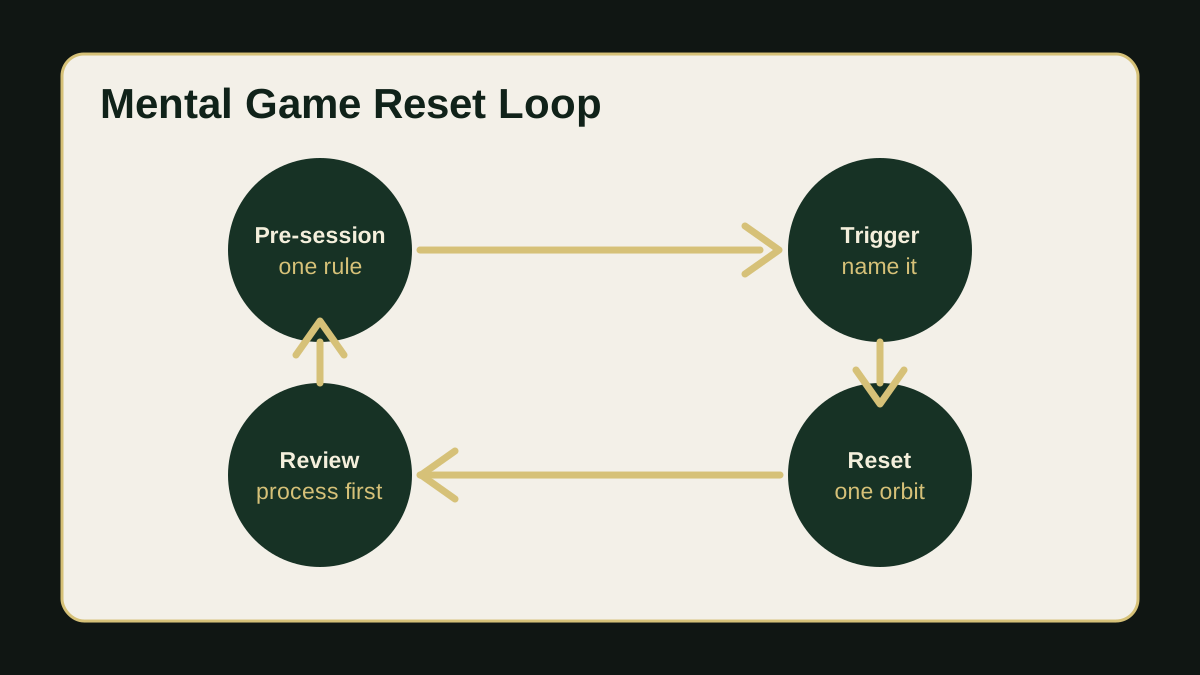 Inline visual: the loop is designed to catch tilt before it becomes a bankroll problem.
PLO Has Unique Tilt Triggers
All poker causes tilt, but PLO has specific tilt triggers that do not exist in Hold'em:
The cracked aces spiral. Pocket aces dominate far more cleanly in NLHE than they do in PLO. In Omaha, aces win much less often than Hold'em-trained players expect, especially once more than one opponent is involved. When they lose with aces three times in a session, the tilt response is extreme. It feels wrong in a way that losing with A-K suited in Hold'em does not.
The set-over-set-over-draw nightmare. PLO boards produce multiway all-ins where you have a set, someone else has a bigger set, and a third player has a wrap and flush draw with more equity than both of you. The complexity of "I had a great hand and it was not even close to the best hand" is uniquely frustrating.
The runner-runner problem. With four cards each, the number of potential runner-runner combinations is much higher. Backdoor flushes and backdoor straights that would be extremely rare in Hold'em are commonplace in PLO. You learn to accept normal draws getting there. Runner-runner is harder to absorb emotionally.
The Biggest Mental Game Mistake: Judging Decisions by Results
This is the foundational error that ruins PLO players' mental health and, eventually, their bankroll.
You get it in with a set against a flush draw. You are ahead. The flush gets there. You think "I should not have gotten it in." That thought is poison. You may still have made the correct play. The result and the decision are separate things in PLO.
Because PLO variance is so high, the correlation between good decisions and good short-term results is weak. You can play perfectly for an entire session and lose. You can play terribly and win. Over thousands of hands, good decisions will produce positive results. Over one session, anything can happen.
Train yourself to evaluate every significant hand with one question: "Would I make the same play again with the same information?" If yes, the hand was played correctly regardless of the outcome. If no, identify what you would change. This is the only framework that produces long-term improvement.
Setting Stop-Losses (and Actually Honoring Them)
Before every session, decide on a stop-loss. Write it down. This is the amount you are willing to lose before you walk away.
A reasonable stop-loss for most PLO players is a few buy-ins, not an unlimited leash. Here is why:
- Very small stop-losses: Too tight. Normal variance will send you home early in many sessions, even when the game is good.
- A few buy-ins: Usually enough room for variance while still imposing a hard cap that prevents catastrophic sessions.
- Very large stop-losses: Dangerous. If you have lost a huge amount in one session, you are unlikely to be playing your best anymore, even if you think you are.
The hardest part is honoring the stop-loss when you are losing. Your brain will generate compelling reasons to stay: "The game is too good." "I am playing well, just running bad." "I need to win some of it back." All of these reasons feel rational in the moment and are almost always wrong. The game will be there tomorrow. Your bankroll might not be if you keep chasing.
Tournament players need the same mental-game separation, but with stack depth and re-entry pressure layered in. The deep-stack PLO tournament patience framework splits those spots into technical, emotional, and game-selection decay.
Here is a spot that triggers tilt -- and understanding the equity makes it easier to accept:
Your aces with the nut flush draw look dominant. But the opponent's wrap still wins about one hand in four. When they get there, it is not some impossible freak event. Knowing this in advance makes the loss sting less.
Building a Pre-Session Routine
The mental game does not start at the table. It starts before you get there.
A pre-session routine creates a mental transition from your regular life to your poker life. It does not need to be elaborate:
- Review your last session's notes. What went well? What was a mistake? What is the one thing you want to focus on tonight?
- Set your stop-loss. Write it down.
- Check in with yourself. Are you tired, angry, stressed, or distracted? If yes, consider not playing. A bad session caused by life tilt is the most expensive kind because the leaks have nothing to do with poker.
- Commit to your strategy. Remind yourself of one or two specific adjustments you are working on.
This takes five minutes. Over the course of a year, it will save you thousands of dollars by preventing sessions where you sat down in a bad mental state and paid for it.
The Post-Session Review
Equally important: what you do after you play.
Within 24 hours of each session, spend 15-20 minutes reviewing the biggest hands. Not the biggest pots -- the biggest decisions. Sometimes the most important hand of the night was a difficult fold that saved you two buy-ins, not the coin-flip you won.
For each significant hand, ask:
- Was my preflop play correct? Did I play this hand from this position with proper hand selection?
- Was my postflop decision well-reasoned? Did I consider my equity, my opponent's range, and the pot odds?
- Did emotion influence any decision? Did I call because I was tilted? Did I fold because I was scared?
Run equity calculations on close spots to check your reads:
Understanding that your aces with top two pair were ahead but not invulnerable helps you accept the times you lose this spot. Knowledge neutralizes tilt.
Accepting Variance as the Price of Admission
Here is the mindset shift that separates struggling PLO players from thriving ones: variance is not something that happens to you. It is the cost of playing a game that is immensely profitable because of that variance.
The same loose players who generate your profit also generate your bad beats. The same close equities that make PLO frustrating also make it highly profitable, because weak players can keep making large mistakes without feeling punished immediately. A calling station who draws out on you with a substantial but losing draw will keep making that same mistake for years. Your job is to keep putting them in those spots and trusting the math.
If PLO equities were as skewed as NLHE equities -- 80/20 instead of 60/40 -- the game would be tighter, less action-oriented, and far less profitable. Variance is not the enemy of your win rate. It is the engine that powers it.
When to Take a Break From PLO
Not every tilt problem can be solved at the table. Sometimes you need time away.
Consider taking a break (days, not hours) if:
- You have lost a large number of buy-ins in a short period and cannot stop thinking about it
- You are playing to win back money rather than to make good decisions
- Poker is affecting your sleep, relationships, or mood outside the game
- You sit down feeling dread instead of excitement
- You catch yourself making plays you know are wrong because "nothing matters anyway"
A break is not quitting. It is maintenance. Every serious athlete takes recovery days. PLO players should too. Come back after 3-7 days, review your game with fresh eyes, and start a new session with the clarity you did not have before.
The Ego Trap
PLO attracts competitive, ego-driven personalities. The game is big, the action is wild, and there is social pressure to keep playing and keep buying in.
Your ego will tell you that taking a stop-loss is weakness. That moving down in stakes is failure. That walking away from a good game because you are tilting means you cannot handle it.
Your ego is wrong on all counts. The strongest mental game move in PLO is the one that feels the most uncomfortable: folding a session when you are losing, dropping stakes when your bankroll demands it, and admitting that tonight is not your night.
The players who last in PLO -- who build sustainable careers or long-term profitable hobbies -- are the ones who manage their psychology as carefully as they manage their hand selection and their bankroll. The players who burn out are the ones who think mental game is soft skill nonsense and that real poker is about reading boards and calculating equity.
Both matter. But on the nights when the math goes against you, only the mental game can save your bankroll.
FAQ
How do I know if I am on tilt? The clearest sign: you are making decisions you would not make if you reviewed them calmly the next day. Calling river bets you know are value bets, bluffing into players you know do not fold, opening hands you know are junk. If you catch yourself thinking "I do not care, I am just going to play this one" -- you are on tilt. Stop.
Is it possible to completely eliminate tilt? No. Tilt is a human emotional response, and the goal is not elimination but management. Even professional poker players tilt. The difference is that professionals recognize it quickly, have systems in place (stop-losses, breaks, routines), and minimize the damage. Over time, you will tilt less intensely and recover faster, but the goal of zero tilt is unrealistic and counterproductive to pursue.
Should I talk to other PLO players about mental game struggles? Absolutely. The poker community, especially among PLO players, tends to be open about variance frustration and tilt. Talking to someone who understands the specific pain of losing with aces three times in a session -- and who does not just say "that is poker" -- can be genuinely therapeutic. Consider finding a study group or a coaching community where mental game is part of the conversation, not an afterthought.