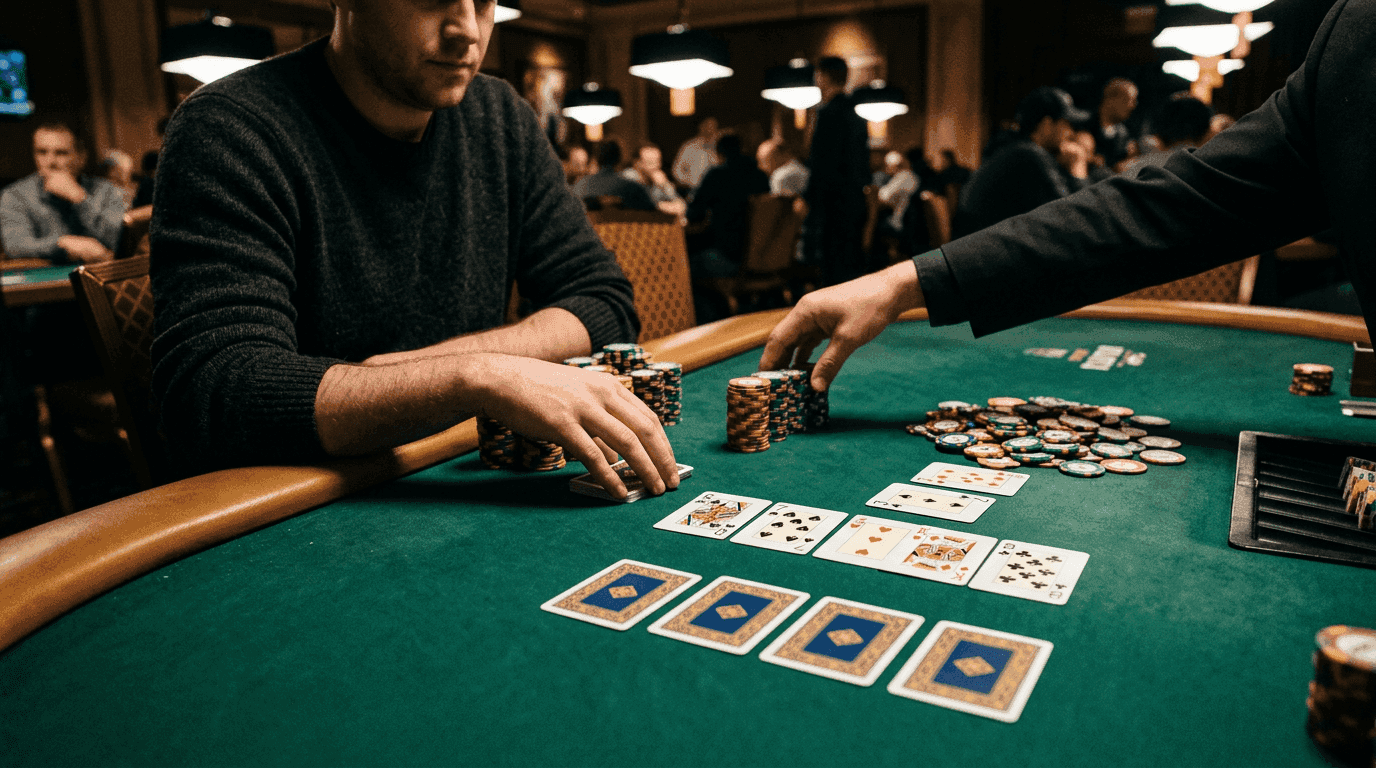
You check-call the flop, check-call the turn, and now you're staring at a river bet on a board that bricked every draw. Your opponent pots it. You tank with top two pair and wonder: how can they have it every time?
They cannot. A lot of the time, the problem is not that villain is uncapped. It is that you did not notice when their line removed enough strong hands that pressure became profitable. That is the heart of capped ranges PLO strategy: recognizing when a passive line lowers the ceiling of a range, then attacking in the right spots with the right blockers.
What a capped range actually looks like
A range is capped when the action taken makes the strongest value hands less likely than they would be in a balanced or aggressive line. The key idea is not that nutted hands are impossible. It is that enough of them have been filtered out that the range has a lower ceiling.
In PLO, that happens often because four-card combinations create many natural raising candidates. For example, a player who cold-calls a 3-bet preflop and then check-calls a monotone flop may still have some flushes, but against most pools the nut flush appears less often than if they had raised. Their line caps them to some degree.
Common capped-range spots include:
- the preflop flat-caller facing a continuation bet
- the flop check-caller on a board where strong made hands often raise
- the player who goes check-check on the turn after calling flop
- the river bluff-catcher line after passive action on earlier streets
If you can identify which premium hands were removed by the line, you can start applying pressure more accurately.
Why capped ranges matter more in PLO than many players think
PLO equities run close, so many players assume pressure matters less than in no-limit hold'em. That is only half true. Because hands run close, fold equity is valuable. And because ranges contain many draws and medium-strength bluff-catchers, a player who misses chances to attack capped ranges often leaves money on the table.
That said, "capped" does not mean "auto-bet." A check-call range on K♥7♣2♠ is very different from a check-call range on J♠T♥8♣. On the first board, passive ranges are often weighted toward one-pair hands and weak backdoors. On the second, a passive range can still contain wraps, pair-plus-draw hands, combo draws, and occasional traps.
That texture difference is where many discussions about capped ranges PLO go wrong.
The debate: solver precision versus exploitative aggression
The community usually splits into two camps.
The solver-oriented camp says players exaggerate how capped ranges really are. They point out that strong strategies keep some very strong hands in passive lines, especially on dynamic boards where protecting a calling range matters.
The exploitative camp says population behavior is simpler than theory. Many players fast-play big hands and under-defend medium-strength bluff-catchers, so if you wait for perfect precision you miss easy barrels.
Both camps have a point.
The solver case: not every passive line is weak
Solver work is useful here because it stops you from turning every check-call into a green light.
First, mixed strategies exist. A theoretically sound player can flat with the nuts sometimes to avoid making their range too transparent. That matters more on coordinated boards where having some very strong hands in a calling line protects the rest of the range.
Second, board texture changes the composition of passive ranges. On K♠8♠3♥, a flop check-call may be relatively capped because fewer robust continuing hands exist. On T♠9♥8♣, check-calling can still include strong wraps, sets with redraws, straights that want protection across later streets, and high-equity combo draws.
Third, overbluffing against a "capped" range is one of the easiest ways to torch EV. If your own line is also face-up, a competent opponent can call wider or spring turn check-raises once your barreling range becomes too bluff-heavy.
So the solver lesson is simple: capped is not binary. It is a matter of degree.
The exploitative case: population usually under-protects passive lines
Now the practical side. In many real games, players do not protect passive ranges very well.
As a baseline heuristic, many low- and mid-stakes players raise sets, made straights, and strong flushes more often than theory would recommend, especially on boards where bad runouts are scary. That means a flop check-call line is often weighted toward medium-strength made hands and draws rather than the top of range. This is a heuristic, not a universal statistic, but it is a reliable starting point for pool-based decisions.
You also do not need exact frequencies to make good exploits. Suppose you hold A♠K♠J♥T♣ on Q♠7♠4♥2♦ after your opponent check-calls flop and checks turn. You have a nut flush draw, a gutshot, and overcard-related equity. If their line removed a meaningful share of sets and two-pair-plus-redraw hands, betting can be strong because you combine live equity with fold equity against one-pair hands and weaker draws.
Street pressure also compounds. If a player check-calls 9♠7♥5♣ and the turn is 2♦, many of their flop continues did not improve. Your range, from their perspective, still contains overpairs, sets, straights, and strong draws. That is why turn barrels versus capped ranges work best when the turn is poor for the defender's continuing region.
For related study, see how to play draws in PLO.
Where both sides get it wrong
The solver camp often overestimates how often ordinary opponents trap. Yes, traps exist. But in a lot of player pools, strong hands are fast-played too often for you to ignore profitable aggression.
The exploitative camp often underestimates texture. That is the bigger mistake.
A capped range on K♥7♣2♠ is usually more attackable than a capped range on J♠T♥8♣. Why? Because even when both ranges are capped, the second board leaves the defender with more high-equity continues: wraps, pair-plus-wraps, strong two-pair combinations, and flush-draw structures depending on suits.
You do not need an exact database number to justify that claim, but you should support the equity idea with examples. Take two representative hands on J♠T♥8♣:
- Q♠9♠7♦6♦ has strong straight connectivity and often robust equity against one-pair or overpair bluffs.
- K♣K♦6♠5♠ on K♥7♣2♠ is a much cleaner value hand facing a passive range that contains fewer natural continues.
You can test how dynamic connected boards preserve more equity for the defender with the PLO equity calculator. For example, compare a connected draw such as Q♠9♠7♦6♦ against a likely aggression candidate on J♠T♥8♣, then compare medium-strength continues on K♥7♣2♠. The point is not a single exact percentage; it is that connected boards leave the capped player with far more resilient continues.
Most mistakes come from treating all capped ranges the same. In practice, the degree of cappedness depends on three things working together:
- opponent tendency
- board texture
- your specific blockers and backup equity
For more on blocker logic, read blockers in PLO.
My approach: exploit first, but only with the right blockers
Against most player pools, my default is still exploitative. If a passive line removes enough strong value, I want to attack. But I do not attack just because a range is capped. I attack when my hand interacts well with the opponent's continuing range.
That distinction matters.
The best bluffing blockers are usually not the cards that block folds. They are the cards that block calls.
Suppose the board is J♠9♥6♣4♦ and your opponent check-called the flop. You hold Q♠T♠8♥7♣. This hand is attractive because:
- it blocks key straight continues
- it blocks some strong pair-plus-draw structures
- it has live equity when called
Now compare that to A♠A♥K♥K♦ on the same board. Your hand may look pretty preflop, but here it blocks less of villain's natural continue region and has far less playability when called. The range may be equally capped, yet the bluff quality is much worse.
You can explore how these properties matter with the equity calculator. The exact output will depend on the villain hand or range you enter, but the exercise shows why hands with connectivity and relevant blockers make better barrels than disconnected overpairs.
How stronger opponents fight back
Better opponents protect capped ranges in two main ways.
First, they retain some very strong hands in passive lines. They may check-call the flop with a set, a made straight, or a strong flush on boards where raising everything would leave their continuing range too weak.
Second, they punish over-barreling with turn aggression. If you attack every capped range automatically, a thinking opponent can respond with turn check-raises, delayed traps, and wider bluff-catches once they see your value region is too thin.
That means your bluffing criteria should tighten versus good regulars. You want:
- better blockers
- more equity when called
- better positional advantage
- better turn and river runout coverage
Position magnifies all of this, so if you need a refresher, see position in PLO.
Practical rules for attacking capped ranges PLO
Here are useful baseline heuristics:
- Attack more on dry or semi-dry boards. K♦7♣2♠, Q♥6♦3♣, and similar textures create more fragile check-call ranges.
- Attack less on highly connected boards. J♠T♥8♣ and 9♦8♦6♠ leave the defender with too many strong draws and robust continues.
- Prefer hands that block calls. Straight blockers, nut flush blockers, and cards that interfere with two-pair-plus-draw continues are valuable.
- Prefer hands with backup equity. Bare air performs badly in PLO because calls happen often.
- Barrel turns that are poor for the defender. Bricks that do not improve pair-heavy or draw-heavy continues are the best pressure cards.
- Slow down versus players who trap or check-raise well. Capped-range attacks are pool-dependent.
A simple contrast helps. On 9♥6♣2♠5♦ after a flop check-call, K♠Q♠J♥T♣ is often a poor turn bluff. It has limited relevant blockers and weak realized equity when called. By contrast, T♠9♣8♥6♦ blocks stronger continues, has pair-plus-draw properties, and can continue on more rivers. Same range spot, very different hand quality.
That is the real skill in capped ranges PLO strategy. Noticing the cap is step one. Choosing the right hand and board to attack is where the money comes from.
FAQ
How do I know whether a range is truly capped or just somewhat capped?
Think in degrees, not absolutes. A line is more capped when the player type fast-plays strong hands, the board is dry enough that raises are natural, and later actions keep removing premium holdings. It is less capped when the board is dynamic, the opponent is strong, or the passive line is one theory would naturally protect.
Which boards are best for attacking capped ranges in PLO?
As a baseline heuristic, dry and semi-dry boards are the best targets because passive ranges contain more one-pair and weak draw holdings there. Boards like K♥7♣2♠ or Q♦5♣3♥ are usually better than J♠T♥8♣, where the defender still has many high-equity continues. You can compare example equities on the equity calculator to see how much more resilient connected-board continues are.
Do blockers matter more than position when attacking capped ranges?
Both matter, but blockers often decide whether the bluff is good. Position gives you the chance to apply pressure after a check. Blockers determine whether your hand interferes with villain's calling range enough to make the bet attractive. The best attacks usually combine position, useful blockers, and some backup equity.
Should I attack capped ranges differently in 6-max than in full-ring PLO?
Yes. As a baseline heuristic, 6-max games create wider preflop ranges and therefore more weak or medium-strength postflop continues after passive lines. That usually increases the value of attacking capped ranges. In tighter formats, passive lines start stronger on average, so your bluff selection should be more careful.