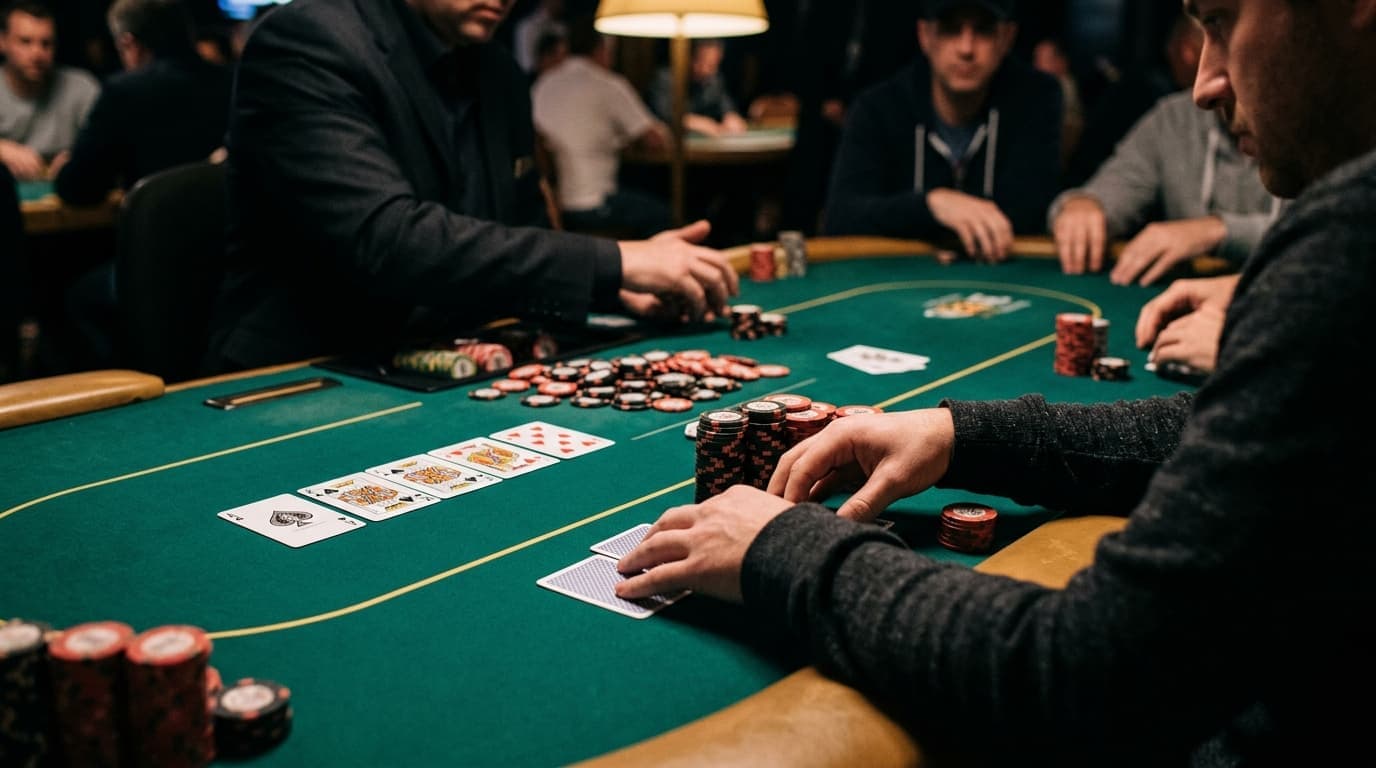
You hold K♠Q♠J♥T♥ in a $2/$5 PLO game. The flop comes K♥9♠4♠. You have top pair, a flush draw, and a gutshot. It looks like a dream. You bet, get raised, and call. The turn is the 2♠, completing your flush — but only the second-nut flush. You bet, your opponent shoves, and you call. They show A♠8♠7♥6♥. The river is irrelevant. You lose a 200 big blind pot with a hand that looked beautiful on every street.
That is reverse implied odds in PLO.
The idea is simple: reverse implied odds measure how much money you stand to lose when you make a strong hand that is still second best. In No-Limit Hold’em this matters in some spots. In Pot-Limit Omaha, it shapes hand selection, flop decisions, and stack-off thresholds constantly. Four hole cards create more draws, more nutted combos, and more situations where a hand that looks huge is actually expensive to continue with.
That is why pretty hands lose so much money in this format. Missing is often cheap. Hitting the wrong part of the board is what empties stacks.
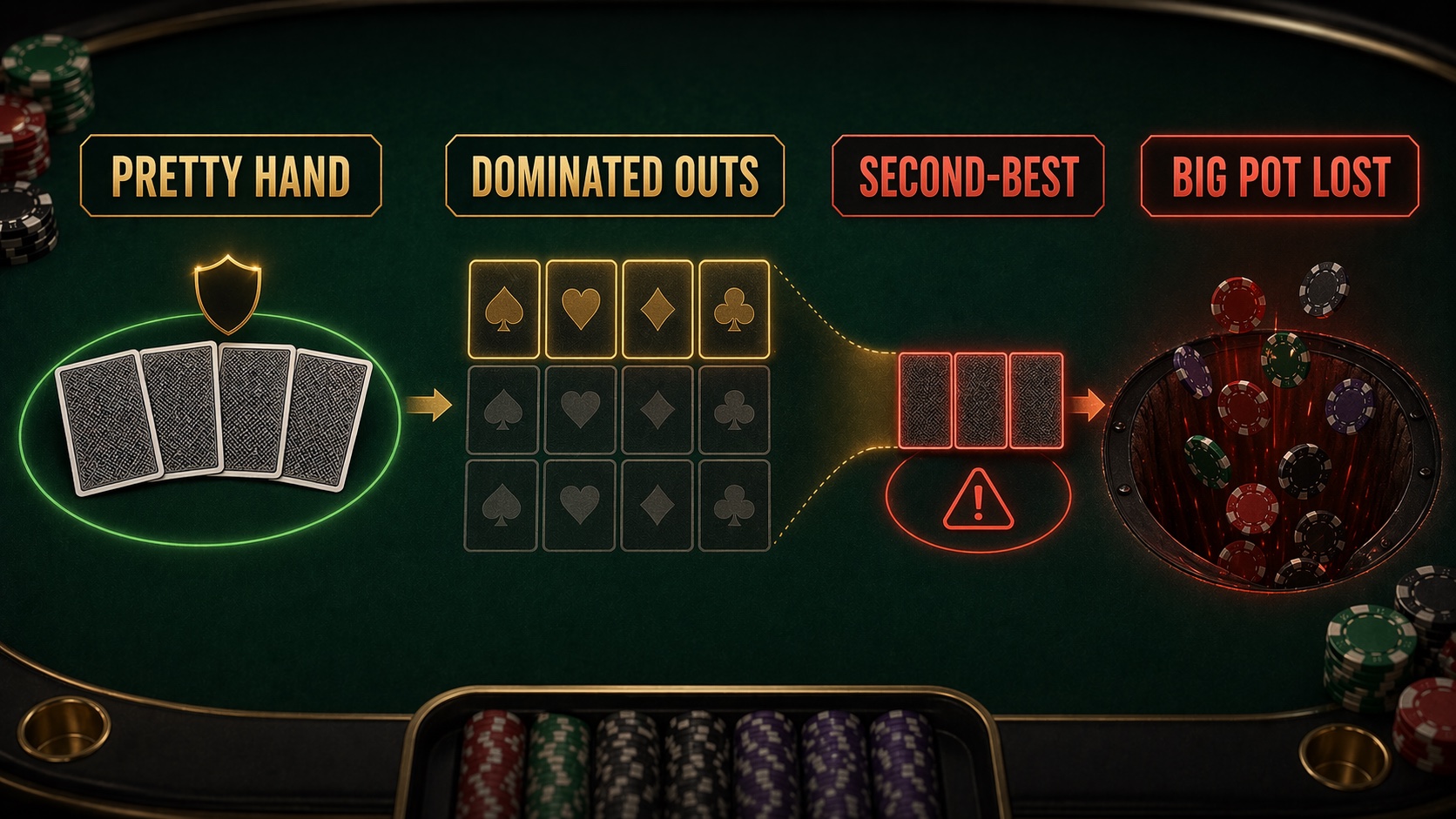 Inline visual: reverse implied odds are most expensive when a hand looks strong enough to continue but not nutted enough to withstand pressure.
Below are the spots where reverse implied odds PLO players ignore most often, and why those leaks get worse as pots and stacks grow.
Non-Nut Flush Draws on Two-Tone and Monotone Boards
You hold Q♠J♠8♥7♥ and the flop comes T♠6♠3♣. Second-nut flush draw, some straight potential, plenty of visual appeal. But the real question is not how strong your draw looks right now. It is what happens when a spade arrives and serious money goes in.
If you make a queen-high flush, you are still in poor shape against any A♠X♠ hand. In a multiway PLO pot, that is not a rare disaster. It is one of the most common ways players overplay draws and then overplay made hands one street later.
The danger increases when your flush draw is bare, especially out of position. Calling a flop bet with K♣Q♣9♦4♥ on J♣7♣2♠ can be reasonable if stacks and price are right. But once a club hits, your made hand is difficult to value bet and difficult to call down with against heavy action. You often end up building a pot exactly when your range is capped below the nuts.
This is why nut-flush potential matters so much in Omaha. It is not only about raw equity on the flop. It is about how safely you can continue after improving. For a related breakdown, see non-nut flushes in PLO.
Small and Medium Sets on Coordinated Boards
Sets are strong in PLO, but board texture decides whether they are stack-off hands or bluff-catchers with redraws.
Take 7♠7♥6♦5♦ on Q♠J♥7♣. Bottom set is a strong made hand, yet the board heavily favors wraps and combo draws. Hands containing KT, T9, or T8 with side connectivity can have enormous equity, and many turn cards either complete a straight or make future streets awkward. If the board runs out through T, 9, or 8, your set can quickly become a hand that only wants to boat up.
The key distinction is not just set versus draw. It is set quality plus redraw quality.
Compare bottom set on Q♠J♥7♣ with top set on the same board. Top set has far better full house coverage because more board-pair runouts improve you. Bottom set often ends up depending on fewer clean runouts and is more vulnerable when the money goes in early.
You can test how redraws change these spots with the equity calculator. For example, bottom set versus a strong wrap on a coordinated flop is rarely the crushing spot newer players imagine. That is exactly where reverse implied odds PLO mistakes begin: you flop “too much hand to fold,” but not enough structural safety to stack off blindly.
For more on that principle, see redraws in PLO.
Bare Overpairs After the Flop
One of the most common transition leaks from Hold’em to Omaha is overvaluing overpairs after the flop.
Suppose you have A♦A♣8♥2♠ on 9♠7♥4♣. In Hold’em, aces on a board like this can still dominate. In PLO, this hand is just one pair with almost no ability to improve. No flush draw. No meaningful straight draw. No robust redraw path if raised.
Against a made set, you are usually in very poor shape. Against a wrap, you may not even be ahead. You can examine one example here:
This is where reverse implied odds PLO players donate quietly. They raised preflop, still hold an overpair, and the board does not look terrifying by Hold’em standards. They bet, get called, keep betting, then face a raise in a pot that is already too large for one pair. Because their hand almost never improves cleanly, later money goes in under severe pressure.
The fix is not to fold every overpair automatically. The fix is to separate A♠A♥K♠Q♥ on T♠9♠3♦ from A♦A♣8♥2♠ on 9♠7♥4♣. One has robust equity and nutted paths. The other mostly has hope.
Dominated Rundowns Facing Strong Ranges
A hand like 8♠7♠6♥5♥ is attractive. It is connected, double-suited, and easy to fall in love with. But hand quality in PLO is relative to the ranges involved.
Calling with that hand on the button against one open can be fine. Facing a three-bet from a strong range is different. The problem is not that 8♠7♠6♥5♥ is unplayable. The problem is that stronger rundowns and high-card connected double-suited hands dominate many of the same boards.
When you make a straight with 8♠7♠6♥5♥, it is often not the nut straight. When you make a wrap, your opponent’s wrap may run above yours. When you both connect, the higher structure usually performs better under pressure.
For example, boards like 9♦6♣4♠ or T♣7♦3♠ can look ideal for the lower rundown, but those are exactly the textures where hands such as J♦T♦9♣8♣ or T♠9♠8♥7♥ keep making higher straights, stronger wraps, or better redraws.
That is reverse implied odds again: you connect, commit, and find out your made hand lives in the second tier.
Rather than using a rigid rule like “always fold if your top card is an 8,” treat this as a baseline heuristic: lower rundowns lose value against tighter and more premium preflop ranges, especially out of position and deep. The best connected hands in best starting hands in PLO share one trait: they reach the nuts more often and hold redraws when they do.
Straight Draws That Make Vulnerable Straights
Not all open-ended straight draws are equal in Omaha.
J♥T♦9♣8♣ on Q♠7♠6♠ gives you strong straight potential, but the board already contains a made flush possibility. Even if you hit a straight on a non-spade turn, your hand may not be comfortable against continued aggression, and flush redraws can still threaten you on later streets.
The problem becomes much worse when your draw makes the low end. With 9♥8♦7♣6♣ on T♠5♠2♥, a 4 gives you 6-7-8-9-T — a straight, but not the nut straight. A J gives you 7-8-9-T-J, which can still lose to Q9. Add a two-spade board or deeper stacks and the apparent value of your draw drops sharply.
This is one of the cleanest reverse implied odds PLO concepts to internalize: a draw is not automatically valuable just because it is open-ended. Ask two questions instead. When I get there, do I make the nuts? And if I do not, can I still face action from better hands or redraws?
Those questions matter more than the visual neatness of the draw itself.
Deep Stacks Make Second-Best Hands Costlier
Stack depth does not create reverse implied odds, but it magnifies them.
Losing with the second-nut flush at 100 big blinds hurts. Losing with the second-nut flush at 200 big blinds hurts twice as much in the most literal sense. That is not strategy theory; it is arithmetic. The strategic point is that deeper stacks increase the penalty for continuing with hands that make strong but non-nutted holdings.
This is why deep live PLO games punish loose preflop curiosity so hard. A hand that might realize enough equity in a shallower pot can become a clear loser when there is much more money behind and both players can keep betting on later streets.
Position matters here too. In position, you can check back more medium-strength made hands, decline thin value bets, and avoid stacking off when a scary card completes obvious nutted parts of the board. Out of position, you are forced to define your hand earlier and defend more guesswork against large bets.
If you want to improve your threshold for these decisions, study position in PLO alongside stack depth. Reverse implied odds PLO leaks are rarely just about the hand itself. They come from the interaction of hand class, board texture, position, and remaining stacks.
Pretty but Disconnected Double-Suited Hands
A♠K♠5♥3♥ looks tempting. It is double-suited, contains premium ranks, and resembles a hand that should print money. In reality, it often creates awkward one-pair spots and thin draw situations.
Yes, making the nut flush is valuable. But that does not happen often enough to justify treating the hand like a premium connected double-suited holding. Most of the time, its postflop life is shaped by top pair, overpairs on bad boards, weak wheel draws, or one strong suit with no coordinated backup.
Put A♠K♠5♥3♥ on K♦8♣6♣. You have top pair and little else. On A♥9♦7♣ you have top pair with a gutshot, but many continuing ranges have wraps, two pair, sets, or stronger pair-plus-draw structures. The hand keeps making something, but not enough.
That is what makes it a reverse implied odds trap. The preflop appearance encourages investment. The postflop structure fails to support that investment when real resistance appears.
A better filter than “it is double-suited, so it must be good” is this: how often does the hand make the nuts, and how often does it make a hand that looks playable but hates pressure? If the answer leans toward the second category, the hand is much weaker than it looks.
The Core Question Behind Every Expensive Mistake
The thread connecting all these spots is simple: in Omaha, expensive mistakes often come from hitting, not missing.
Second-nut flushes, vulnerable sets, bare overpairs, low-end straights, and pretty disconnected high-card hands all share the same flaw. They produce hands that look strong enough to continue, but not strong enough to withstand concentrated action.
That is the practical meaning of reverse implied odds PLO players need to remember. Before calling with a draw, betting a medium-strength made hand, or stacking off on a coordinated board, ask one question:
If I improve, can I still lose a huge pot?
If the answer is yes, slow down. Many of the prettiest hands in PLO are expensive precisely because they tempt you to keep building when the nuts are still far more plausible on the other side.
FAQ
What does reverse implied odds mean in PLO?
Reverse implied odds describe the money you can lose after making a strong hand that is still second best. In PLO, this comes up constantly because four hole cards create more draws, more nutted combinations, and more dominated made hands than in Hold’em.
Are non-nut flush draws always bad in PLO?
No. Their value depends on position, stack depth, side-card strength, and whether they come with extra equity such as a pair or straight draw. A bare K♣Q♣ draw is much riskier than a second-nut flush draw paired with a wrap or strong blockers. The issue is not the draw alone, but how safely you can continue after improving.
Why are bare aces so often overplayed after the flop?
Because players import Hold’em instincts into Omaha. A hand like A♦A♣8♥2♠ can be premium preflop and still become fragile on a board like 9♠7♥4♣. Without redraws, bare aces often have only one pair and poor future playability. The equity calculator is useful for seeing how quickly that edge disappears on connected boards.
How should stack depth change my approach to reverse implied odds PLO spots?
Use stack depth as a baseline heuristic for caution: the deeper the stacks, the more you should prefer hands that make the nuts and carry redraws. Deep money gives opponents more room to punish second-best flushes, lower straights, and vulnerable sets. That usually means tighter preflop selection and more discipline when strong-looking but non-nutted hands improve.