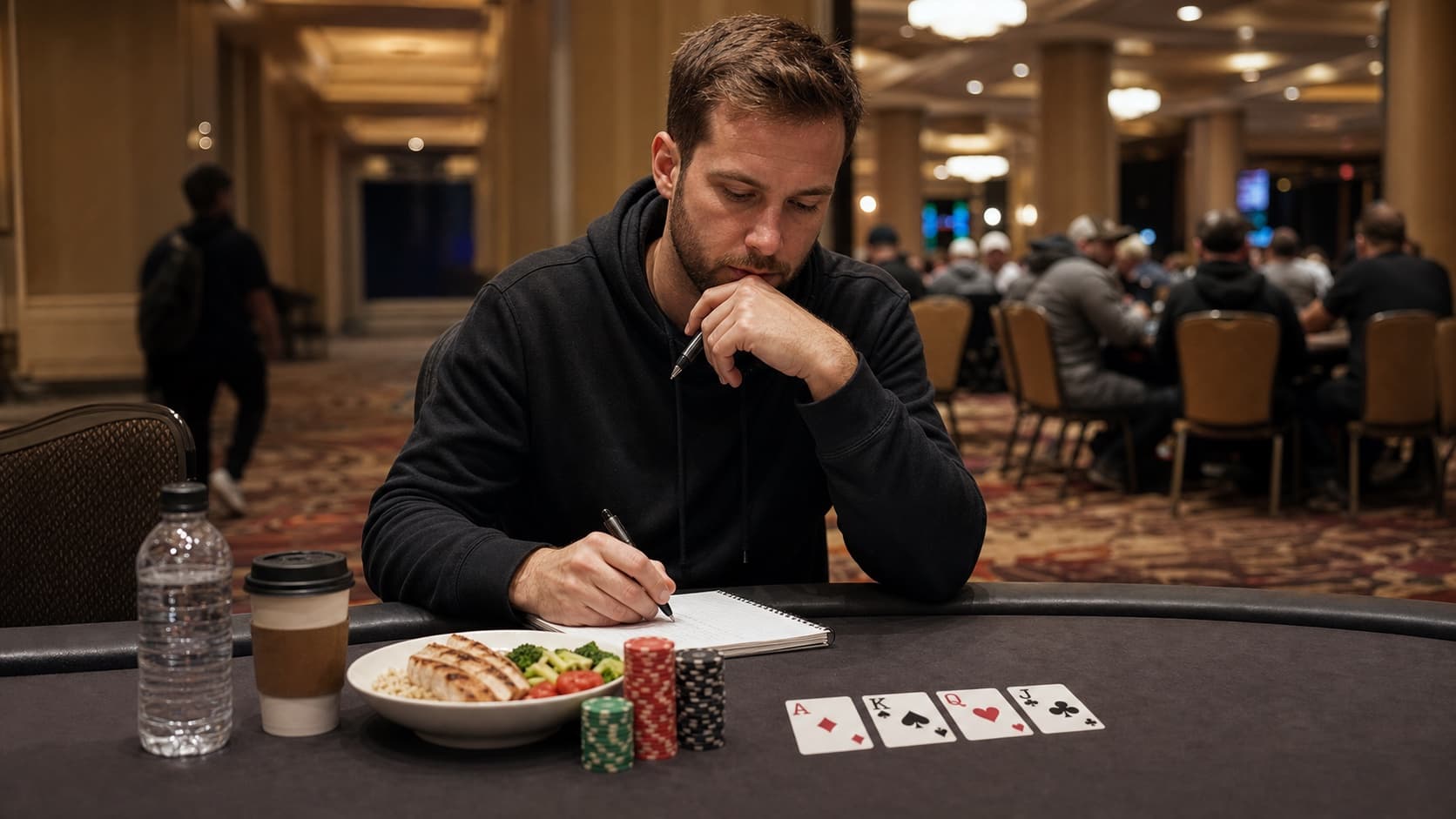
Healthy food near WSOP matters because long poker days turn ordinary body signals into betting decisions.
You sit down feeling fine. By level four, the fold you usually find becomes "close." The turn barrel you usually check back becomes automatic. The soft player leaves, but you keep playing because leaving feels like losing.
This is not a diet plan. It is a PLO mental-game operating rule for protecting the next two levels of execution.
The official 2026 WSOP schedule lists the bracelet series at Horseshoe / Paris Las Vegas, so the problem is simple: long sessions, short breaks, casino food friction, hydration, caffeine, and re-entry decisions collide.
Make Food an Execution Rule
Use one pre-session rule:
Decide meal timing, hydration, caffeine cap, and quit/rebuy trigger before you sit down.
It prevents the predictable crash. If a heavy meal makes you sluggish, go lighter during play. If extra caffeine makes you shaky, cap it before the second cup starts negotiating for you. If hunger makes every pot feel urgent, treat the next break as part of your strategy, not an interruption.
Good food planning answers one poker question: "Will this choice help me make the next close PLO decision clearly?"
Three-Bucket Execution-Decay Diagnostic
Use these three buckets to separate normal variance from a process problem.
- Technical triggers: Physical signal: thirst, heavy stomach, or shaky focus. Poker symptom: you skip SPR checks, miscount the pot, or fire a pot-sized bet before deciding which worse hands continue. Default action: pause on the next break, drink water, and review the last orbit before continuing.
- Emotional triggers: Physical signal: hunger after a losing orbit. Poker symptom: urgency replaces range logic, and folding feels like surrender. Default action: sit out if possible, eat something small, and decide again after the first wave of emotion passes.
- Game-selection triggers: Physical signal: fatigue makes a worse seat feel acceptable. Poker symptom: you stay after the soft spot leaves or keep playing because you are already invested in the day. Default action: table-change, move down, or quit.
The diagnostic is intentionally plain. When you are tired, clever systems fail. You need labels you can use in a hallway, not a theory chart you admire later.
Break Ladder For Horseshoe And Paris
Copy this ladder into your phone before the series.
| Level | Signal | Process check | Action |
|---|---|---|---|
| Green | Not thirsty, rushed, shaky, or heavy | Last big decision is explainable | Continue after water or a protein-forward snack |
| Yellow | Hungry, over-caffeinated, or sped up | You skipped an SPR check or called because folding felt annoying | Pause before rebuying or late-registering |
| Orange | Food, fatigue, and lineup all deteriorate | The game is tougher and your process is slipping | Leave the table before another buy-in |
| Red | Same Yellow signal ignored twice | You forced a thin stack-off or bad bluff after naming the warning | Review tomorrow before playing again |
Tie the ladder to money. A rebuy can fit your PLO bankroll management plan and still be wrong if your execution has already dropped. The reverse is also true: losing a standard pot with a clear process is not a reason to quit a good lineup.
Worked Example 1: Tournament Variance Or Food Leak?
Early in a long WSOP-style PLO tournament day, you lose a medium 100bb single-raised pot with A♠A♥K♠J♥. You opened, got two loose callers, c-bet a reasonable K♥9♠4♣ flop, and folded the river when the front-door draw completed and the tight player finally led big.
That can be normal variance. You can explain the open, flop sizing, turn plan, and river fold without rewriting the hand to protect your ego.
Default action: continue after water and food on the next scheduled break.
Later, at 40bb, you lose two small pots and start thinking about the next event. You are hungry, rushed, and annoyed. Now A♠K♠Q♥J♥ on J♠T♦7♣ feels like a hand you "have to" force because waiting feels unbearable.
That is different. The hand has playability, but your motive is broken. You are no longer asking whether your equity, blockers, and stack depth justify pressure. You are trying to make the level end.
Default action: pause. If you cannot reset, skip the next event instead of turning one tired level into two bad buy-ins. Pair this with your late-registration rules, not with whatever emotion is loudest.
Worked Example 2: 100bb Cash And The Hungry Turn Barrel
- Positions: Hero opens cutoff with A♠K♠J♦9♦. Loose button calls. Competent big blind squeezes. Hero calls; button calls.
- Stacks: 100bb effective.
- Lineup: Button is the reason the game is good; big blind is strong enough to punish autopilot.
- Board texture: K♦T♣6♠ is dynamic and multiway. Hero has top pair plus straight/backdoor potential, but not a hand that prints money into two sticky ranges.
- Flop action: Big blind checks. Hero bets too fast. Button calls. Big blind calls.
- Turn action: 3♥. Big blind checks again. Hero barrels large without rechecking SPR, fold equity, or which worse hands continue.
- Leak/stable marker: The leak is speed plus hunger. A stable marker would be pausing before the flop bet and asking: "Am I betting because this hand wants to build a pot, or because I am tired and want the hand to end?"
Default action: quit for food and review later. Do not rebuy immediately just because the game is technically within your bankroll limits.
Hard Caps Versus Execution Stops
Hard caps help when the risk is predictable: no extra caffeine when already shaky, no heavy meal before late levels if it reliably makes you sluggish, and no rebuy when you cannot explain the last big pot.
Execution stops handle mixed signals. Normal variance plus stable process means continue. A softer table plus deteriorating focus may still mean stop. The point is not to become precious about food. The point is to stop preventable fatigue from choosing your calls, barrels, and stop-loss decisions.