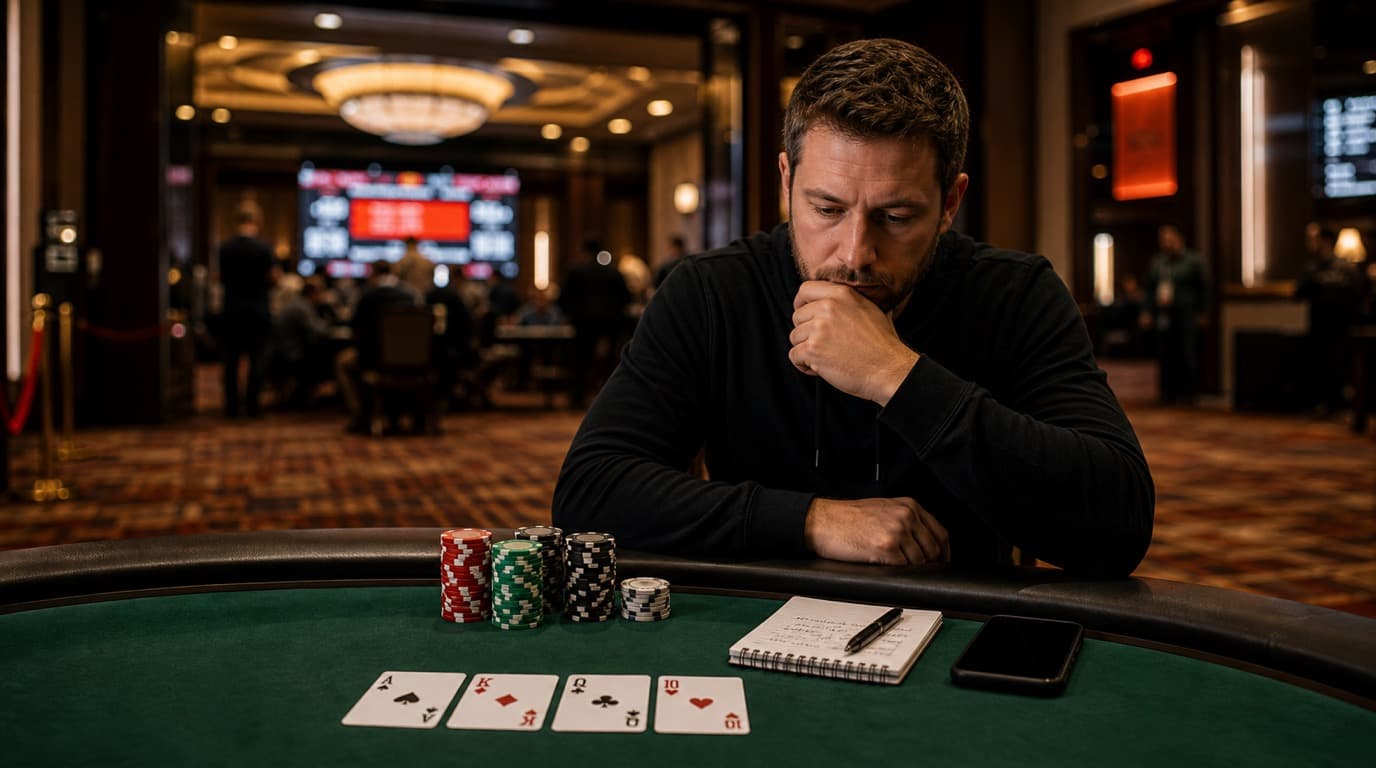
You want the bigger stack, but you also know PLO punishes tired decisions faster than most tournament formats.
That is the real WSOP PLO late registration problem. It is not just “How many chips do I miss?” It is “Can I still convert the stack I buy?”
Late registration is a bankroll and mental-game decision disguised as a tournament-structure decision. A deeper stack is valuable only when your bankroll, table edge, and freshness let you play the next close PLO spot well. If those three inputs are not green, more chips can simply give you more room to make expensive tired mistakes.
Before you use any specific event detail, verify the official WSOP structure, starting stack, late-registration window, and re-entry rules. For the broader summer schedule, pair this with a full WSOP PLO prep plan. The framework below is deliberately about the decision, not a claim that one registration time is always best.
The Rule: Buy Stack Only When You Can Use It
Use one rule:
Register earlier when deeper stack depth increases your edge and you are rested enough to navigate multi-street PLO decisions. Late-register when freshness prevents more mistakes than the missing chips cost. Skip or refuse a re-entry when bankroll pressure or execution decay has removed the edge.
That gives you three clean options.
| Decision | Best when | Bad sign | Default action |
|---|---|---|---|
| Register early | You are rested, bankrolled, and have a real deep-stack edge | You are entering early only because you fear missing value | Buy the full structure |
| Late-register | You are fresh, the event is still playable at the entry stack, and shorter-stack PLO decisions suit your study | You are using late registration to avoid tough deep-stack spots | Enter with a written plan |
| Skip or no re-entry | You are tired, underbankrolled, tilted, or facing a bad lineup | You are buying chips to repair emotion | Walk away or review |
The mistake is treating the starting stack as pure upside. In PLO, stack depth is only valuable if you can use it. A tired player with 100bb can leak more than a fresh player with 40bb because the deeper stack creates more turn and river decisions, more pot-sized pressure, and more chances to overplay non-nut equity.
Diagnose Execution Decay Before You Blame Variance
PLO variance is loud. Execution decay is quieter. You need to separate them before deciding whether to enter, re-enter, or stop.
Use three buckets:
| Bucket | What it looks like | Registration decision |
|---|---|---|
| Normal variance | You followed the plan, got money in with sound equity, and lost | Continue if bankroll and table edge are intact |
| Yellow execution | You are slower, annoyed, hungry, or missing obvious SPR details | Pause, eat, walk, or late-register later |
| Red execution | You are widening ranges, rushing pot bets, or chasing a lost bullet | Skip the re-entry |
Normal variance example: you raise A♠A♥K♠J♥, get two loose callers, and play a low-SPR K♥9♠4♣ flop where weaker kings and backdoors can continue too wide. If your preflop sizing, SPR plan, and flop commitment were sound, losing the pot does not mean the late-registration decision was wrong. That is PLO variance doing what it does.
Execution-decay example: after a losing orbit, you force Q♣J♣T♦9♦ into a dynamic board against tighter players because you want chips back. The hand may be playable, but the motive is broken. That is the moment to pause before buying another bullet.
Fuller PLO Hand Breakdown: Fresh 40bb Late-Registration Spot
Here is the exact kind of hand that shows why freshness can beat a bigger stack.
You late-register fresh into a hypothetical WSOP-style PLO event with 40bb effective. You are in the cutoff with Q♣J♣T♦9♦. The lineup has two tired big stacks who over-call too wide, a competent button, and blinds that are not squeezing enough.
Action folds to you. You open the cutoff. The button folds. The small blind folds. The big blind calls. You go heads-up to the flop with position and an SPR low enough that one pot-sized mistake can shape the tournament.
The flop is J♠T♥7♣.
You have top two pair plus wrap components, but the board is dynamic. Your hand is strong enough to bet for value and protection against worse two pair, pair-plus-draw, and dominated straight draws. It is also vulnerable enough that potting automatically can create a bad stack-off against sets, stronger wraps, or hands with cleaner redraws.
Decision point one: big blind checks. A stable process chooses between a smaller bet and a check back based on opponent response. Against a passive caller who over-peels, betting smaller is attractive because worse hands continue and you preserve room for turn decisions. Against a check-raise-heavy blind, checking back can be better because you deny them the chance to force your whole stack in before you understand the turn.
Decision point two: you bet, and the big blind check-raises. The tired-player leak is calling off because “I late-registered and need chips.” The stable-process marker is different: ask which hands you beat, which turns improve you, and whether villain has enough dominated raises.
Now give yourself two turn cards.
If the turn is 2♠ after your flop bet gets called, much of the board texture stays similar. You can continue value-betting against worse two pair and straight draws if the opponent over-calls. If the turn is 8♣, the board changes sharply. Straights complete, club equity appears, and your hand becomes more about blockers, pot control, and avoiding a tired stack-off.
That is the difference late registration is supposed to buy: not magic short-stack luck, but the ability to pause, classify the turn, and execute the plan you already had. The fresh 40bb player can make that decision. The tired 100bb player often just sees top two plus activity and tries to win the full stack immediately.
The Re-Entry Red-Flag Ladder
Before any WSOP PLO re-entry, run this ladder in order.
- Bankroll: the next bullet must fit your written PLO tournament budget. If it touches cash-game money, travel money, or life money, stop. Build the plan first with PLO bankroll management.
- Freshness: no registration after two rushed pot-sized decisions in one orbit. Walk, eat, hydrate, and check your mental game before another bullet.
- Lineup: continue only if one clear edge remains: weak blind defense, loose over-calling with non-nut draws, obvious fatigue, or overfolding to turn pressure.
- Stack-depth competence: if very late entry leaves shallow PLO nodes you have not studied, do not buy in just to gamble.
- One-hand review: write one hand, one emotion trigger, and one table-selection note. If the leak is emotional, review mental game for PLO before another bullet.
This ladder is intentionally stricter than “Do I feel like playing?” PLO gives tired players too many plausible excuses. Every hand has equity. Every bad call can be explained as variance. A written ladder keeps the decision from drifting.
When Hard Caps Help and When They Hurt
Hard caps are useful when access, ego, or travel pressure can override judgment. “Two bullets maximum” is a clean rule if the main risk is bankroll creep. “No re-entry after midnight” can be a good rule if fatigue reliably turns your close decisions into guesses.
But hard caps can also become lazy. Quitting a soft table after one standard cooler while you are still rested and executing well is not discipline. It is fear wearing a responsible outfit.
Use hard caps for the risks that numbers control: bullets, time, and bankroll. Use the execution diagnostic for the risks numbers cannot see: fatigue, tilt, lineup change, and whether your actual PLO edge is still present.
If you are unsure whether a downswing is ordinary noise or a meaningful bankroll risk, model the swing with the variance simulator. Then come back to the real question: are you still capable of playing the stack you are buying?
FAQ
Is late registration bad in WSOP PLO events?
Not automatically. Late registration can be good when you are fresher, the remaining stack is still strategically playable, and your bankroll plan supports the entry. It is bad when it becomes an excuse to gamble short or avoid deeper PLO decisions you need to study.
Should I always register early to get the full starting stack?
No. A full stack is valuable only if you can use it. If you have a strong deep-stack edge and are rested, early entry is attractive. If you are exhausted or likely to make bigger mistakes with more streets available, freshness can matter more than the extra chips.
How many re-entries should I allow myself?
Set the number before the event from your bankroll plan, not from how the first bullet felt. The right cap depends on your bankroll, edge, travel schedule, and emotional control. If the next bullet would change how you play, it is too expensive.
What is the biggest late-registration leak in PLO?
The biggest leak is buying a stack after your decision quality has already dropped. PLO hands always look playable enough to justify one more call, one more pot bet, or one more bullet. The good late-registration decision protects execution first.