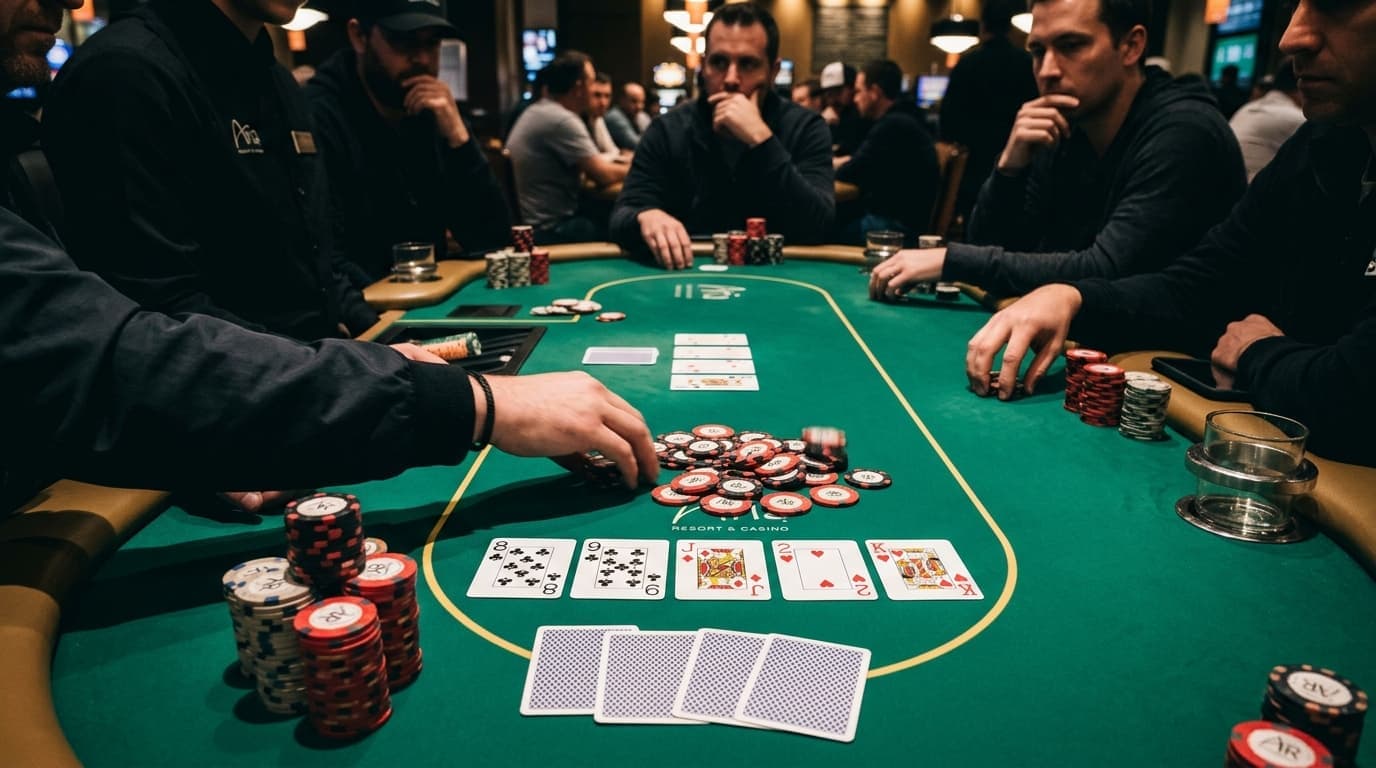
Two players check to you on a live multiway river. You hold the bare A♠ on a three-spade board, and every instinct imported from heads-up pots says pot it — nobody calls without the nuts. Here is the arithmetic that instinct skips: a pot-sized bluff has to work half the time to break even.
Now suppose both opponents are massive overfolders who each give up 70% of the time. Your bluff needs both folds, and 0.70 × 0.70 = 0.49. You found the two most foldy players in the room and still lost money. Multiway rivers do not punish bad bluffs; they punish bluffs priced for one opponent.
That compounding is the whole subject of live PLO multiway river decisions, because the river is the only street where nothing can rescue a called bluff. On the flop or turn, a called bluff keeps outs, position, another card, another story. On the river it keeps a number, and the number is usually this one: hold A♠K♦J♣9♦ on Q♠8♠4♥2♣6♠ and the weakest hand that can look you up — one bare pair of queens — wins at showdown 100.0% of the time. Your ace-high has 0.0%.
So a multiway river bet is never a hand — it is a purchase of folds, one player at a time, at a price that compounds with every player still in. The playbook is three moves in strict order: label the board, multiply the folds, and only then ask what your blockers are worth.
Board Coverage Decides Before Your Cards Do
Every multiway river takes one of three labels: covered (several ranges reach the nut region), capped (earlier action removed the nuts), or abandoned (the field quit and the river bricks the draws). Diagnosing a cap street by street is capped ranges in PLO's job; this article assumes that read and prices what the cap is worth once three players share the pot. The short version: bluffs live on abandoned rivers, negotiate on capped ones, and die on covered ones.
If it feels wrong that a label outranks your four cards, watch the same two hands trade places. On a J♠9♠6♦ flop, J♥J♦T♥8♦ is top set against the two-pair hand A♣J♣9♣8♥ — a 98.2% favorite.
Move the identical hands to K♣T♣4♦ and the jacks are a 44.5% underdog to the same opponent's bare ace-high.
Neither hand changed; the board changed which one owns it. A multiway river runs that ownership question across every range still standing — so the first question is never "is my card scary," it is "whose range contains this river," the same test that decides nut advantage in multiway pots.
Multiply the Folds Before You Pick a Victim
River bluff math is short. A pot-sized bet needs folds 50% of the time, two-thirds pot needs 40%, half pot needs 33.3% — those are the prices before anyone finds a raise.
Multiway, you do not get to shop per player. One opponent who folds 70% clears every one of those prices; the second caller is what drags the product below break-even, and a third cuts it to 34%. Stretch it to four opponents — one limped family pot — and even a table full of 80% folders multiplies out to about 41%: still a loser at full price. No blocker anywhere in the deck buys that back. Hence the one-fold rule: bluff a multiway river only when prior action has already collapsed it into a heads-up problem — every player but one so capped and so weak that only one decision at the table matters. You are never really bluffing three people. You are bluffing one person who happens to have company, and if a second genuine caller exists, no bet size fixes the price.
One calling station vetoes the play outright. A station never folds, so your chance of collecting every fold you need sits near zero no matter how the others play. Short stacks veto it more quietly: live multiway pots routinely reach the river with the pot as large as the money behind, and a "pot-sized" bluff that is really a shove for less threatens nobody. A player who feels priced in stops folding, so check the stacks before you check your blockers — deep rivers leave room to pressure, short ones only leave room to get looked up.
The fold rates themselves come from observation, not theory: face-up folds of flushes and straights push a player's number up, sticky showdowns with weak pairs drag it down, and the speed of earlier calls tells you whether the river reached them with a plan or a hope. Two defaults protect you when the sample is thin. First, price the unknown player as a caller — multiway pricing punishes optimism far harder than it rewards it. Second, distrust any "one-fold spot" that heavy action created: if a turn pot bet thinned the field to a single caller, you did not find a capped victim, you found the survivor of a filter, and survivors run nutted. The one-fold rule wants a field that went quiet on its own, like the checked-through turn in the next hand.
A Bluff That Clears the Bar
Now give the hand that opened this article its verdict, with the full context in view. Live $2/$5: hero opened A♠K♦J♣9♦, c-bet the Q♠8♠4♥ flop into two callers, watched the 2♣ turn get checked through, and faces that three-spade river with the field checking again.
The filters pass. The label: capped — both opponents checked back a turn they would usually attack with strong queens, sets, or big draws, so their flushes still exist but their eagerness does not. The story: open, c-bet, check the blank, pot the spade river — a line that reads like big spades the whole way. The blocker earns its keep last: under PLO's exactly-two rule (every hand must use exactly two hole cards), hero's lone A♠ cannot make a flush — and it means nobody else makes the nut flush either. The bare pair of queens from the opening beats this hand at showdown every time, so its fold is pure profit. The bigger target is the second-tier flush, and the engine is just as blunt there — against a king-high flush like K♠9♠J♥3♦, hero's ace-high is 0.0%.
So the lineup, not the card, makes the final call. Two cautious regulars who hate stacking off with non-nut flushes: fire. Swap either for a player who has never folded a flush in their life: check, because you need both folds and their call just zeroed the product. And if you fire, fire big — a small bet is the worst compromise on the menu, setting a price that non-nut flushes and stubborn queens happily pay while folding out only the hands that were never calling anyway.
The Mislabeled Bluff: When You Are Potting the Nuts
Move up to $5/$10, five ways to a flop. Hero defends the big blind with A♣K♣7♦6♦. The flop J♦T♠4♣ checks around. The turn Q♥ gets bet by the preflop raiser and called in two spots; hero calls closing the action. The river is the 9♠.
The live instinct says: scary river, I hold the ace and the king everyone is afraid of, pot it and watch them fold. That thought process is spew even when the bet accidentally is not, because hero is not bluffing anything — A♣K♣ made Broadway, the nut straight, and the turn caller sitting there with K♥Q♦8♥7♣ has just rivered the second-nut straight, drawing dead.
Say out loud what the bet is for: as a bluff, potting into three interested ranges on a covered river torches money; as a value bet, the identical action is excellent, because the K-Q straights and two-pair hands that make this river unbluffable are exactly the hands that pay you. And the cousin of this hand holding a bare ace with no straight attached gets its answer straight from the label — covered board, multiple live ranges, check-fold and move on.
The River That Turns Their Missed Draws Into Your Customers
Now drop to a low-stakes table where nobody folds before the flop. Hero raises K♥K♣T♥9♣ on the button over limpers, several players see the T♠7♠3♦ flop, hero bets and gets two callers. The turn 2♥ checks through. The river is the T♦, pairing the board while every spade draw misses.
Here is the mechanic most live players run backwards: the river card re-prices every fold rate at the table, and busted-draw rivers price them at the floor. Everyone who watched those spades brick now owns a story about why you missed too. The "all the draws whiffed, bomb it" instinct fires at exactly the moment folds are most expensive to buy.
The same card moves the value side up — the mirror of the bluffing thesis, and where the money actually is. Hero made trip tens, and the busted spade hand hero would supposedly be scaring away — A♠Q♠J♦8♦, now reduced to the board's pair of tens — is drawing dead and can only give money away by calling.
The only decision left is the size that gets paid. The station who calls "because the draws missed" funds the big bet; the cautious regular with a worse ten pays the medium one — pick the number they call without flinching, not the number that makes folding feel smart. And since a low-stakes river check-raise on a paired board is almost never a bluff, bet-fold here is close to free; facing river check-raises in PLO covers the hands that make that discipline hard.
The One-Victim Checklist
Run five questions before any live multiway river bet, in order:
- Label the river. Covered, capped, or abandoned? Only the last two are bluffing country, and covered kills the plan outright.
- Count the genuine callers. More than one player whose range still contains calls means the price already lost — no blocker beats two live opponents.
- Name the victim and the folding hands. "The regular in seat 4 folds non-nut flushes and one-pair hands to a pot-sized bet" is a plan. "They probably fold" is a prayer.
- Check that your line owns the story. If the value version of your hand would have bet the turn, your river bomb arrives from nowhere and gets looked up.
- Price it against the stacks. Match the size's break-even to the folds you can actually name, confirm the money behind is deep enough to threaten, and when in doubt apply the one-fold rule: bluffs that need one fold are plays, bluffs that need two are spew.
Blockers still decide which stories you can tell — the card-removal layer belongs to blockers in PLO, and the heads-up version of the story bet to river strategy in PLO, which signs off with the warning that the worst bluffs are multiway. This article is the arithmetic behind that warning. Blockers choose the story, the board chooses the audience, the lineup sets the fold rates, and the multiplication decides whether you get paid.
FAQ
Should I ever bluff a live multiway river into two or more players who can call?
Almost never at full price — two genuine callers multiply even generous per-player fold rates below what a big bet needs, which is the arithmetic this article opened with. The good multiway bluffs are the ones prior action already reduced to one real decision: one live opponent, everyone else capped dead.
Does being last to act after everyone checks make the bluff safe?
It helps less than it looks. Checks discount strong hands, but they do not remove calling hands — live players check-call rivers constantly with bluff-catchers they hoped to show down cheaply. Position improves your information, not their fold rates; its real gift is the free showdown whenever the label says the bluff is bad.
How big should a multiway river bluff be when the spot is right?
As big as the victim's folding hands require — usually pot, because non-nut flushes and stubborn pairs call anything smaller. Check the geometry before the size: if potting merely sets a short stack in for their last chips, the threat evaporates and so does the play. The half-pot "discount bluff" lowers the break-even to 33.3% on paper, but against live ranges it mostly raises the call rate faster than it lowers the price.