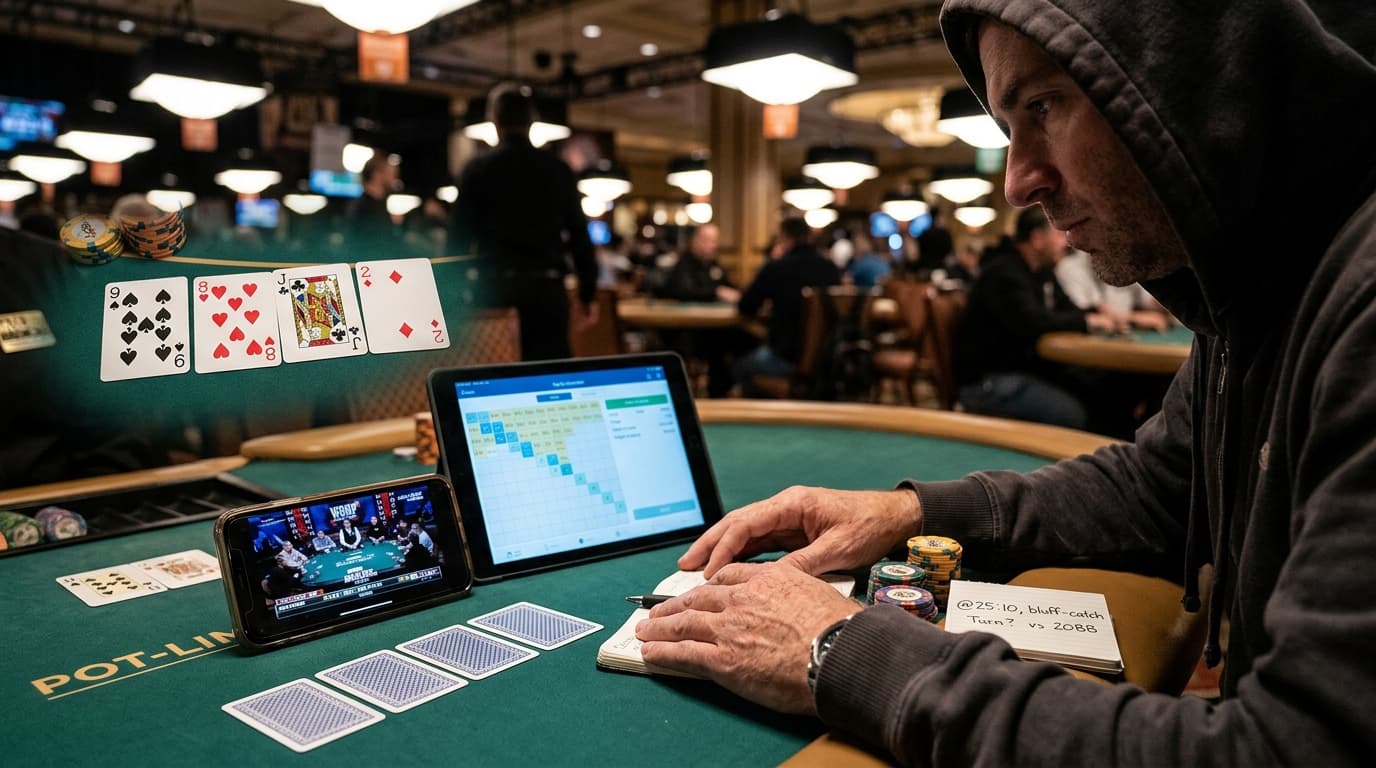
WSOP PLO study gets dangerous when entertainment becomes imitation.
You watch a streamed final-table hand, see a player fire a dramatic river bluff with one blocker, and the booth loves it. Ten minutes later, you are in a regular PLO game trying the same move against someone who has not folded top two pair all night.
That is not study. That is copying the output without owning the inputs.
The better workflow is simple: tag the spot, rebuild the context, test the equity, compare it to your own games, and only then decide whether the televised line belongs in your strategy. Treat WSOP PLO streams as raw study footage, not as strategy instructions.
Why WSOP PLO Streams Can Make Your Game Worse
Most players watch streamed PLO hands for lines. They write down “big river bluff,” “thin value bet,” or “sick call,” then try to import the action into a totally different game.
That gets expensive because the line is the last thing you should study.
A WSOP feature-table hand is camera-selected, commentary-driven, and played under stack, payout, table-image, fatigue, and opponent-specific conditions you usually do not share. The successful blocker bluff becomes memorable. The same bluff failing in a smaller pot may never become your reference point. That is survivor bias with better lighting.
Your first study question is not “Would I bet?” It is:
Is this context transferable to my games?
If the hand depends on payout pressure, a known opponent tendency, a specific short-stack ladder, or an exhausted final-table dynamic, mark it as tournament-context only. If the decision is about nut advantage, SPR, blockers, redraws, or multiway equity in a structure you actually play, save it for review.
Use official WSOP streams or confirmed replays when possible. Before publishing notes, quoting a hand, or attaching a player name, verify the hand through the broadcast, WSOP.com, or official coverage. For your own study, “roughly remembered from a clip” is not enough.
The Six Tags That Turn a Stream Into Study
Good WSOP PLO study starts with tags, not vibes. “Sick bluff” does not tell you what to review. “Button single-raised pot, 100bb, Broadway-heavy flop, blocker river” does.
Use six tags:
| Tag | What to record | Bad note | Useful note |
|---|---|---|---|
| Preflop action | Position, opener, callers, 3-bets | “He called pre” | “Button flats cutoff open, BB folds” |
| SPR | Deep, medium, low, or exact estimate | “Big pot” | “100bb SRP, medium SPR” |
| Board texture | Paired, monotone, Broadway-heavy, low-connected, dynamic | “Wet board” | “K-high Broadway board, two-tone” |
| Blocker relevance | Which nut hands or draws are removed | “Has blocker” | “Blocks A-Q nut straight, no flush equity” |
| Decision node | Value, bluff, bluff-catch, fold, check back | “Sick river” | “River bluff after missed nut hearts” |
| Review question | The work you will do later | “Interesting” | “Does caller have enough nut advantage to raise flop?” |
Your note should look like this:
SRP / 100bb / K-high Broadway board / top pair plus wrap / turn aggression / review whether to continue aggressively or keep the pot smaller
Now you know the next action: assign ranges, check equity, or compare the spot to your own database. For a broader structure, pair this with how to study PLO, but do not let streams replace review of your own hands.
Example 1: Rebuild the Spot Before You Copy the Bet
Suppose a stream shows an aggressive c-bet and turn barrel on a K-high board. The action looks clean. The commentator says the bettor has range advantage. You write down “attack K-high boards.”
That note is too thin.
Rebuild a similar spot instead:
- Game tree: 100bb single-raised pot.
- Hero: button with A♠K♠Q♥J♥.
- Board: K♥T♠4♦.
- Action: cutoff opens, hero calls button, blinds fold, cutoff checks.
Slow down. Your tag set is:
Button SRP / 100bb / K♥T♠4♦ / top pair + Broadway wrap potential / no made nuts / review c-bet and turn plan
Now ask the useful questions:
- Does the preflop raiser have more A-A-x-x, A-K-Q-J, and high Broadway density?
- Does the button caller retain more T-9-8-7, K-Q-J-T, and suited connected hands?
- If hero bets and gets check-raised, which continues are equity-driven and which are ego-driven?
- Which turns improve hero’s betting plan: A, Q, J, 9, spade, or board pair?
That is already better than copying the stream. You are no longer asking whether the televised player bet. You are asking whether this exact hand has enough equity, blockers, and future playability to bet.
This is where the equity calculator belongs in the workflow. Run the exact hand first, then replace one opponent hand with a practical range. Do not stop at the raw output. Ask which turns let you keep betting, which turns force pot control, and which raises should make you fold.
Example 2: The Flashy Final-Table Line You Should Not Import
Here is the televised play that damages bankrolls: a 45bb WSOP final-table pot, a dramatic shove, one key blocker, and a fold from a hand that looks too strong to release. The table reacts, the clip spreads, and viewers remember the result instead of the conditions.
Ignore the drama. Tag the incentives.
Suppose you reconstruct a valid hypothetical spot:
- Hero: A♥A♦7♣3♠.
- Board: Q♦9♥2♠.
- Stack: 45bb effective.
- Context: final-table payout pressure, short stacks behind, and an opponent who has shown the ability to fold medium-strength made hands.
Hero has an overpair, but poor nutted development and limited backdoor improvement. A shove may exist in that specific tournament tree because payout pressure and fold equity change the value of denying realization. That does not mean you should 3-bet preflop, miss the board, and blast every Q-high flop in your regular 100bb game.
Also check your transcription before equity work. If your notes are incomplete, do not force a calculation from memory. A wrong suit or duplicated visible card can turn a marginal overpair into a fake draw, a missed blocker into a nut blocker, or a fold into a false “mandatory” continue.
Now contrast that with K♣J♣8♦5♦ on Q♣J♦T♠ in a hypothetical 30bb short-handed tournament spot. You have middle pair, straight blockers with K-J, some backdoor potential, and interaction with a Broadway board. A streamer might turn a later street into a blocker-heavy bluff. Before imitating the action, ask:
- Is the SPR low enough that fold equity changes the value of aggression?
- Do your blockers remove the hands villain actually continues with, or only hands they rarely have?
- Would your opponent fold under the same payout pressure, or are you playing a caller-heavy pool?
- If this were a 50bb low-SPR cash-game decision, would you prefer a call, fold, 3-bet, or smaller-pot line?
Your decision after review should be explicit: ignore the televised line for your game, test it under your own stack depth, or add it to a database review filter for similar low-SPR decisions.
The “Do Not Copy” List
Some stream moments should almost never go straight into your game.
| Stream moment | Why it misleads | What to study instead |
|---|---|---|
| One-blocker river bluff gets through | Result hides opponent, payout, and image context | Which value hands the blocker removes and whether your pool folds |
| Short-stack final-table jam | Tournament pressure changes fold equity | SPR, stack distribution, and payout incentives |
| Hero call with third pair plus blocker | Streamed hands are selected for drama | Range construction and whether villain has enough bluffs |
| Loose preflop defend by elite player | Postflop edge may be doing the work | Your own out-of-position realization by hand class |
| Solver-sounding commentary | Booth shorthand can compress assumptions | Rebuild the ranges before trusting the phrase |
The point is not to distrust every streamed hand. The point is to separate “this happened” from “this is profitable in my pool.”
A Weekly WSOP Stream Study Routine
Do this once per week as a real study block, not every night and not for hours.
Watch one official WSOP PLO stream segment or confirmed replay. Before you start, open a notes file with six columns: preflop action, SPR, board texture, blocker relevance, river decision, and review question. Your goal is not to find the coolest hand. Your goal is to tag five hands cleanly.
From those five, choose two:
- One hand for reconstruction. Write the likely preflop ranges. Use practical ranges, not perfect charts you cannot justify. Who opens A-A-x-x? Who flats double-suited rundowns? Who defends disconnected kings? Who 3-bets too wide because the table is short-handed?
- One hand for calculation. Enter the exact cards and board into the equity calculator, then change villain from one hand to a range. If you need help reading the output, use the PLO equity calculator guide.
Then compare one tagged spot to your own play. If you play cash, search for 100bb single-raised pots on Broadway-heavy boards. If you play tournaments, search for 30bb to 50bb low-SPR decisions where you had an overpair, blocker, or combo draw.
Write one adjustment for your next session:
- play one board class more cautiously;
- stop forcing one-blocker river bluffs into calling stations;
- continue more aggressively only when your hand has equity plus credible nut pressure;
- or build a new filter for your next database review.
The stream gives you the prompt. Your own review decides the change. If you need a broader stack of review resources, use this alongside the best PLO study tools instead of letting the stream become the whole study session.
FAQ
Can watching WSOP PLO streams actually improve my game?
Yes, if you treat streams as hand-history prompts instead of lines to copy. The value is in reconstructing positions, stack depth, board texture, blockers, and incentives, then testing whether the idea applies to your own games.
How many streamed hands should I study at once?
Five tagged hands is enough for one session. Reconstruct one hand deeply, calculate one hand, and compare one similar spot from your own play. More than that usually becomes entertainment again.
Should I copy elite WSOP players’ blocker bluffs?
Only after you rebuild the context. A blocker bluff that works under final-table pressure against a specific opponent may be bad in a caller-heavy cash game. Study the blocker, value range, fold equity, and pool tendency before importing it.
What is the biggest mistake when studying poker streams?
The biggest mistake is remembering the result instead of the conditions. In PLO, the same visible line can be brilliant or terrible depending on SPR, redraws, nut advantage, blocker quality, and opponent willingness to fold.