Most expensive WSOP PLO mistakes start before the flop. A player brings a deep cash-game hand class into a tournament orbit, calls because the hand is pretty, then discovers at 45bb that the pot is already too big and the hand does not make enough nutted turns.
That is where WSOP PLO adjustments should begin: not with a fixed idea of "the field," but with stack depth, position, and table behavior you can verify in the first orbit. Use the official WSOP schedule for dates and structures, then use the table in front of you for strategy.
Use this as the tactical layer inside the larger WSOP PLO format prep guide. For a full summer schedule workflow, pair it with the WSOP 2026 PLO study plan; if the event is five-card, run the same stack-depth logic through the five-card PLO tournament prep guide.
The Reads That Matter In A Bracelet PLO Field
Do not assume every WSOP PLO table is soft. A lower-buy-in deepstack, a mid-stakes bracelet event, and a high-roller PLO table create different mistakes. What matters is the live read and the preflop consequence.
- If opens get over-called: move toward nut-making hands in position. Add double-suited Broadway, premium rundowns, and nut-suited Axxx. Cut weak single-suited Broadway and disconnected big-card hands that make second-best top pair or non-nut flushes.
- If 3-bets are rare: at 100bb, you can flat more premium connected hands in position. At 50bb, stop carrying that habit forward; the lower SPR makes passive flats much less forgiving.
- If medium stacks are protecting chips: widen your fold equity assumptions carefully. 3-bet more linearly with AAxx, strong KKxx, and premium connected Broadway, but do not start punting weak blockers.
Before using any default, ask: who is over-calling, who is actually capable of 4-betting, and what SPR will exist if I call?
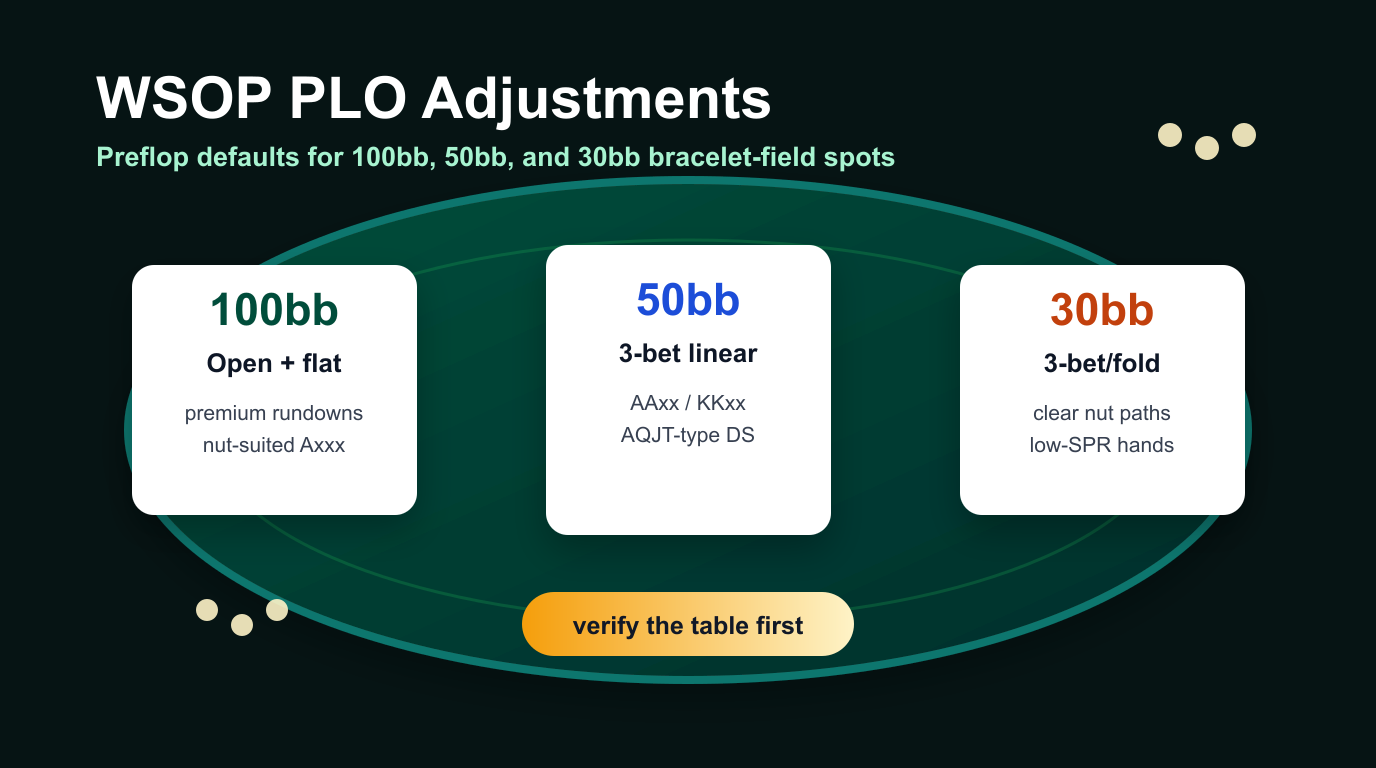
The 100bb / 50bb / 30bb Framework
At 100bb, prioritize nut coverage and position. You can open and flat more hands that realize over several streets: A♠J♠T♥9♥, Q♣J♣T♦9♦, A♥5♥4♣3♣, and AAxx with suited or connected support. The hands to remove first are disconnected Broadway like A♦K♣J♠4♠ and weak suited kings that make dominated flushes.
At 50bb, remove the pretty flats. A hand that plays well as a button flat at 100bb can become awkward at 50bb because calling creates a pot where one flop bet commits too much of your stack. Strong KKxx with side-card help, AAxx with backup, and AQJT-type double-suited hands move up. Single-suited gappers and dominated Broadway move down.
At 30bb, stop playing implied-odds PLO. You want hands that can make strong overpair-plus-draw, top-pair-plus-nut-draw, or high-card rundown structures in low-SPR pots. A♥A♣7♦6♦ is playable because it starts with aces and has suit/connectivity support. A weak disconnected suited ace is not the same hand. At this depth, SPR decides how much postflop maneuvering you really have.
WSOP PLO Preflop Adjustment Matrix
| Spot | Hand-class filter | Default action | Why |
|---|---|---|---|
| 100bb, unopened CO/BTN | Premium rundowns, DS Broadway, best SS connected hands like A♠J♠T♥9♥ | Open | You have position and enough depth to realize nutted equity. |
| 100bb, facing one open in position | Premium DS rundowns, best AAxx, high pair plus suit/connectivity | Flat selectively | Rare 3-bets behind make position valuable, but weak suits still get punished. |
| 100bb, facing one open out of position | AAxx, premium KKxx DS, very best DS connected hands | 3-bet or fold | Calling OOP invites multiway reverse-implied-odds spots. |
| 50bb, unopened any seat | Strong connected suited hands, supported pairs, remove weak SS Broadway | Open tighter | The stack is too short for loose realization but too deep to gamble blindly. |
| 50bb, BTN vs MP open and one caller | Strong AAxx, K-K with support, premium AQJT-type DS | 3-bet | Punish capped callers and avoid taking a dominated hand multiway. |
| 30bb, facing one open | AAxx, premium KKxx, best AQJT-type DS | 3-bet/get in or fold | Calling burns fold equity and creates low-SPR guessing games. |
| 30bb, open and caller in front | Only top-end classes with clear nut paths | Fold more | Overcalls need equity that survives all-in pressure. |
For close hand-class comparisons, test the exact combo in the PLO equity calculator. Raw equity will not give you the whole tournament answer, but it keeps you honest about which "pretty" hands are actually behind.
Worked Examples
Matrix row: 100bb, unopened CO/BTN | Premium rundowns, DS Broadway, best SS connected hands like A♠J♠T♥9♥ | Open
Hand: A♠J♠T♥9♥
Default action: Open
Downgrade condition: Fold or tighten from HJ if both blinds defend wide and the button is an active 3-bettor.
Matrix row: 50bb, BTN vs MP open and one caller | Strong AAxx, K-K with support, premium AQJT-type DS | 3-bet
Hand: K♣K♦J♠9♠
Default action: 3-bet
Downgrade condition: Fold more often if the opener is tight, the caller is sticky, and the hand drops to K♣K♦J♠8♠.
Matrix row: 30bb, facing one open | AAxx, premium KKxx, best AQJT-type DS | 3-bet/get in or fold
Hand: A♥A♣7♦6♦
Default action: 3-bet/get in against a loose opener; open if folded to you.
Downgrade condition: Do not treat rainbow disconnected aces as the same hand.
The Adjustment That Wins Chips
The edge is not memorizing one WSOP chart. The edge is noticing when your table is over-calling, under-3-betting, or protecting medium stacks, then moving hand classes between open, flat, 3-bet, and fold buckets before the pot gets expensive.
If you want one rule to carry into the summer, make it this: as stacks shrink, stop asking whether the hand looks playable and start asking whether it realizes cleanly at the SPR you are about to create. That one question prevents more bracelet-field PLO mistakes than any preflop chart.
FAQ
Are WSOP PLO bracelet fields always loose? No. Some tables over-call and under-3-bet; others contain strong PLO regulars who punish loose entries. Treat "bracelet field" as a context, not a read. Build your default from the first orbit.
Should I play tighter in PLO tournaments than in cash games? Usually yes once stacks compress. Deep tournament levels can resemble live cash, but 50bb and 30bb stacks punish speculative flats because the pot reaches commitment territory faster.
What is the best quick study drill before a WSOP PLO event? Review opening ranges by position, then run five close hands through the equity calculator and write the stack depth where each hand stops being a flat.